
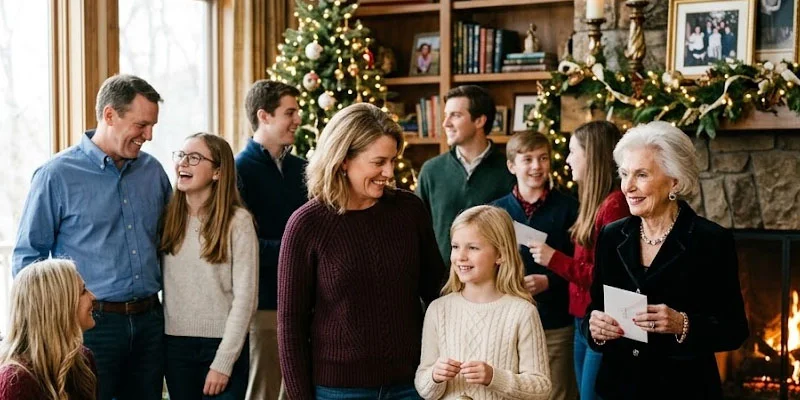
By the time my mother walked into the living room carrying a pile of envelopes, our family reunion had already begun to feel less like a family gathering and more like an awards ceremony.
My older brother Shane’s son, Blake, stood proudly beside the fireplace wearing a blue ribbon that said:
“MOST TALENTED GRANDCHILD.”
Everyone clapped as Dad took pictures.
Then my younger sister Noel’s daughter, Ruby, was presented with a beautiful set of art markers after being named “Future Illustrator.”
My older sister Chelsea’s daughter received a certificate for memorizing every character in Mom’s famous children’s book.
One after another, the grandchildren stepped forward.
They received ribbons.
Opened presents.
Posed for pictures.
And smiled beneath a banner featuring the bright red fox from the book that had shaped our family for decades.
My husband, Seth, sat next to me with a paper plate balanced on his knees.
Our twelve-year-old daughter, Kira, leaned forward each time Mom reached for another envelope.
“Maybe mine is for the trivia competition,” she whispered.
I squeezed her hand.
“You did really well.”
She had.
During the trivia round, Kira had answered almost every question correctly.
For two weeks before the reunion, she had studied Grandma’s book every night.
She memorized the characters.
The colors.
The smallest details in the illustrations.
Even the sequence in which the animals appeared.
She wanted to make her grandmother proud.
That was what made what happened next even more painful.
Mom picked up another envelope.
She waited until Dad had his camera raised.
Then she looked straight at Kira.
“Now,” she announced, “this one was decided by the entire family.”
Before I could stop her, Kira stood.
She walked toward the center of the room wearing the small nervous smile I knew so well.
Mom held one hand toward her as if she were preparing to give her something meaningful.
“Some awards,” Mom said warmly, “should show how the family truly feels.”
A few adults exchanged looks.
Nobody said anything.
Mom opened the envelope.
Then she pulled out a gold-trimmed sash.
For a brief moment, I saw only one word.
Favorite.
Then Mom turned it around.
LEAST FAVORITE GRANDCHILD.
The words stretched across the front.
My stomach sank.
Mom stared directly at my daughter.
“We all voted,” she announced. “And Kira, you are officially the least favorite grandchild.”
Dad was the first to laugh.
Then someone near the dining table chuckled into their drink.
Mom placed the sash over Kira’s shoulder as though she were crowning a pageant winner.
“Don’t look so serious,” she said. “The voting was anonymous.”
Kira’s smile disappeared.
Mom handed her a cheap plastic trophy with the number eight attached to its base.
There were eight grandchildren.
Kira had supposedly come in last.
Mom looked around the room, waiting for applause.
Instead, people laughed.
And my twelve-year-old daughter stood by herself in the middle of it all.
Not one adult stopped it.
Kira lowered her eyes toward the sash.
Her fingers slowly moved across the words.
Least favorite.
Blake was laughing with two cousins.
Ruby covered her mouth, but I could still see her shoulders shaking.
One of my uncles joked,
“Well, somebody had to finish last.”
That sent everyone into louder laughter.
Kira looked around the room.
She appeared to be searching each face for some sign that this was supposed to be affectionate.
That there was some joke she had failed to understand.
She found nothing.
Mom had already moved on.
“All right!” she said brightly. “Next award—most creative performance!”
Another child quickly stepped forward.
Everyone applauded.
Dad turned his camera away from Kira.
My daughter slowly backed away until she reached the wall beside the coat closet.
The sash slipped partly from her shoulder.
She didn’t even take it off.
For two long seconds, I remained completely still.
Then Seth quietly said my name.
“Mallerie.”
That brought me back to reality.
I crossed the room.
Kira looked at me.
And before I could say anything, she whispered,
“Did everybody really choose me?”
That question shattered something inside me.
I took the sash from her shoulders and folded it so she wouldn’t have to see the words anymore.
Her face had turned pale.
She pressed her lips together as she fought back tears.
“That vote should never have happened,” I told her. “This says nothing about you.”
She leaned against me.
“Did Grandma vote too?”
I didn’t know.
So I refused to lie to her.
“I don’t know. But every adult here allowed this to happen.”
Seth came over and placed his hand against Kira’s back.
His jaw was clenched.
“We can leave right now.”
Everything inside me wanted to agree.
But another voice surfaced in my mind.
An old voice.
The rules I had grown up learning.
Don’t ruin Mom’s event.
Don’t be jealous.
Don’t embarrass everyone because you lost.
Don’t make a scene.
Then Mom called across the room.
“Kira! Come back over here. We’re doing the grandchildren’s picture.”
Kira tightened her grip on my hand.
That was enough.
I turned toward everyone.
At first, no words came out.
Mom was already arranging the grandchildren according to height.
“Kira,” she called impatiently. “Come on.”
My daughter stayed where she was.
Mom sighed.
“Mallerie, please don’t make this awkward.”
Something inside me finally shifted.
“Everyone, stop for a second.”
A few conversations continued.
Dad kept positioning the children for the photograph.
I raised my voice.
“Stop.”
The room fell silent.
Mostly because I had never spoken to my family like that before.
My hands were trembling, so I held the folded sash between them.
“This is the last family event Kira and I will ever attend where children are treated like this.”
Someone gave a nervous laugh.
I continued.
“You ranked eight children according to how much people supposedly liked them. Then you publicly labeled the child who came last and laughed while she stood here alone.”
Nobody was smiling anymore.
“We’re done participating in this.”
Mom’s expression became hard.
Dad lowered his camera.
Chelsea stared at the floor.
Shane looked between me and Kira.
Mom scoffed.
“Oh, please. You’re upset because Kira didn’t win.”
One of my aunts called us poor losers.
Another adult muttered that children needed thicker skin.
Mom reached for the sash.
“Give me that. You’ll calm down tomorrow and realize it was funny.”
I stepped away from her.
“No.”
Seth gathered Kira’s sweater, my purse, and our car keys.
Then he put the plastic trophy back beside Mom’s envelopes.
“We’re leaving.”
Mom followed us toward the door.
“You’re humiliating me in my own house!”
I turned around.
“You humiliated a twelve-year-old girl in front of her entire family.”
Then I looked at her.
“We’re finished.”
Nobody laughed after that.
Seth opened the door.
Kira walked outside between the two of us.
For the first ten minutes of the drive home, nobody said a word.
The sash was sealed inside a grocery bag in the back seat.
Five hours later, I sent one email to my entire family.
And that email changed everything.
But to understand why, you need to understand the book.
My mother had written and illustrated a children’s story when I was young.
It was about a red fox searching for his way home.
The book became extremely successful.
Bookstores carried it across the country.
Schools invited Mom to conduct readings.
People recognized her.
Royalties paid for vacations, a larger house, and a beautiful studio that Dad treated almost like a museum.
For my siblings and me, there was never really a family life separate from that book.
Mom was the author.
The book was her success.
And little by little, the book became the way she judged all of us.
There were four children.
Chelsea.
Shane.
Me.
And Noel.
Chelsea quickly learned how to compliment Mom.
Shane realized that making Mom laugh brought him extra attention.
Noel could draw the characters beautifully.
And me?
I tried.
But somehow, I was almost never the favorite.
Mom turned everything into a competition.
Trivia during dinner.
Drawing contests.
Performances.
Memory games.
Dad recorded the scores on a yellow legal pad.
Sometimes the prizes were candy or toys.
But those weren’t what we truly wanted.
The real prizes were access.
Sitting beside Mom at dinner.
Being allowed inside her studio.
Going with her to a bookstore appearance.
Having an afternoon alone with her.
Winning wasn’t simply about receiving something.
Winning meant getting Mom.
When I was nine, I made one mistake that stayed with me for years.
We were at a library.
I found a picture book about a stubborn bear and started laughing.
Mom asked what was so funny.
Without thinking, I said,
“I think I like this book better than the fox book. The ending is happier.”
I was nine.
To me, it was simply an opinion.
Mom never forgot it.
She began introducing me as “our little book critic.”
Whenever I correctly answered one of her trivia questions, she said I had finally started paying attention.
If I asked to help in her studio, she joked that perhaps I should help another author instead.
Dad laughed.
So everyone else learned to laugh too.
From that point on, I became the difficult child.
Chelsea was dependable.
Shane was business-minded.
Noel was artistic.
I was the one who supposedly failed to appreciate everything Mom had given us.
Eventually, the childhood competitions ended.
But the scoring never truly stopped.
Then we all became adults.
And the prize changed.
Instead of candy, the prize became inheritance.
Mom often reminded us that one day the book rights, original artwork, royalties, property, and everything else she had built would belong to us.
She never told us exactly how much money existed.
That made it seem enormous.
Chelsea constantly praised the book.
Shane talked about anniversary editions.
Noel encouraged Ruby’s artwork and discussed preserving Mom’s legacy.
And I kept my distance while continuing to attend every family gathering.
Then the grandchildren arrived.
And slowly, the old game started again.
Children who remembered quotes received special gifts.
Children who drew the fox were invited into Mom’s studio.
Children who impressed Grandma received attention.
Kira liked the story.
But she didn’t worship it.
Mom noticed.
Seth asked me several times why we continued participating.
I always gave him the same answer.
“I want Kira to know her cousins.”
That was true.
But there was another reason.
A small part of me still hoped Mom might change.
Then she announced the reunion.
All eight grandchildren would compete.
Trivia.
Drawing.
Performances.
Voting.
Awards.
Kira desperately wanted to do well.
She studied for two weeks.
And I let her.
Then my mother put that sash over her shoulders.
Back home, Kira sat at our kitchen table wearing her pajamas.
The grocery bag containing the sash was sitting between us.
She explained something I hadn’t realized.
The cousins had been asked to privately rank each other from favorite to least favorite.
They knew the rankings would affect an award.
But nobody had told them that the child who ended up at the bottom would be publicly humiliated.
“What if they all really put me last?” Kira asked.
I told her that the game couldn’t measure how much people cared about her.
She looked directly at me.
“Did Grandma and Grandpa agree with it?”
I answered carefully.
“Grandma created it. Grandpa supported it.”
Kira pushed the sash toward me.
“I never want anybody to see me wearing that again.”
I sealed it inside a box and placed it on the highest shelf in our garage.
That was when I realized that leaving the reunion had ended the event.
But it hadn’t ended what the event had placed inside my daughter’s mind.
After Kira went to bed, I opened my laptop.
Seth sat beside me.
“I should have stopped these games years ago,” I admitted.
He didn’t argue.
He simply said,
“You stopped this one. Now decide what comes next.”
So I wrote the email.
Mom.
Dad.
Chelsea.
Shane.
Noel.
I told them that Kira and I would have no contact with Mom and Dad for the foreseeable future.
We would never attend another event where children competed for affection.
Then I told my siblings something none of us had ever clearly said.
Mom’s contests had taught us to measure love through scores, gifts, invitations, access, and eventually money.
And now we were teaching our children the same lesson.
I described Kira standing there in the sash while everyone laughed.
Then I wrote:
“Ask yourselves what our children learned in that room. They learned that protecting their own place in the family mattered more than protecting someone being hurt.”
I didn’t demand that my siblings stop talking to Mom.
I simply said the cycle would end with me.
At 10:17 that night, I clicked send.
Nothing happened right away.
Then the next evening, Mom replied to everyone.
Her email began:
“Since Mallerie has chosen to reject this family…”
She never mentioned Kira.
Never mentioned the sash.
Never mentioned the laughter.
Instead, she accused me of insulting her life’s work.
Then came the threat.
If I wanted no contact, she said, I would receive nothing.
No book rights.
No royalties.
No artwork.
No share of the house.
No money.
Everything would go to Chelsea, Shane, and Noel.
Kira would inherit nothing.
Mom ended with:
“I hope you remember this choice when your siblings and their children are financially secure and you are not.”
Dad replied:
“Your mother has every right to protect her legacy.”
Seth read both emails.
Then he looked at me.
“She’s threatening a twelve-year-old with inheritance because you objected to humiliating her.”
I saved everything.
Strangely, I wasn’t scared.
For years, Mom had made that future inheritance sound enormous.
But now I could see what it actually represented.
Control.
An hour later, Noel called me privately.
“The award was cruel,” she admitted.
She told me she was ashamed that Ruby had laughed.
Ashamed that she hadn’t stopped it.
For a moment, I thought she was finally going to stand beside me.
Then she explained why she couldn’t.
Mom had promised money for Ruby’s future college education.
Noel was terrified that challenging her would cause that money to disappear.
“I know what happens when Mom gets angry,” she whispered.
That sentence told me everything.
My sister wasn’t staying silent because she believed Mom was right.
She was staying silent because Mom had tied her daughter’s future to obedience.
The following evening, Shane called.
He agreed that Mom had crossed a line.
Then he said something I didn’t understand.
“Mallerie, you need to know something before that inheritance email scares you.”
“What?”
“There is no fortune.”
I thought he meant Mom had already changed the will.
Then Shane sent me a picture of a royalty statement.
I enlarged it.
The total payment from Mom’s famous book for the entire previous year was:
$53.
I thought I had read it incorrectly.
“Is this quarterly?”
“No.”
“Is there another payment?”
“No.”
Fifty-three dollars.
The book that was supposedly guaranteeing our family’s financial future had barely earned anything for years.
Then Shane told me the rest.
Mom and Dad had started asking him for money.
At first, they said it was temporary.
A repair.
Taxes.
A delayed payment.
Then the requests became monthly.
Eventually, Shane demanded to see their finances.
Their savings were almost gone.
The house that had once been completely paid off had been mortgaged.
Credit-card balances were high.
Expensive vacations had been financed.
Mom continued buying impressive gifts because cutting them back might expose the fact that the wealthy image was collapsing.
Shane had quietly been paying part of their mortgage and utilities.
Mom made him promise not to tell us.
Dad called keeping the secret “family loyalty.”
There were no valuable movie deals.
No major licensing agreements.
The original illustrations might have some value, but nowhere near enough to financially secure four families and eight grandchildren.
Then I remembered Noel.
“Mom told Noel Ruby already has a college fund.”
Silence.
Finally Shane said,
“There is no college fund. There can’t be.”
Chelsea had apparently been told something else.
Mom promised her a larger share of the house in exchange for helping with a debt.
Mom had been telling each of us different financial stories.
Because she knew we rarely compared information.
That was the system.
Keep us apart.
Promise each child something.
Make everyone afraid of losing their position.
I asked Shane to tell Chelsea and Noel.
At first, he hesitated.
Then he said,
“She used imaginary money to keep a mother quiet after humiliating her child. I’m done protecting this.”
He sent everyone the financial documents.
Within minutes, Noel messaged me.
“Is this real?”
“Yes.”
I didn’t feel victorious.
Their fear had been real.
The fortune simply wasn’t.
Mom had controlled all four of us with money she didn’t even possess.
One month later, my siblings and I arranged another gathering.
This time, it was at my house.
All eight cousins were invited.
Mom and Dad were not.
We established a few simple rules.
No fox-book trivia.
No rankings.
No secret voting.
No inheritance talk.
No prizes for affection.
Seth noticed that I had bought some prize bags out of habit.
He quietly took them away.
“They don’t need to win lunch,” he said.
He was right.
At first, everyone seemed uneasy.
For years, our family gatherings had always followed a program.
A winner.
A competition.
Someone being praised.
Someone wondering why they weren’t.
This time, I simply opened the back door.
“There are games outside. There’s food. No prizes.”
Eventually, the kids relaxed.
Ruby found Kira near the fence.
“I’m sorry I laughed.”
Kira waited.
Ruby admitted that she laughed because everyone else was laughing—and because she was relieved she wasn’t the one wearing the sash.
“I didn’t vote you last,” Ruby said. “But laughing was still wrong.”
Then Blake came over.
He admitted that he had ranked the cousins strategically.
Mom had hinted that the top award might come with money.
So he ranked the children he viewed as competition lower.
“I was trying to win,” he said. “I didn’t think Grandma was actually going to announce who lost.”
Other cousins admitted that the ballot had made them nervous too.
They were all afraid of becoming the person at the bottom.
Kira listened.
I didn’t pressure her to forgive anyone.
Finally, she said,
“Don’t ever rank me again.”
They agreed.
Later, Blake started a soccer game.
He asked Kira if she wanted to keep score.
She said no.
Then she joined the game anyway.
By dessert, she was sitting beside Ruby arguing about a movie.
That was when I realized something important.
The vote had never proved that Kira was hated.
It had simply made one child the loser of a cruel game.
We were cutting the cake when someone knocked on the front door.
I expected it to be a neighbor.
Instead, Mom and Dad were standing there.
Mom was dressed for dinner.
And she was carrying the fox book.
“I heard the whole family was together,” she said.
I remained in the doorway.
“Who told you?”
“That isn’t important. I’m the mother of four children and grandmother of eight grandchildren. Of course I belong at a family event.”
Then she raised the book.
“I thought the children might enjoy a proper reading before dessert.”
“They’re already having dessert.”
Her smile tightened.
“Mallerie, this has gone far enough. You’ve made your statement. Let us inside.”
Dad added,
“Your mother is trying to move forward.”
Mom stepped toward the doorway.
For most of my life, I would have stepped aside.
This time, I didn’t.
“You weren’t accidentally forgotten,” I told her. “You were intentionally not invited.”
Her expression changed.
Then Chelsea appeared beside me.
Shane stood on my other side.
Noel came forward last.
All four of us stood across the doorway.
Mom looked from one face to another.
“This is Mallerie’s anger,” she said. “You don’t have to participate.”
Chelsea answered first.
“I agreed you shouldn’t be invited.”
Shane nodded.
“So did I.”
Noel swallowed.
“Me too.”
For once, Mom couldn’t speak to us separately.
She couldn’t make four different promises.
She couldn’t threaten four different inheritances.
We all knew the same truth.
Noel spoke first.
“You let me believe Ruby’s college money already existed.”
Mom said plans change.
Chelsea stepped forward.
“You promised me more of the house if I helped with your debt. You never told me the house was mortgaged.”
Mom turned angrily toward Shane.
He didn’t back down.
“I would have helped you honestly. I was already helping you. But you used money you don’t have to keep everyone obedient.”
Dad snapped that their financial situation was private.
Shane replied,
“It stopped being private when you used it as a threat.”
Then I pulled up Mom’s email.
“The money isn’t even the biggest issue.”
I looked at both of them.
“You made us compete for your attention when we were children. Who sat beside you. Who got invited into the studio. Who won your approval. Then you repeated the same system with our children.”
Mom called the reunion harmless fun.
I shook my head.
“Kira stood against a wall wearing a sash calling her the least favorite while everyone laughed. You watched her. Then you continued handing out awards.”
Mom straightened.
“I am still your mother. I am still their grandmother. Those titles don’t disappear because you’re angry.”
Before I could respond, Chelsea spoke.
Her voice was completely calm.
“We didn’t take another vote. But if we followed your rules, you’d probably be the least favorite grandmother.”
Mom went pale.
For one second, she looked exactly like Kira had looked beneath that sash.
Searching everyone’s faces.
Trying to determine whether we truly meant it.
Dad immediately snapped at Chelsea.
“You should be ashamed of yourself for talking to your mother that way.”
I looked at him.
“That is exactly how she spoke to my twelve-year-old daughter while you stood beside her laughing.”
Nobody had an answer for that.
Mom called us cruel.
Ungrateful.
Vicious.
I told her to leave.
Dad eventually guided her toward the car.
She walked down the steps still carrying the fox book.
They sat in the driveway for a while.
Maybe they expected one of us to follow.
Nobody did.
I closed the door.
Then Seth brought the kids back inside.
We finished the cake.
Six months have passed since that day.
Kira and I still have no contact with Mom and Dad.
Chelsea and Noel maintain limited contact with them.
Shane continues helping with certain essential expenses, but only under strict conditions.
He pays bills directly.
He requires financial statements.
And Mom is not allowed to make promises using his money.
My parents eventually sold some expensive belongings.
They stopped traveling.
They began living on a realistic budget.
They aren’t wealthy.
But they’re surviving.
The image that controlled our family disappeared the moment nobody was willing to secretly finance it anymore.
Something else happened too.
My relationship with my siblings improved.
Chelsea, Shane, Noel, and I still disagree sometimes.
We haven’t magically erased our childhood.
But now we compare information instead of competing for private approval.
Our children see one another regularly.
There are no rankings.
No secret ballots.
No prizes for being the favorite.
Kira has become much closer to Blake, Ruby, and the other cousins.
She still remembers the sash.
I’m sure she always will.
But she no longer enters a family gathering wondering whether she has earned the right to belong there.
And that has become the only family rule I care about:
Belonging is not a prize.
It isn’t something you win.
It isn’t something another person gets to rank.
And it should never be something a child is afraid of losing.