
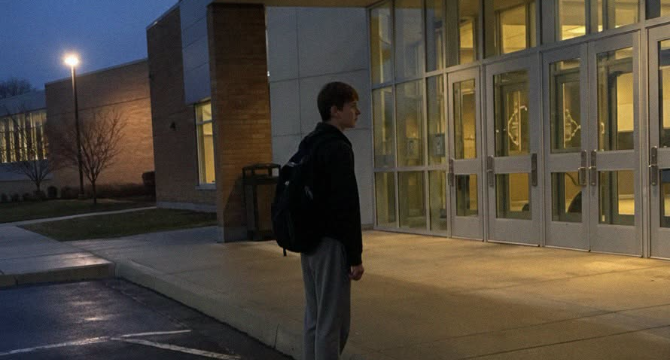
A mother thought her 16-year-old son was finally taking school seriously when he began leaving home 40 minutes early. But a concerned call from his teacher revealed he had been sitting outside the locked school every morning, and one strange question suggested there was a reason why.
For the past two weeks, my 16-year-old son, Nolan, has been leaving for school almost 40 minutes earlier than usual.
At first, I didn’t think much of it.
Nolan has never been a morning person, so when he suddenly started coming downstairs at 6:50 a.m., already dressed, backpack on, shoes tied, I was honestly impressed.
“Why are you up so early?”
He shrugged.
“Trying not to be late anymore.”
Fair enough.
His school is only about a 12-minute walk from our house.
He’d gotten a warning for being tardy twice last month, so I figured maybe he was finally taking it seriously.
Every morning, I’d watch him grab a granola bar, say “bye,” and head out.
Then last Thursday, his English teacher, Mrs. Carter, called me.
The first thing she said was, “Is Nolan okay?”
My stomach immediately tightened.
“Yes. Why?”
There was a pause.
Then she asked, “Do you know why he’s been sitting outside the school every morning before the doors open?”
I honestly thought I had somehow misunderstood her question.
“What?”
She explained that she usually arrives early to prepare for first period. And for almost two weeks, she had been seeing Nolan sitting alone on the concrete steps near the side entrance.
Sometimes 30 minutes before anyone else arrived. Sometimes longer.
“He’s just sitting there?” I asked.
“Most mornings.”
“Doing homework?”
“No.”
“On his phone?”
“Not really,” she said. That was when I started getting worried.
I asked if maybe he was meeting friends.
Mrs. Carter said no.
She had actually gone outside that morning and asked him if he wanted to come in early because it was cold.
Nolan immediately stood up and said he was fine.
Then he asked her something strange.
“Did anyone come looking for me yesterday?”
I felt this horrible little chill go through me.
“What did you tell him?”
“I just asked who he meant,” she told me.
“And?”
“He wouldn’t say.”
When Nolan came home that afternoon, I was waiting in the kitchen.
I tried to keep my voice casual.
“Mrs. Carter called me today.”
He froze for maybe half a second.
Then he dropped his backpack by the door.
“Why?”
“She said you’ve been getting to school really early.”
“Oh.”
“Why?”
“No reason.”
“Nolan.”
“I just like getting there early.”
“You hate school before eight.”
He rolled his eyes.
“Mom, it’s not a big deal.”
I asked why he was sitting outside instead of going inside.
He said the doors were locked.
I asked why he needed to be there before they opened.
No answer.
Then I asked, “Who were you expecting?”
His whole face changed.
Not dramatically.
Just enough that I knew I’d finally hit the right question.
“Nolan?”
He looked away and was clearly feeling uncomfortable.
“Nobody.”
“That’s not true.”
He picked up his backpack.
“I have homework.”
I stepped between him and the hallway.
“Please don’t walk away from me.”
His jaw tightened.
“I’m fine.”
“I didn’t ask if you were fine,” I said.
That stopped him.
I lowered my voice.
“Who are you waiting for every morning?”
He stared at the floor for several seconds.
Then he said, “My dad.”
For a moment, I forgot how to breathe.
“Your dad?”
He nodded once.
I almost laughed, but there was nothing funny about it.
Eric hadn’t been part of Nolan’s life in seven years.
He left when Nolan was six.
At first, there were visits.
Then missed visits.
Then phone calls that became less frequent.
By the time Nolan was nine, Eric had stopped showing up altogether.
I had spent years trying to explain his absence without destroying my son’s idea of himself.
Sometimes I said Eric was going through a difficult time.
Sometimes I said that adults made bad decisions.
Eventually, Nolan stopped asking.
I thought that meant he’d stopped caring.
Apparently, I’d been wrong.
“How long have you been talking to him?”
“I haven’t.”
“What do you mean?”
“He sent me a letter.”
“What letter?”
Nolan walked past me, opened his backpack, and pulled out an envelope.
It was creased from being handled too many times.
My son’s name was written across the front.
I recognized Eric’s handwriting immediately.
“Where did you get this?”
“At school.”
“He mailed it there?”
Nolan nodded.
“Can I read it?”
He hesitated briefly before finally handing it over.
The letter was short.
Eric said he was back in town.
He knew he had no right to ask Nolan to forgive him.
He knew saying sorry after seven years probably meant very little.
Then came the part that explained everything.
He wrote that for the next two weeks, he would be across the street from Nolan’s school at 7:15 a.m. before starting work nearby.
He wouldn’t approach.
He wouldn’t call.
He wouldn’t go anywhere near the school property.
If Nolan wanted to see him, he could.
If not, Eric would leave him alone.
I looked up.
“You’ve been meeting him?”
“No.”
“Then what have you been doing?”
Nolan swallowed.
“Seeing if he’d keep coming.”
That hurt me far more than I had expected.
“What?”
“He said he’d be there.”
“And?”
“So I wanted to see if he actually would.”
Every morning, Nolan had walked to school early.
He’d sat on those cold concrete steps and looked across the street.
Eric would be there.
Near the bus stop.
Sometimes holding coffee. Sometimes standing beside his car.
They could see each other.
Neither one crossed the street.
“How many times?”
“Almost every day.”
“Almost?”
Nolan’s expression changed.
“Not Wednesday.”
That explained Mrs. Carter’s question.
“Yesterday?” I asked, although I knew the answer.
He nodded.
“You were waiting for him.”
“I thought maybe he went inside.”
“That’s why you asked if anyone came looking for you.”
Nolan looked embarrassed.
“I didn’t know.”
I sat down.
“Why didn’t you call him?”
“He put his number in the letter,” Nolan said.
“That’s not what I asked.”
Nolan shoved his hands into his pockets.
“Because then I’d be the one chasing him again.”
I went quiet.
He was six the first time Eric didn’t show up for a promised visit.
Nolan had sat by the living room window for almost an hour.
At seven, he asked me to call.
At eight, he asked again.
At nine, I told him Dad probably got stuck somewhere.
Eric called the next morning with an excuse.
Two weeks later, it happened again. Then again. Eventually, Nolan stopped waiting by the window. Apparently, he had never forgotten what it felt like.
“He said he’d show up,” Nolan continued. “I wanted to see if he could.”
“What happened Wednesday?”
“I don’t know.”
“You didn’t ask?”
“No.”
“Nolan.”
“I told you,” he said. “I’m not calling him.”
I looked at the letter again.
“So what are you planning to do?”
He shrugged.
“I don’t know.”
“Do you want to talk to him?”
“I don’t know.”
“Do you want me to tell him to stay away?”
“No.”
That answer came immediately. I noticed. And Nolan noticed that I noticed.
He looked irritated.
“Don’t make it a thing.”
“It is a thing.”
“Mom.”
“Your father disappeared for seven years and is now standing across from your school every morning. It’s already a thing.”
He looked away.
Then he said quietly, “I just wanted to know if he meant it.”
That night, I barely slept.
Part of me was furious because Eric had gone around me.
He had contacted my son directly after years of silence.
He hadn’t called first.
Hadn’t asked permission.
Hadn’t even warned me.
Another part of me kept thinking about Nolan sitting outside every morning.
Testing his father without ever saying a word.
The next morning, I came downstairs at 6:45 a.m.
Nolan was already dressed.
When he saw me with my coat on, he frowned.
“Where are you going?”
“With you.”
“No.”
“Yes.”
“Mom.”
“I’m not letting you handle this alone.”
“I’m 16.”
“I know.”
“Then stop treating me like I’m six,” he protested.
I took a breath.
“Being 16 means you get a say. It doesn’t mean you have to do hard things alone.”
He stared at me. Then sighed.
“Fine.”
We walked to school mostly in silence.
When we reached the corner, Nolan slowed.
Across the street, near the bus stop, a man was standing beside an old gray car.
Eric.
Seven years had changed the way he looked.
More gray in his hair.
Thinner face.
Lines around his eyes.
But I knew him immediately.
He was holding a piece of cardboard.
Written across it in thick black marker were the words, “I’M SORRY ABOUT YESTERDAY. CAR DIED. I SHOULD HAVE FOUND A WAY.”
Nolan stopped walking.
Eric saw us.
His eyes moved from Nolan to me. He didn’t come closer.
That mattered.
He stayed exactly where he was.
I looked at Nolan.
“Do you want to go?”
He stared across the street.
Then nodded.
We crossed together.
Eric looked at me first.
“Laura, I… I wasn’t expecting you to come too.”
Hearing my name in his voice after seven years felt strange.
I didn’t answer.
He looked at Nolan.
“Hi.”
Nolan shoved his hands into his jacket pockets.
“Why did you leave?”
Eric went still.
No hello. No small talk. No easing into it.
I was proud of my son. Super proud.
Eric looked down.
“I don’t have a good answer.”
“That’s not an answer.”
“You’re right.”
He took a breath.
“After your mom and I split up, I messed up a lot of things.”
Nolan said nothing.
“I lost my job and moved around. I was angry, ashamed, and unreliable.”
“You stopped calling me when I needed you.”
“I know.”
“You stopped visiting.”
“I know.”
Nolan’s jaw tightened.
“You don’t get to say ‘I know’ as if that fixes it.”
Eric nodded.
“You’re right.”
He wasn’t defending himself.
I almost wished he would. Anger is easier when somebody argues back.
Nolan looked at him.
“Why didn’t you come back?”
Eric’s eyes filled.
“At first, I kept thinking I’d come back when I had my life together.”
“And?”
“It took longer than I thought.”
“Seven years?”
“Yes.”
Nolan gave a humorless laugh and said, “I was nine.”
“I know.”
“You decided I was better without you.”
Eric nodded.
“I told myself that.”
Nolan stepped closer.
“You decided that for me.”
Eric looked at him.
“I did.”
“You didn’t get to make that choice alone.”
“No.”
That was the first moment Nolan’s voice cracked.
He looked away.
I wanted to put my arm around him. I didn’t.
This was his conversation.
Eric continued.
“I kept waiting until I had something that would make leaving understandable.”
Nolan looked back at him.
“Were you able to find it?” he asked.
Eric shook his head.
“No.”
“Good.”
Eric frowned.
Nolan’s eyes filled.
“Because there isn’t anything.”
Eric closed his eyes.
“No. There isn’t.”
For a while, none of us spoke. Then I asked the question.
“Why did you contact him through the school?”
Eric looked at me.
“I didn’t know where you lived.”
“You could have found me.”
“I was afraid you’d throw the letter away.”
I felt anger rise again.
“You had no right to go around me.”
“You’re right.”
“Why do you keep agreeing with everything I say?”
He gave a tired smile.
“I don’t have much ground here.”
Before I could answer, Nolan spoke.
“Mom.”
I looked at him.
“I would’ve wanted the letter.”
That stopped me.
He wasn’t six anymore.
I had spent years protecting him from disappointment.
But at 16, he was old enough to decide what he wanted to know.
I nodded.
“Okay.”
Then I looked at Eric.
“That still doesn’t make what you did right.”
“I know.”
Nolan glanced toward the school.
“I have to go.”
Eric nodded quickly and said, “Okay. You can go.”
Nolan started to leave.
Then stopped.
“Saturday.”
Eric looked up.
“What?”
“One hour.”
Hope flashed across his face so quickly it almost hurt to see.
“Anywhere you want.”
“The diner on Main,” Nolan called out. “Be there.”
“Ten?”
Nolan thought.
“Ten.”
“I’ll be there.”
Nolan looked at him.
“You better be.”
Then he crossed the street.
I stayed.
Eric looked at me and said, “Thank you.”
“Don’t thank me.”
“This is his decision.”
“I know.”
“And if you disappear again, don’t expect me to help you explain it.”
“I won’t.”
I started to walk away.
Then Eric said, “Laura.”
I turned.
“I really am sorry,” he said as he looked at me.
“Tell that to Nolan with your behavior,” I said.
That was all I had for him.
That evening, Nolan was quieter than usual.
After dinner, he sat beside me on the couch.
“Were you mad?”
“At him?”
“At me.”
That surprised me.
“Why would I be mad at you?” I asked.
“For not telling you.”
I shook my head.
“I wish you had.”
“Same thing.”
“No. It isn’t.”
He leaned back.
Then he said, “I used to ask about him all the time.”
“I remember.”
“You always looked sad when I asked where he was,” he whispered.
“So I stopped,” he added.
My chest tightened.
“I thought you stopped caring.”
“No.”
He looked at his hands.
“I stopped asking because every time I asked about him, you looked sad.”
That hurt.
All those years, I thought silence meant healing.
For Nolan, silence had meant protecting me. I took his hand.
“You never had to do that,” I said.
“I know.”
“Do you?”
He smiled faintly.
“Maybe not.”
Saturday came.
At 9:55 a.m., Nolan was dressed and pretending to scroll on his phone.
At 9:56 a.m., he looked toward the window.
At 9:57 a.m., again. I didn’t say a word.
At 9:58 a.m., a gray car pulled up.
Nolan stood.
“He’s early.”
I looked at the clock.
“By two minutes.”
He tried not to smile.
“Still counts.”
That first meeting lasted exactly one hour.
Then there was another meeting the following weekend.
Then a phone call in the middle of the week.
Eric didn’t suddenly become Dad again.
Nolan didn’t forgive seven years because of a few breakfasts.
He made Eric earn every inch.
Some weeks Nolan wanted to see him.
Some weeks he didn’t.
Eric learned not to push.
And, to his credit, he kept showing up.
A few weeks later, I came downstairs at 6:50 a.m.
Nolan was sitting at the kitchen table eating cereal.
No backpack.
No coat.
“You’re not leaving early?”
“No.”
“Why?”
He shrugged.
“Don’t need to.”
I understood. Eric no longer waited anonymously across the street.
They had a schedule now.
Saturday mornings.
Occasional calls.
No promises beyond what Eric knew he could keep.
Nolan didn’t need to sit outside school every morning testing whether his father would appear.
For two weeks, I thought my son had finally learned how to get to school early.
I didn’t realize he was sitting on those cold steps every morning asking a much bigger question. Would his father finally show up when he said he would?
This time, at least, Nolan wasn’t six years old staring through the living room window.
He was sixteen. He got to decide what happened next.
And maybe that was the part I had to learn too.