
My eleven-year-old son had spent four months looking forward to one particular afternoon.
For those same four months, I had been putting aside every dollar I could so I could give him that afternoon.
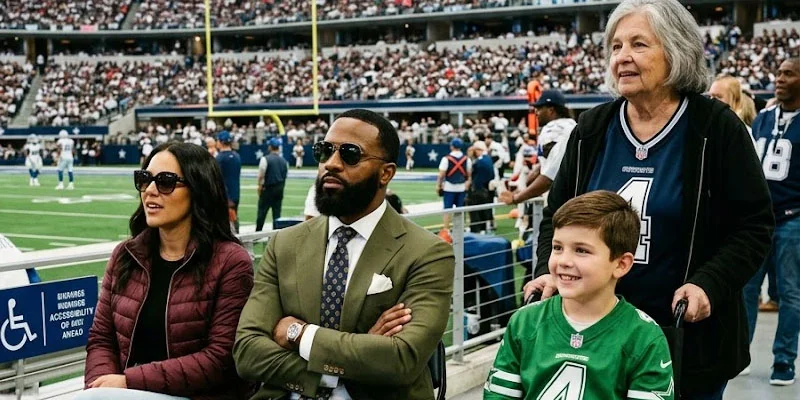
Then, when we finally arrived at our accessible seats beside the football field, a wealthy stranger was already sitting there.
His wife’s designer handbag had been placed exactly where my son’s wheelchair was supposed to be.
When I showed the man our tickets, he hardly gave them a glance.
“Find somewhere else to sit.”
I explained that my son couldn’t.
Those seats were specifically reserved for wheelchair access.
The man simply shrugged.
“Not my problem.”
Then he looked at Caleb and said,
“He can watch from the concourse. I seriously doubt he even knows enough about football to understand what’s happening anyway.”
My son gently touched my arm.
“It’s okay, Mom. We can leave.”
Before I could respond, an elderly woman standing behind us rose from her seat, an old metal lunchbox in her hands.
She looked straight at the man.
“Get out of that seat.”
He laughed.
Then she extended the lunchbox toward him.
“Open it.”
The instant he saw what was inside, the color drained from his face.
And before even a minute had passed, the man who had refused to move was kneeling beside my son’s wheelchair, asking him for another opportunity.
But to understand why that happened, you first have to understand what that football game represented to Caleb.
My name is Dana Pierce.
I’m thirty-seven years old, and Caleb is my son.
His father left us when Caleb was four, so for nearly his entire life, it had just been the two of us.
Caleb found football when he was six.
At a garage sale, he discovered an old football that was slightly deflated. It cost three dollars, and he brought it home as if he had found something priceless.
“Mom, can I keep it?”
“Of course.”
Then he asked,
“Do you know how to throw?”
“A little.”
“Can you teach me?”
I taught him everything I knew.
It wasn’t very much.
He learned the rest from watching videos, listening to coaches, and spending thousands of hours practicing.
He threw passes in our backyard.
He ran routes around the trees.
He practiced his footwork until the grass beneath him became worn down.
By the time he was eight, he was playing on a youth football team.
By ten, his coaches had started speaking about him in a different way.
They saw something in him.
Potential.
Caleb saw it too, although he acted like he didn’t.
Football had become his passion.
His favorite professional team played at a stadium roughly forty minutes from our home.
His favorite player was a wide receiver who had grown up in a small town in Alabama and worked his way into professional football.
Caleb saved birthday money and the money he earned mowing lawns until he could finally buy that player’s jersey.
He wore it every Sunday.
Then, one afternoon in October, everything changed.
Caleb was walking home from school.
He was only two blocks away from our house.
A five-year-old boy was playing outside near the corner when his ball rolled into the street.
The little boy chased after it.
At the same moment, a pickup truck was coming down the road.
The driver didn’t see the child.
Caleb did.
He ran into the street and pushed the little boy back toward the sidewalk.
The truck struck Caleb instead.
Thirty miles per hour.
The driver had not been drinking.
He wasn’t using his phone.
It was simply one of those terrible moments when several events happen too quickly for anyone to reverse them.
Caleb’s surgery lasted six hours.
I spent every one of those six hours in the waiting room, still wearing the clothes I had put on for work that morning.
When the surgeon finally walked out, I could tell from his expression that my life was about to be separated into a before and an after.
Caleb had suffered damage to his spinal cord.
The doctors had done everything possible.
But no one could promise me that he would ever walk again.
When Caleb woke up, I held his hand.
His voice was faint.
“Mom?”
“I’m here.”
“Is the little boy okay?”
I nearly started crying.
“Yes. He’s okay.”
Caleb closed his eyes for a moment.
“Good.”
Then he said,
“If I hadn’t pushed him, he’d be the one here.”
He was eleven years old.
He had just come through six hours of surgery.
And the first thing he wanted to know was whether the child he had saved was safe.
During the months that followed, people assumed the wheelchair would be the most difficult thing for him.
It wasn’t.
Losing football was.
He couldn’t run alongside his teammates anymore.
He couldn’t practice in our backyard.
He couldn’t climb the school bleachers and sit where he used to watch Thursday practices.
Still, every Sunday, he watched professional football.
He watched the game differently from me.
Caleb noticed things before they happened.
“Watch the slot receiver. He’s coming across the middle.”
Or,
“The line isn’t holding. They’re going to give the tackle some help.”
Or,
“Look at that route, Mom. Did you see that?”
Half the time, I hadn’t.
But I watched him.
That was enough.
About four months after the accident, Caleb asked me something.
“When I’m stronger, can we go to a game?”
I said yes before I stopped to think about how much it would cost.
Then I checked the prices.
Accessible seats weren’t cheap.
Especially