
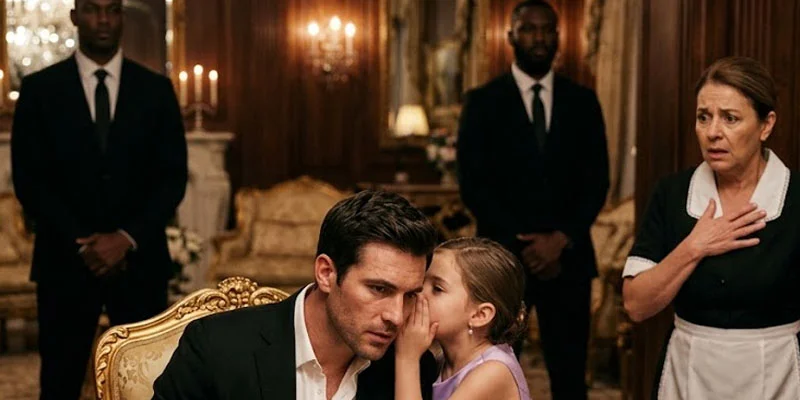
“Dad, please don’t leave… Grandma takes me somewhere secret whenever you’re away, and she says I can never tell you.” That afternoon, I followed them myself—and what I uncovered sent a chill through every instinct I had.
That morning, I stood in our Greenwich kitchen, pouring warm milk into Fiona’s beloved panda mug while my driver waited outside. Within the next hour, I was meant to be at Teterboro, followed by a noon meeting in a Chicago conference room where I would finalize an acquisition worth more than my father had ever made in his lifetime.
But Fiona had hardly touched her breakfast.
Normally, my seven-year-old daughter turned mornings into a comedy show, arguing that waffles were “morally superior” to toast and secretly feeding pieces of bacon to our golden retriever. But that morning, she sat curled over her plate, moving her fork through the untouched eggs.
“Sweetheart, you need to eat.”
She continued staring down at her mug.
“Daddy?”
There was something in her voice that made me pull out a chair and sit directly across from her.
“Yes, baby?”
“Do you really have to leave?”
I gave her a gentle smile. “Just two nights. I’ll be back before your spelling test.”
Her bottom lip began to shake.
“Grandma Wendy says promises don’t matter when grown-ups have important things to do.”
I immediately felt a wave of irritation.
Wendy, my mother-in-law, had moved into our guest cottage six months earlier after her husband died. In the beginning, I had welcomed the arrangement because Jessi loved having her mother nearby, and I believed Fiona would enjoy being close to her grandmother.
But over time, Wendy began acting as though the entire house belonged to her. She criticized Fiona’s clothes, corrected our employees, reorganized the kitchen, and repeatedly told Jessi that “children need family when their parents are too busy chasing careers.”
I tolerated it.
Then Fiona looked toward the hallway.
That one glance changed everything.
It wasn’t the nervous look of a child who had broken a toy and was hiding it.
It was fear.
“Fiona,” I said cautiously. “Has Grandma done something that scared you?”
She shook her head much too quickly.
Outside, my driver sounded the horn.
I paid no attention.
Fiona leaned toward me and held onto the edge of the table so tightly that her knuckles turned white.
“Daddy, don’t go to Chicago.”
I knelt down beside her. “Tell me why.”
Her eyes filled with tears. “Grandma takes me somewhere when you’re gone.”
My chest tightened. “Where?”
“I don’t know.”
“What do you mean you don’t know?”
“She makes me lie down in the back seat first.”
For several seconds, the only thing I could hear was the pounding of my own heart.
Fiona lowered her voice even further. “She says it’s our secret place. She says Mommy will get hurt if I tell you, and it will be my fault.”
Everything inside me froze.
I kissed Fiona on the forehead, stood up, and called my pilot. “Mechanical problem,” I said. “Cancel today’s flight.”
Then I dismissed my driver as if nothing unusual had happened.
No one else in the house knew I was staying.
Two hours later, I watched from an upstairs window as Wendy escorted Fiona toward her SUV. I waited thirty seconds, took the keys to an old Range Rover the family rarely drove, and followed them from a distance.
Wendy drove past downtown Greenwich.
Then she continued onto roads I didn’t recognize.
Eventually, she entered an industrial district without parks, shops, or any obvious reason for a seven-year-old child to be there.
Her SUV pulled to a stop behind a brick building with no windows.
I parked half a block away and watched as she guided Fiona toward a steel entrance.
Then the door opened.
A man walked outside.
The moment I recognized his face, my hands tightened around the steering wheel.
Because according to my wife, that man had been dead for eight years.
The man standing at the steel door was Arthur Vance.
Jessi’s father.
My daughter’s grandfather.
Eight years earlier, I had stood beside Jessi at his funeral while Wendy cried over a mahogany coffin that had looked strangely empty.
Yet Arthur was alive.
And Wendy had been secretly taking Fiona to him.
I waited until the door closed before crossing the street.
Through a narrow window along the side, I saw Fiona sitting at a table while Arthur spread several photographs in front of her.
“Which man came to your house last Thursday?” he asked.
Fiona hesitated before pointing.
My blood turned cold.
They weren’t pictures of family members.
They showed me, my business partners, my head of security—and men I recognized from confidential meetings about acquisitions.
Wendy stood behind Fiona. “Remember what Grandma taught you,” she said quietly.
I reached into my pocket for my phone.
Then Arthur asked a question that made me stop.
“Does your father still keep the silver key in his office?”
Fiona nodded.
That silver key unlocked a private safe containing documents connected to the Chicago acquisition.
This wasn’t an unusual secret meeting between relatives.
They were exploiting my daughter to gather information.
I moved away from the window and called my security director. “Secure my office. Nobody goes inside.”
There was a pause. “Sir… someone already went in.”
My stomach sank. “When?”
“Twenty minutes ago.”
I looked back through the window.
Wendy’s phone began ringing.
She answered, listened for a moment, and smiled. “We have it.”
Arthur immediately started collecting the photographs.
Then Fiona suddenly turned toward the window.
She saw me.
For one awful second, we stared at each other.
Then my seven-year-old daughter did something I never could have anticipated.
She desperately shook her head.
Don’t come inside.
And behind Arthur, another door swung open.
Jessi entered the room.
My wife didn’t look surprised to see her father, whom she supposedly believed was dead.
She embraced him.
My entire world rearranged itself in one silent instant.
The grief Jessi had poured onto my shoulder eight years earlier.
The recurring corporate failures our firm experienced whenever a major acquisition approached completion.
Wendy’s unexpected decision to move into our guest cottage.
None of it had been accidental.
It was all part of one carefully planned corporate operation.
And the final weapon they had against me was my seven-year-old daughter.
Inside the windowless room, Jessi pulled a digital flash drive from her purse—the drive she had copied from my silver-key safe twenty minutes earlier—and handed it straight to Arthur Vance.
“Ivan’s flight is currently over Indiana,” Jessi said, without any of the warmth she had shown when she kissed me goodbye that morning. “By the time he reaches Chicago, the proxy board meeting will be finished. Vance Global will control sixty percent of the voting shares.”
Arthur inserted the drive into a rugged laptop. “And the child?”
Wendy gently ran a hand through Fiona’s hair. “Fiona knows exactly what to say if Ivan asks questions. Don’t you, sweetheart?”
Fiona sat rigidly, her eyes locked on the side window where I remained concealed in the shadows.
She didn’t cry.
She didn’t recoil.
My seven-year-old daughter was trying to protect me.
At that moment, the fear inside me vanished, replaced by a cold and unmistakable clarity.
I stepped away from the window, took out my phone, and called a private contact I had not used since leaving corporate intelligence five years earlier.
“Leo,” I said quietly.
“Ivan? Aren’t you supposed to be in the air?”
“Ivan speaking. Execute Protocol Zero across every Sterling Capital server immediately. Freeze all external transfers, secure the board proxy tokens, and notify the FBI financial crimes division. I’ve located a live corporate espionage site in Greenwich.”
A short silence followed. “And your wife?”
“Activate the asset separation clause,” I answered, my voice completely cold. “She’s the primary operative.”
I ended the call, put the phone away, and headed toward the steel entrance.
I didn’t knock.
I drove my foot into the latch where the door frame met the deadbolt.
The heavy steel door flew inward, crashing against the concrete wall with a deafening sound.
Wendy gasped as her phone slipped from her hand.
Arthur quickly snapped the laptop shut.
Jessi turned around, every bit of color draining from her face.
“Ivan…” Jessi whispered, stepping backward without meaning to. “You… you’re in Chicago—”
“I never left Connecticut, Jessi,” I said as I entered the room with slow, controlled steps.
I paid no attention to my wife.
I ignored Arthur.
I ignored Wendy.
I walked straight to the table, picked Fiona up, and held her tightly against my chest.
She buried her face against my shoulder, gripping my coat with both hands.
“Daddy’s here, baby,” I whispered against her hair. “You did so well. You’re completely safe now.”
Arthur Vance attempted to regain control, stepping forward with an arrogant expression. “Ivan, listen to me carefully. You have no idea what you’re dealing with. Vance Global has the digital authorization keys from your safe. By noon, the acquisition belongs to us. If you leave through that door, we’ll destroy you publicly—”
My phone chimed.
I took it out, activated the speaker, and held it up.
Leo’s voice echoed through the concrete room:
“Ivan, Protocol Zero is complete. The flash drive your wife copied contained our honeypot decoy files. The instant Arthur Vance connected it to his network, it activated a self-executing forensic tracker. The FBI field office in New Haven has flagged Vance Global’s accounts for federal wire fraud, identity falsification, and corporate espionage. Federal agents are three minutes away from your location.”
Arthur’s face went completely pale.
He staggered backward into the table, sending his coffee spilling over.
Wendy let out a shrill scream and grabbed her pearl necklace. “Jessi! Do something!”
Jessi sank to her knees and stared up at me with desperate, tearful eyes—the same expression she had used for eight years.
“Ivan, please!” she cried, reaching toward my coat sleeve. “They forced me into this! My father owed millions to dangerous people! I only did it because I wanted to protect you and Fiona!”
I looked down at the woman I had shared my life and bed with for almost ten years.
“You used our seven-year-old daughter as a spy, Jessi,” I said, my voice flat and cutting. “You allowed your mother to frighten her into keeping secrets. You don’t get to claim you were protecting anyone.”
Sirens began sounding in the distance, getting louder with every passing second.
I turned my back on the three of them and carried Fiona through the shattered steel doorway into the bright morning sunlight.
EPILOGUE: THE SUNLIGHT IN THE KITCHEN
Six months later.
Morning light poured through our Greenwich kitchen, spreading a warm golden glow across the hardwood floor.
The air smelled of fresh coffee, toasted sourdough, and maple syrup.
Fiona sat at the island, swinging her legs in bright yellow socks as she used her fork to construct an elaborate “waffle tower,” while our golden retriever watched every movement with intense interest.
Her cheeks were full again.
Her eyes were shining.
The frightened, distant expression she had worn six months earlier had disappeared.
I set her favorite panda mug in front of her and poured in warm milk.
“Thank you, Daddy,” she giggled, immediately sneaking the dog a tiny piece of waffle.
“Don’t let the dog bribe you,” I said with a smile, kissing the top of her head.
The legal consequences of what happened that morning in the industrial district came quickly and completely.
Arthur Vance and Wendy Vance were convicted of federal offenses involving corporate espionage, wire fraud, and conspiracy.
Arthur’s staged death eight years earlier—created to help him escape millions of dollars in bank-fraud liabilities—also resulted in tax-evasion and identity-theft charges.
Both were now serving lengthy federal sentences.
Jessi’s betrayal had been fully documented.
Faced with the digital forensic evidence and Fiona’s recorded interview with child-protection specialists, Jessi signed an uncontested divorce agreement.
The family court granted me sole legal and physical custody of Fiona and issued a permanent restraining order preventing Jessi from approaching our daughter except through court-ordered supervision.
With no access to my capital and facing civil restitution claims from Sterling Capital, Jessi left Connecticut, her corporate career and social reputation destroyed.
The front door chimed quietly.
My security director, Leo, stepped into the kitchen with a folder.
“Morning, Ivan. Morning, Fiona,” Leo said with a smile, placing a small wooden box on the counter. “The final family trust documents came in from the probate court. Every asset is now formally secured under Fiona’s independent name.”
“Thanks, Leo,” I said as we shook hands.
Fiona looked up from her waffle tower, her blue-gray eyes clear, fearless, and overflowing with happiness.
“Daddy?” she asked.
“Yes, my sweet girl?”
“Are we going to the park after my spelling test today?”
I knelt beside her chair and held her small, warm hand in mine, feeling the quiet peace of a home rebuilt on trust and protection.
“We can stay at the park for as long as you want, Fiona,” I promised, my voice calm and warm. “No secrets, no hidden places, and no broken promises ever again.”