
The knock came just after sunset, when grief had already worn me down to the point that even the sound of knuckles against wood felt cruel. I had come home from Dona Marlene’s wake less than an hour earlier. I had taken off my black shoes by the door because my feet were swelling, set my handbag on the table without turning on the light, and sat in the narrow chair by the window of my little rented house because I could not yet bear the thought of moving through another evening in a world where she no longer existed. Outside, the neighborhood was settling into its ordinary noises—televisions beginning behind thin walls, a dog barking twice and then losing interest, a motorcycle buzzing past toward the main road, someone upstairs dragging a chair across tile. I remember thinking, with that stunned dullness grief gives you at first, that it was offensive for the street to still sound normal. The woman who had become my family had been buried before noon, and yet the bakery at the corner would still open at six tomorrow, children would still run after school, the jacaranda leaves would still fall into the gutter, and the whole neighborhood would keep breathing as if a room had not just gone dark forever.
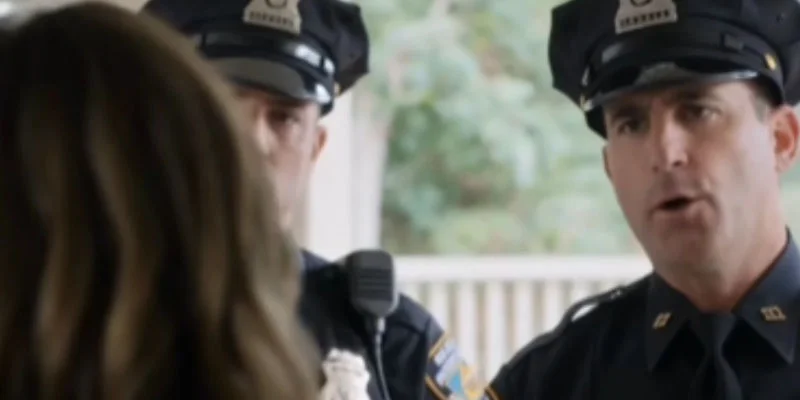
When the knock came the second time, firmer now, I rose because I had spent too many years of my life answering doors for other people to ignore one at my own. I wiped my face with the heel of my hand before I opened it, though I do not know why. Two uniformed police officers stood under the porch light, hats tucked beneath their arms, both wearing the grave expression officials practice when they must interrupt mourning with something that will make it worse.
“Are you the one who cared for Dona Marlene?” the older of the two asked.
For one terrible second I thought perhaps something had been discovered at the hospital, some detail about her death that would send the whole day back through my chest again. “Yes,” I said. “Is something wrong?”
The younger officer looked at the older one, and then the older officer said, “We need you to come with us.”
My stomach dropped so suddenly that I had to grip the doorframe. I remember hearing myself ask, “Why?” in a voice that no longer sounded like mine. The officer did not answer directly. “It concerns Dona Marlene’s estate,” he said. “It would be better if you came now.”
Estate. It is strange which words the mind seizes in moments of fear. He might as well have been speaking another language. All I could think was that her daughters had decided to accuse me of something. Theft, perhaps. Manipulation. Missing jewelry. Missing cash. The stories people tell themselves when a mother dies and they do not want to look at what they failed to give her while she lived. I had seen the way they looked at me at the wake, as if my tears offended them because they were too real and therefore exposed their own. I had seen them whispering by the dining room archway while her body lay in the front parlor, already talking in tight, urgent voices about keys and documents and the safe in the bedroom wardrobe. They had barely touched her hand, but one of them—Raquel, the older daughter—had asked three times where Dona Marlene kept her bank papers. So when the police said they needed me, fear did not feel like imagination. It felt like continuation.
“I need my bag,” I said.
I remember locking my own door, though later I had no memory of turning the key. I remember sitting in the back seat of the police car and watching the familiar streets slide by in bands of yellow and shadow. We passed the square where Dona Marlene and I used to buy sweet corn from a vendor on Thursdays. We passed the pharmacy where I picked up her blood pressure pills every month. We passed the bus stop where, seven years earlier, I had first seen her standing in the window of that big old house with the pale green shutters, looking out at the street as if she were waiting for a life that kept postponing itself. That was how it had begun, with a window and a woman no one noticed properly anymore.
At that time, my life had already shrunk to practical survival. I was forty-six then, though in memory I feel both younger and more worn. My husband had been dead for three years—an aneurysm, sudden and senseless, leaving behind one half-buttoned shirt, a pan on the stove, and a silence that changed the shape of every room we had ever entered together. We had not had children. By the time I lost him, I had also buried my mother, my last aunt, and the younger brother who never lived past thirty-eight because alcohol and despair make terrible collaborators. I was not a woman surrounded by dramatic tragedy every minute, but I was undeniably alone. I rented a small house on Rua das Laranjeiras with a roof that leaked over the sink in heavy rain and a gate that dragged on the pavement when it opened. I worked days cleaning two homes and doing evening shifts at a small private clinic where I changed bed linens, restocked bathroom towels, and mopped floors that always seemed somehow too white for the lives passing through them. I came home tired, cooked for one, ate standing at the counter some nights because sitting at the table made my husband’s empty chair feel theatrical. People say loneliness is quiet. That has not been my experience. Loneliness is loud. It makes spoons sound too metal against bowls. It makes television laughter in neighboring houses feel like mockery. It turns Sundays into long corridors. You can survive it, but after a while survival begins to resemble disappearing.
Dona Marlene lived four streets over from me in one of those older neighborhood houses built when people still believed a front porch should be wide enough for conversation and every room should have high ceilings because heat was better negotiated than fought. Even before I knew her, everyone knew of her. Not in the sense that anyone truly knew her, but in the way neighborhoods generate reputations out of fragments. “That widow with the lace curtains.” “The one whose husband left her the transport business.” “The one with those ungrateful daughters in the fancy part of town.” “The one who still keeps silver tea spoons locked in a drawer.” “The one who gave so much to the church bazaar years ago.” There were always stories. Wealth makes people visible from far away while making them harder to see up close. What I knew of her then was simple: she was elegant even in old age, she wore cardigans draped over her shoulders even when the weather did not quite require them, and most afternoons around five she stood at the front window and looked out at the street with the fixed attention of someone expecting a particular car.
The first time I spoke to her, she was at the gate arguing softly with a torn grocery sack.
I was walking home from the clinic, carrying my own shopping in two reusable bags that cut into my palms. The sky had that orange-gray color evenings get just before rain. As I passed her house, I saw her on the porch bending awkwardly over a paper sack that had split open at the bottom. Potatoes rolled across the tiles. A carton of milk tipped onto its side. She made a small sound—not a cry for help, more a vexed little sigh as if the groceries had personally insulted her dignity. I set my bags down without thinking and hurried to the gate.
“Let me help,” I said.
She straightened too quickly, one hand flying to her chest, then narrowed her eyes at me with the offended suspicion of an old woman who still preferred to pretend she could manage everything herself. Up close she was more striking than I had expected. Not beautiful in the delicate storybook sense, but vivid. Her hair was white and set carefully. Her lipstick, though slightly faded, had been applied with precision. She wore a gold chain at her throat and pearl earrings so small you almost missed them. There are some women who never stop looking like themselves, even when age rearranges everything else. She was one.
“I only dropped one sack,” she said, as if clarifying that her life was not generally one that dropped things.
“And I only offered to help pick it up.”
That got the ghost of a smile from her. “Well,” she said, stepping back. “Since we are both already involved.”
We knelt and gathered potatoes. I picked up the milk and saw that the carton had burst at the corner. “This one is gone,” I said.
“Like some of my relatives,” she replied dryly.
That made me laugh in spite of myself. Her eyes flicked toward me, assessing. When we had rescued the remaining groceries and carried them into the kitchen, she insisted on making coffee. I protested that she didn’t need to. She answered, “If a woman helps me rescue potatoes from public disgrace, the least I can do is offer her coffee before the rain starts.” It had indeed begun by then, tapping against the windowpanes, and I was more tired than I realized. So I sat.
That kitchen became one of the great rooms of my life, though neither of us knew it then. It smelled faintly of cinnamon and furniture polish. The cabinets were old wood painted cream and worn along the handles by decades of use. Copper pots hung over the stove though she admitted she only used two of them anymore. There were blue-and-white tiles behind the sink and a small radio on the counter that played low all afternoon, usually old songs or news reports. On the windowsill above the sink she kept African violets in chipped porcelain cups because, as she told me that first day, “Plants need smaller homes when they get old, just like people.”
I should tell you now that Dona Marlene was not poor. Her late husband had built a successful transport company. The house was hers free and clear. She had savings, an investment account, two cars she no longer drove, jewelry tucked in velvet boxes, and enough land inherited from her own parents to make distant cousins remember her every holiday. She did not need money. What she lacked was something much harder to buy and much easier to notice once you sat at her table for more than ten minutes. She lacked tenderness. She lacked interruption. She lacked the ordinary friction of being loved by people who knew your habits. Her daughters, Raquel and Denise, appeared in bursts—never long enough to finish a whole cup of coffee, always long enough to leave with something. A signature for a transfer. A “small loan” that was never returned. Jewelry “borrowed” for some function. Cash for a grandson’s school trip. Help with a tax issue. Help with a husband’s business problem. Help with a fridge payment. Help, help, help, always phrased as if mothers are born with money tucked under their tongues specifically to save adult children from embarrassment.
But on that first day, all I knew was that the coffee was strong, the rain had trapped me, and the woman across from me spoke like someone who had spent years saying interesting things into empty rooms.
“What do you do?” she asked.
I told her.
“And you live alone?”
“Yes.”
She took that in without pity, which I appreciated. Pity from strangers is one of the cheapest and most exhausting forms of attention. “It is a noisy kind of silence,” she said after a moment.
I looked up. “What is?”
“Living alone after not living alone.” She stirred her coffee once though she had already added sugar. “People who have never done it think the silence is peaceful. It isn’t. It’s crowded. Every object starts sounding opinionated.”
I stared at her and then laughed because it was exactly right.
When the rain eased enough for me to leave, she walked me to the porch with her cardigan around her shoulders. “What is your name, child?”
I told her.“Well,” she said, “next time you pass by, if you see me wrestling with a vegetable, come in.”
I did pass by again, two days later, and she was not wrestling with a vegetable but standing in the front window looking out with such open expectancy that I felt embarrassed on behalf of whatever person had not come. She saw me, lifted one hand, and then, almost shyly, gestured for me to enter.
I went in for five minutes and stayed two hours.
That was how the pattern began. Not formally. Not by contract. By repetition. At first I only stopped occasionally—an afternoon coffee, a quick conversation on my way to the clinic, a helping hand with a shopping bag or a jar lid. Then the stops became expected. If I missed two days, she would say, “I assumed you had come to your senses and abandoned old women as a hobby.” I learned her routines. She liked coffee at four, tea at eight, the newspaper folded into precise quarters, and the curtains opened first thing in the morning because she said a closed house “forgets the shape of daylight.” She loved card games and cheated without skill but with style. She made the best sweet pumpkin jam I have ever tasted and claimed the secret was patience, though I suspect it was the indecent amount of cloves. She could speak for an hour about fabrics, politics, or whether women forgive too much out of laziness rather than virtue. She told stories about her youth that made me realize she had once been formidable in a way that frightened weak men. She had danced. She had traveled. She had learned French badly and worn it like perfume. She had once slapped a mayor at a charity event when he patted her waist without permission. “Not hard enough,” she said later. “My only regret.”
I began helping because she needed help, but I stayed because I needed what happened to me inside that house. I became visible again.
There were little jobs at first. Carrying groceries. Reading the small print on medicine boxes when her eyes were tired. Checking that the gas bill had actually been paid. Tightening the bolt on the garden gate. Walking with her to the corner bakery on Tuesdays because she did not trust the young clerks to slice her bread evenly. Then there were more. A doctor’s appointment where she rolled her eyes at the specialist and squeezed my hand under the table when he spoke to me instead of her. An afternoon organizing old family photographs because “if I don’t do it now, one day those vultures will throw your favorite versions of me into garbage bags.” A night when the water heater failed and I stayed until the repairman finished because she hated the sound of empty hallways after dark. She started leaving a little envelope for me on the kitchen table every Friday. “For your time,” she would say when I protested. “Affection is free; labor is not. Don’t insult us both by pretending otherwise.” So I accepted. Dignity matters. She knew that. Later, when I reduced my clinic shifts because she needed more help after a dizzy spell, she simply told me what my weekly pay would be and dared me to argue.
In those first two years, I learned the map of her loneliness.
It lived in the front window. In the way she checked her phone, old-fashioned flip model at first, then later a simple smartphone one of the grandchildren had given her and never taught her to use properly. It lived in the careful way she dressed when she expected one of the daughters and the defeated way she loosened her earrings when the hour passed without a car at the gate. It lived in the fridge stocked with food she kept buying “in case people come,” and in the dining table that could seat eight though she and I ate most meals together in the kitchen because the larger room felt obscene when empty. It lived in birthdays.
The first birthday of hers that I shared was in July. She turned seventy-eight. Three weeks before, she had mentioned the date casually while we were shelling peas. “They usually come by,” she said, which was not the same as saying she expected them. I asked what kind of cake she liked. Her face changed at once, softening in a way that startled me. “Coconut,” she said. “But not too sweet. And don’t make a fuss.”
I made the cake.
I bought fresh flowers for the table because the garden roses had finished blooming. I helped her choose a blue dress with pearl buttons down the front. At ten in the morning she was already glancing toward the window. At noon she said Denise was probably delayed by traffic. At two, she said Raquel had some issue with her son’s school, she was sure. At four, the cake sat untouched between us, the coconut beginning to dry. At six thirty, just as I had convinced her to eat a slice, the gate buzzer rang.
The transformation in her face in that second would break a stronger person than I am. It was hope, naked and immediate, the kind children wear before they learn better. She went to the mirror, adjusted her hair, lifted her chin, and said, “Well, at least they came.” Then Raquel entered already talking into her phone, kissed the air somewhere near her mother’s cheek, set a department store bag on the counter, and said, “I can’t stay, Mama, we have another dinner, but I needed your signature on two things.” Denise arrived fifteen minutes later with a grandson who did not take off his headphones once. Neither daughter asked about the cake. Both asked whether their mother had decided yet what to do about the country land. One of them mentioned taxes. The other mentioned a buyer. They stayed thirty-eight minutes. I know because I looked at the microwave clock after they left and realized I had been holding my own breath the whole time.
After the gate clicked shut behind them, Dona Marlene stood in the kitchen without moving. Then she walked to the table, cut herself a large slice of coconut cake, and said in a tone so light it made my throat ache, “Well. More for us.”
We ate cake for three days.
That was the rhythm of her family. Long absences, hurried arrivals, the smell of expensive perfume and impatience, then silence again. They rarely came separately from need. If a month passed without a visit, you could be sure one of them would appear soon with a new problem requiring money. Raquel, the older daughter, was elegant and brittle, always wearing clothes too young for her and annoyance like an extra accessory. She spoke to her mother with a mix of false sweetness and barely disguised irritation, the tone some people use with hotel staff when a room is not ready fast enough. Denise, the younger, had a softer face and a quicker smile, but her softness was strategic. She wept easily, apologized beautifully, and extracted money with the wounded grace of a woman convinced the world continually underfunded her disappointments. If Raquel demanded, Denise dissolved. Between them, they could turn an afternoon into a small heist conducted in polished voices. They never screamed. They never needed to. Entitlement is most efficient when delivered politely.
They disliked me almost from the beginning.
Not because I was rude. I was careful, if anything too careful. I stood when they entered. I offered coffee. I made myself scarce if the visit seemed private. But people who profit from neglect do not like witnesses, and I had become one simply by staying. At first they addressed me as though I were interchangeable with the maid from twenty years earlier. “Could you bring more cups?” “Can you find Mama’s blue folder?” “Tell her the cardiologist called.” Then, gradually, a note of accusation entered their voices. I was in the room too often. I knew too much about medication schedules, doctor appointments, account passwords, grocery lists. Once, after Raquel asked her mother for a sum large enough to buy my entire rented house twice over and Dona Marlene said no for the first time I had ever heard, Raquel turned to me and said, “You shouldn’t interfere in family matters.”
I had not spoken.
Before I could answer, Dona Marlene put down her teacup and said in the icy tone that must once have frightened politicians, “If I refuse to finance your chaos, darling, do not flatter yourself that someone else put the idea in my head.” Raquel went pale under her makeup. Denise looked away. I pretended to be fascinated by the sugar bowl, but inside I loved Dona Marlene a little more than I had the day before.
Our real closeness grew in the ordinary spaces her daughters never saw.
It grew in the mornings when her joints were stiff and I rubbed ointment into her fingers while she told me about the first apartment she shared with her husband before the money came. It grew in the afternoons when we played cards and she insisted on high stakes, meaning the winner got to avoid drying dishes. It grew in the market where she used to inspect tomatoes like a queen reviewing soldiers, and in the pharmacy where the clerks began calling me by name because I collected her prescriptions so often. It grew one Christmas Eve when both daughters promised to come and neither did, and we ended up eating roast chicken in the kitchen while a thunderstorm rolled over the neighborhood and she confessed that loneliness at the holidays feels “less like sadness and more like being erased in decorative lighting.” It grew when I caught the flu one winter and missed three days, and on the fourth morning I found on my doorstep a basket with soup, lemons, and a note in her careful slanted handwriting that read, If you insist on being ill, at least do it with broth. It grew in grief too. On the anniversary of my husband’s death, I tried to keep the day hidden, but she noticed. “Ah,” she said, seeing something in my face at once. “One of those dates.” I nodded. She did not offer platitudes. She simply pushed the deck of cards aside and asked, “Tell me one thing he ruined and one thing he made better.” It was the best memorial I’d been given.
By the third year, I had a key to her house.
“It is ridiculous for you to stand outside if I’m in the shower,” she said, dropping the key into my palm as if it were an afterthought, though I think she had polished the brass ring first. “Also, if I fall and crack my skull on these offensive tiles, I would prefer not to wait for the milkman to discover me.”
The truth was she had already fallen once, lightly, in the garden while trying to clip dead rose branches without telling me she was doing it. She bruised her hip and spent a week pretending the pain was less than it was. After that, I became less helper than caregiver in any formal sense. I took her to more appointments. I organized her medicines into labeled boxes. I kept a spare apron in her kitchen. I stayed some nights when her blood pressure wavered or her heart medication needed adjusting. She began calling me in the mornings just to hear another voice before breakfast. “I am verifying that you still exist,” she would say if I sounded sleepy. “Don’t make this emotional.”
I never had to ask whether I was in the way there. That is one of the reasons her house became sacred to me. It did not ask me to shrink. It asked me to come in.
She had a room at the back overlooking the garden where the late afternoon light turned everything gold. Some evenings, when her legs were bad and we had finished eating, we sat there with the windows open and listened to neighborhood life settle around us. A pressure cooker hissing next door. Someone practicing scales on a keyboard badly. Children playing football in the alley until their mothers called them inside. On those evenings, Dona Marlene talked most about family—not in sentimental terms, but with the brutal accuracy old age sometimes grants people who are too tired to lie attractively.
“Blood,” she told me once, “is a very overpromoted substance.”
I laughed. “You shouldn’t say that.”
“Why? Because Hallmark cards would object?” She adjusted the blanket over her knees. “Family is not made by blood. Blood is biology. Family is attendance. Who shows up. Who stays when the room smells of medicine. Who remembers how you take your tea when you no longer remember where you put your glasses.”
I said nothing because my throat had tightened.
She looked at me sharply. “Don’t cry over philosophy. It makes it too powerful.”
But she reached for my hand anyway.
Not every day was tender. Caring for an elderly person, especially one as proud as Dona Marlene, has frustrations no one writes about in lovely social media posts. She could be impossible when she was tired. She hated being told to rest. She lied about how much salt she put on her food. She hid medical symptoms if she thought a doctor might use them to restrict her independence. She once fired a physical therapist mid-session for saying “very good” in a tone she considered condescending. “I am recovering, not performing for applause,” she told him. He never came back. Another time she refused to use the walking cane for three days because Denise had called it “cute,” and Dona Marlene would have rather risked a fractured hip than carry anything described with that adjective. But even in her worst moods, she never made me feel smaller. Irritated, yes. Exasperated, certainly. Once she told me my taste in curtains was “earnest bordering on criminal.” But small, never.
The family grew more aggressive as her body weakened.
Perhaps they sensed what selfish people often sense first: that time was becoming finite and with it the opportunity to position themselves well around a will they preferred not to think about openly. They began arriving more frequently, never together if they could avoid it, each trying to establish a separate claim in the emotional accounting of a woman they had mostly abandoned. Raquel brought expensive fruit baskets and spoke in the exaggerated, public voice people use in hospital corridors to sound caring. Denise cried more. She always did best when tears were involved. Once she spent an entire afternoon clutching her mother’s hand and whispering about guilt and stress and life being so hard with teenagers, only to ask, at the moment she put on her shoes, whether Mama could “temporarily” cover a debt before the bank made things unpleasant. I watched Dona Marlene’s face close like shutters.
“How much?” she asked.
Denise named a figure large enough to pay my wages for a year.
“No.”
Denise blinked. “Mama, you don’t understand—”
“No,” Dona Marlene repeated. “What I understand is that every time I look like I might die, you become a person with urgent bills.”
Denise’s tears vanished as if a hand had wiped them away from inside. “You’ve changed,” she said coldly, and her eyes slid toward me. “Some people have been whispering in your ear.”
Dona Marlene straightened in her chair. “No,” she said. “Some people have finally stopped whispering. I simply began listening to myself again.”
After Denise left, slamming the gate hard enough to set the dogs barking two houses over, I went to the kitchen to give Dona Marlene privacy with the humiliation of loving the wrong people. She followed me five minutes later and found me standing by the sink pretending the kettle needed watching. “Don’t do that,” she said.
“Do what?”
“Turn my pain into something I must manage for your comfort.”
I turned. She leaned one hand on the doorframe, looking both exhausted and fierce. “You are allowed to stay in the room when something hurts me,” she said. “That is one of the definitions of family.”
I have carried that sentence ever since.
The fourth year brought a bad autumn. She had a minor stroke—not the catastrophic kind, thank God, but enough to frighten us both. She dropped a cup one morning and could not remember the word for sugar for almost a minute. I called an ambulance. She cursed me while they strapped her in and then apologized from the hospital bed because fear, on her, always came dressed as temper. Recovery was slow. Her left hand took months to fully obey again. Her walking became more cautious. She slept more in the afternoons. Yet her mind, once the fog cleared, was as sharp as a knife drawn across silk. If anything, the stroke made her more determined. “When people think you are fading,” she told me during rehabilitation, “they start arranging your life out loud in front of you. It is educational.”
She was not wrong. The daughters became almost energetic after the stroke. Raquel appeared at the hospital in immaculate beige trousers and asked the doctor whether cognitive decline should make the family “prepare certain legal structures.” Denise started talking about selling the second car “before it deteriorates unused.” A nephew no one had mentioned in years suddenly called to ask after her “estate planning.” I saw something harden in Dona Marlene then. She had spent years tolerating their opportunism out of habit, guilt, maybe even a private shred of maternal hope that one day one of them would arrive without an angle. The stroke, I think, burned that hope away. Survival can do that. When a woman has nearly lost language, she becomes less patient with those who only use it to take from her.
A few weeks after she returned home from the hospital, she asked me to find a specific folder in the bedroom wardrobe. It contained her identification papers, property deeds, bank records, and a sealed envelope addressed in her neat hand to a law office downtown. I brought the folder to the kitchen table and asked, “What’s all this?”
“My affairs,” she said.
I hesitated. “Do you want me to call one of your daughters?”
She looked at me for a full three seconds, and in that look there was so much dry disappointment that I nearly apologized. “No,” she said at last. “I want you to call a taxi.”
She went downtown that afternoon dressed in navy and pearls. She did not ask me to accompany her inside the law office. “Some matters require privacy,” she said. “Even from loved ones. Especially if one intends to surprise them.” I assumed she was updating documents after the stroke, making practical arrangements so the daughters would not fight over things. That seemed wise and, frankly, inevitable. I did not ask specifics because I believed her property, like her children, was not my territory. Later she also made a visit to the notary’s office and one to the police station. She told me she was “putting things in order so that vultures will have less room to improvise.” I laughed at the phrasing, but I still thought the order she meant would favor her blood relatives. Old women can be angry at their children and still leave them everything. I had seen it too often to imagine otherwise.
There were, however, moments that should have told me she was thinking more radically than I allowed myself to believe.
One evening we sat on the porch during a power outage, candles on the table between us and the whole street smelling of wet earth because a storm had passed. The neighborhood was darker than usual, softer. You could hear distant conversation drifting over walls, forks against plates, someone singing to a child in the next block. Dona Marlene said, “If you had a house, what would you do with it?”
I laughed. “Live in it, I suppose.”
“Besides that.”
I considered. “Open the windows. Plant herbs. Paint the back room yellow. Never make anyone feel they are visiting if they are hungry.”
She nodded as though noting something on an invisible list. “Good answer.”
Another time, after Raquel had left in a furious cloud because her mother refused to lend her a sum for her husband’s failed investment, Dona Marlene stared at the closed gate for a long while and then said, “People assume inheritance is a reward for biology. Nonsense. It should be an answer to a simpler question: who loved the life that held these objects?”
I was wiping the table. “You talk as if your furniture needs romance.”
“My furniture has seen more honesty than my children,” she said. “Do not underestimate it.”
I smiled. I did not hear the future hidden in the joke.
The fifth year we spent together was in many ways our happiest, though her body was undeniably weaker. By then our routines were so established that the house itself seemed to expect me. I no longer knocked. I came in through the side door, called out “It’s me,” and usually found her in one of three places: at the kitchen table doing a crossword she pretended not to need help with, in the back room by the window with a blanket over her knees and a book she was not really reading, or in the front sitting room, where she liked to watch the street and complain about everyone’s gardening standards. We cooked together on good days. On tired days I cooked and she supervised, which she considered an equal labor. We played canasta every Thursday because it was the day her husband had always returned early from work when he was alive and she had decided after his death that Thursdays therefore required ritual. We watched old black-and-white films on Sundays. We argued about sugar. We remembered people. We forgot some on purpose.
That was also the year she started asking more about me.
Up until then our friendship had been slightly unequal in the way caregiving relationships often are. She spoke, I listened. She remembered, I encouraged. She offered advice whether requested or not. I answered questions but rarely volunteered my own wounds. I had spent so long living as the dependable one that confessing need felt like speaking a foreign language. But old women with sharp eyes do not let you stay hidden forever.
“Why did you never have children?” she asked one afternoon while we peeled apples.
The question landed with the quiet thud of a fruit dropping into water. Most people knew better than to ask directly, or pretended to. “It didn’t happen,” I said.
“That is an evasion.”
I kept peeling. “We tried for some years. Then we stopped. Then time passed.”
“Did you want them?”
“Yes.”
She nodded once, not prying further. After a moment she said, “People assume grief only belongs to what was fully formed. Rubbish. We grieve shapes too.”
I looked at her sharply because it was exactly the kind of sentence that can break you if it finds the right crack. She did not look back with pity, only with recognition. In that moment something old and tightly bound in me loosened. I told her then about the miscarriages no one discussed after the funerals had passed. About the small box in the bottom drawer of my wardrobe where I still kept, for reasons I could never justify, a pair of knitted baby socks my mother had made the first time I was pregnant. About the fact that after my husband died, I no longer knew whether my greatest grief was losing him or losing the future in which someone might one day have looked like us both. Dona Marlene listened without interrupting, hands folded over her cane. When I finished, she said only, “No wonder you know how to stay.”
It was the most accurate thing anyone ever said about me.
The sixth year brought more trouble with the daughters.
By then the old transport company accounts had been consolidated, several pieces of land had been sold under Dona Marlene’s supervision, and the house itself, though large, was the main visible symbol of her wealth. Raquel wanted it sold while Marlene was still alive so “you can move somewhere easier and not burden anyone.” Denise wanted a power of attorney “for emergencies.” Both framed greed as concern, which is an art form among certain families. They started mentioning nursing homes in the tone people use when discussing rain: unfortunate, perhaps, but necessary. Dona Marlene, who had more intelligence in one fingernail than they had together on their best day, saw through all of it. So did I. One Sunday, they arrived together, which never meant anything good, and sat in the front sitting room with matching expressions of urgency. I brought coffee and tried to retreat, but Marlene called, “Stay.” So I stayed.
Raquel did most of the talking. She said the stairs were unsafe. She said the neighborhood was “declining.” She said the upkeep on such a house was irrational for one old woman. She said if the house were sold and the money “structured properly,” everyone could feel more secure. Denise cried at the right moments and murmured about Mama’s health, Mama’s comfort, Mama not understanding how difficult modern life had become for the family.
Dona Marlene listened all the way through, hands folded over one another in her lap, face unreadable. When they finished, she asked, “And which one of you would prefer the front bedrooms?”
Both daughters froze.
“Really,” she went on lightly. “I only ask because you’re discussing my life as if I’ve already left it.”
“Mama, that’s unfair,” Denise began.
“No, unfair would be forcing me out of my house while I can still tell you to get out of it yourselves.” Her voice did not rise. It did not need to. “I am not selling. I am not moving. And no one is receiving power of attorney unless I personally invite the apocalypse.”
Raquel’s composure cracked. “This is because of her,” she snapped, pointing at me so abruptly that hot coffee sloshed in my cup. “You let the staff get too close and suddenly family is the enemy.”
Dona Marlene smiled then, the dangerous smile I had seen only twice before. “My dear,” she said, “if you are losing a competition against kindness, perhaps the problem is not the competition.”
Raquel stood up so fast her chair scraped hard across the tile. Denise started crying in earnest, though I noticed there were no tears yet. They both left in a storm of outrage, threats, and dramatic declarations about lawyers. When the gate finally banged shut, I said weakly, “Perhaps I should have gone to the kitchen.”
“No,” Dona Marlene said. “I am tired of witnesses being exiled to make liars comfortable.”
After that, the daughters became openly hostile toward me. They sent messages through neighbors asking what “influence” I thought I had. One afternoon Denise stopped me at the pharmacy and said, in a tone sugary enough to rot teeth, “You should remember your place.” I looked at her and, for perhaps the first time in my adult life, replied, “I do. That’s why I’m not the one asking my mother for money in public.” Her face flushed so dark I was afraid she might strike me. She didn’t. She only hissed, “She’s confused. She doesn’t know what she’s saying anymore.” I walked away before I could answer because there are some lies so large that arguing with them feels like giving them furniture.
Dona Marlene was not confused. Tired, yes. Forgetful in the ordinary ways age makes people—misplacing glasses, repeating a story after three weeks, forgetting the name of an actor and then remembering it two days later in the middle of lunch. But confused in the legal or moral sense? Not for one second. If anything, the closer she came to death, the more precise she became about what mattered. She labeled boxes in her wardrobe. She instructed me which shawl should go to which neighbor if she died before winter ended. She made a list of recipes I knew by heart already and insisted on writing them down anyway. “Memory is arrogant,” she said. “Paper is modest. It stays.”
Then came the last winter.
There was no single announcement. Bodies do not usually send formal notices when they begin preparing to leave. Instead, I saw it in increments. The way she tired more easily after walking from bed to kitchen. The way her appetite thinned. The mornings she did not want coffee first thing, which was unlike her in a way that frightened me more than lab numbers ever did. Her doctor spoke carefully about her heart. There was fluid. There was weakness. There were options, but none that would restore youth or reverse time. She listened, asked smart questions, and afterward told me in the car, “I am not afraid of dying. I am irritated by how much paperwork it will save my daughters.”
I laughed because she wanted me to. Later, alone in my little house, I cried over the sink while washing rice.
During those final months, the front window changed meaning. She no longer stood there waiting for her daughters. She sat by it because the light was best there and because she liked watching the world continue. Schoolchildren passing with oversized backpacks. The bread delivery truck reversing badly. Women arguing amiably over fruit prices. Boys kicking a ball too close to the gate. “Life is so shameless,” she said once. “It keeps happening right in front of the dying.” Yet there was no bitterness in it, only astonishment.
We spoke a great deal about love then, though not in sentimental terms. Dona Marlene distrusted sentimentality. “It always appears when sincerity is about to say something unpleasant,” she claimed. What she wanted to discuss was how people fail each other. How mothers can spend years excusing their children because motherhood trains women to turn injury into explanation. How some children remain perpetually hungry because no affection can compete with entitlement once it hardens. How loneliness wears manners to the bone. Sometimes she spoke of her husband, who had been generous in public and difficult in private, though never cruel. Sometimes she spoke of her daughters as girls—their braids, their fevers, the dresses she sewed by hand when money was still tight. Those stories hurt her most. Not because the daughters had once been bad. Quite the opposite. Because they had once been beloved in ways that made what came later almost impossible to understand.
“What happened?” I asked one evening as I folded towels at the foot of her bed. The rain had been falling for hours, and the room smelled of eucalyptus rub and damp garden. “To them, I mean.”
She was quiet for so long I thought she might not answer. Then she said, “Success happened too fast. Comfort without gratitude. The belief that help would always arrive because it always had. Their father’s death. My money becoming, in their minds, less his gift to me than their future delayed. And perhaps this too: I taught them to expect rescue from me. I did not teach them to deserve it.” She looked at the ceiling. “Mothers think love is proven by how much they give. Sometimes it is proven by what they refuse to finance.”
That night, before I left, she took my hand and said, “You must not let guilt make choices for you forever.”
I stared at her. “What guilt?”
“The kind that makes a woman believe she has to earn her place in every room by being useful.” Her mouth turned at one corner. “You carry it like a second spine.”
I wanted to deny it. I couldn’t. Not to her. Instead I said, “Maybe that’s just being practical.”
“No,” she replied. “Practicality fixes roofs and pays bills. Guilt makes you apologize for needing soup when you’re sick.”I laughed because she was referring to the basket she had once left on my doorstep. But even laughing, I knew she was right. That knowledge sat between us often in those final weeks, unspoken but alive. She knew what I was. A woman who stayed, yes, but also a woman who accepted too little for herself because she had been taught that gratitude and self-erasure were cousins. Perhaps that is why what she eventually did was not only generous but corrective. She did not merely leave me things. She contradicted, with legal force, the ugliest story I had ever believed about my own worth.
The last full day I had with her was quiet.
The weather was mild. The jacaranda outside the back wall had started dropping purple blossoms so the path looked bruised in the prettiest possible way. She ate half a bowl of soup and complained that I had become sentimental with parsley. We played one hand of cards, which she lost because she was distracted and refused to admit it. She asked me to open the wardrobe and take out the blue shawl because the house felt chilly. Then, while I draped it around her shoulders, she said, “If I die before you, you must promise me one thing.”
“I don’t like promises phrased that way.”
“Too bad.” Her eyes, though dimmer than before, were still exactly themselves. “You must keep living toward people, not away from them.”
I thought she meant grief. I touched the shawl fringe to hide the sudden tears in my face. “All right.”
“Say it properly.”
“I promise.”
“Good.” She leaned back. “And if those vultures make a scene after I die, do not waste your best tears on them.”
I smiled weakly. “You’ll outlive us all just to prove a point.”
“That sounds exhausting.”
I stayed later than usual because she dozed and woke restless twice. When I finally rose to leave, she squeezed my fingers. “Come early tomorrow.”
“I always do.”
“Still,” she said. “Come early.”
She died before dawn.
I found her just after six, sitting not in bed but in the armchair by the back window, shawl around her shoulders, hands folded, as if she had only paused midway through a thought. There was no violence in it. No struggle visible, no panic impressed into the room. The doctor later said it was likely her heart, quiet and swift in the end. I was grateful for that and furious at it too. Grief is inconsistent. I called the ambulance though I already knew. I called the daughters because legally I had to, though even dialing their numbers felt like opening the gate to dogs. Raquel arrived first, hair perfect, mouth already arranged for tragedy. Denise followed with mascara running in prepared streaks. They both looked at the body, then at each other, then at me. I knew instantly that I had become, in their minds, not a grieving companion but a variable.
The wake took place in the front parlor because that is what Dona Marlene had requested years earlier in a conversation so casual I had not understood at the time that she was rehearsing her own exit. “If I die in a hospital, bring me home,” she had once said. “I want one last night under my own ceiling so the hypocrites must at least come to me.” So we brought her home. The undertaker arranged flowers around the coffin. The good silver candlesticks were set on either side. Neighbors came, church friends came, two women from her old charity committee came and cried honestly, which felt like a blessing. And, of course, the family came in black clothing that hung on them like costumes.
They performed grief with competence. Raquel pressed a handkerchief to her face at intervals carefully spaced. Denise held people too long in embraces and spoke in a voice so broken it sounded theatrical even to the priest. A grandson stood by the wall looking bored until his mother hissed at him to lower his phone. I sat near the kitchen because every time I approached the coffin, one of the daughters drifted somehow into the space between, not openly blocking me, just arranging the room so that I always felt half-excluded from the sorrow that was more mine than theirs. Still, I stayed. I poured coffee for visitors. I found extra chairs. I accepted condolences. More than once I saw the daughters whispering not by the coffin but by the sideboard where the house keys usually lay.
By late afternoon, the masks were slipping. Raquel asked the lawyer—whom she had summoned far too quickly, in my opinion—whether the house documents were all in order. Denise wanted to know if there were outstanding loans. A son-in-law I barely knew said something under his breath about appraisals. I was standing in the hallway with a tray of little bread rolls when I heard Raquel say, “We need to find out if she changed anything recently.” Denise answered, “She couldn’t have. She was barely herself.” I almost dropped the tray. Barely herself. I wanted to drag them both into the kitchen and list, hour by hour, every sharp, lucid, infuriating, loving thing their mother had said in the last month. Instead I stood there until one of the neighbors touched my elbow and said softly, “Don’t let them poison your mourning.” It was good advice. I only partly managed to follow it.
After the burial, after the church flowers and the damp cemetery earth and the formal embraces, after watching the coffin disappear into the ground and feeling something ancient in me go silent, I went home because I could not bear another minute inside that parlor with those women measuring curtains in their heads. I sat in my own dark kitchen until the police knocked.
By the time the patrol car turned the corner onto Dona Marlene’s street, my hands were numb. Her house was lit up as if for a party. Three cars lined the curb, including Raquel’s white sedan and Denise’s husband’s black SUV. The gate stood open. One of the officers got out first and opened the back door for me, not unkindly. I stepped onto the pavement and saw through the front windows that the whole family was gathered in the sitting room, their silhouettes jagged with agitation. My first stupid thought was that there had been a burglary. My second was that they meant to accuse me of one.
Inside, the air was thick with perfume, stale funeral flowers, and anger. Raquel turned the moment I entered. Her eyes were bloodshot, but not in the way grief reddens eyes. These were furious eyes, calculating eyes. Denise stood near the armchair where her mother used to read, her face blotched, phone clenched in one hand so tightly I thought the case might crack. Two sons-in-law hovered with the puffed-up stance of men who feel entitled to outrage when money moves in directions they did not pre-approve. At the far end of the room stood a notary I recognized vaguely from town, one of the officers from the car, and, to my surprise, Chief Almeida himself, broad-shouldered and gray at the temples, the same man who had once danced awkwardly with Dona Marlene at a neighborhood festival years ago when the brass band needed volunteers and she refused to let him hide in the back.
He nodded when he saw me, but his expression gave nothing away.
Operations coordinator for a mid-sized medical software company whose executives used phrases like synergy and scalability without irony and whose internal systems looked as though three different decades of bad decisions had been welded together. I loved it almost immediately. Not the jargon. Not the fluorescent meeting rooms. The work itself. The clean logic of moving parts. The satisfaction of identifying inefficiency and solving it before it became public embarrassment. I was good at anticipating bottlenecks because I had been raised by them emotionally.
You would be amazed how transferable family damage can become in the right corporate setting.
Within three years, I was running projects bigger than my title suggested. Within five, I had learned how to enter rooms full of men who assumed I was there to take notes and leave with three action items assigned to them instead. Within eight, I had a reputation. Steady. Precise. Reliable under pressure. The one who never seemed flustered, which, in executive culture, people mistake for some innate gift rather than a skill learned through years of swallowing panic before it hit your face.
My family noticed all of this only in the vaguest, hungriest sense.
Mom would introduce me to people as “our Lauren, she’s very high up in healthcare” without ever remembering the actual company name.
Dad would say, with shy pride, “She handles big things,” which was his version of awe.
Chloe would ask whether I thought she could “maybe do consulting or something like that” and then pivot to whether I knew anyone who could comp a hotel room for a launch weekend she was helping with.
None of them wanted the specifics.
Specifics might have made me real.
It was easier to keep me symbolic.
The dependable one.
The successful one.
The one who “made plenty.”
The one for whom money existed as a recurring condition rather than labor converted over time into choices.
That was always the great insult under the surface of my mother’s requests. Not that she needed help. Everyone needs help. Not even that she occasionally manipulated. Most families have their own crooked methods of obtaining what they want. It was the way she talked about my financial stability as though I had stumbled into it by temperament rather than built it from years of work, delayed gratification, and the kind of vigilance she had spent most of her life mocking in me.
“You always were the careful one,” she’d say, in the same tone some women say you always were the pretty one.
As if care were an aesthetic.
As if discipline were a personality quirk.
As if my mortgage paid itself because I color-coded folders in college.
When the bank froze the card, what shocked my family most was not the investigation.
It was that I had chosen systems over narrative.
That I had given the situation to people outside the family.
People with forms.
People with thresholds.
People who do not particularly care whether your mother feels hurt when a resort charge is declined.
This is what families like mine count on: that you will keep the damage indoors. That you will prefer emotional discomfort to institutional consequence. That you will choose private mess over public structure because public structure feels too severe, too cold, too exposing.
But cold was exactly what I needed.
Not cruelty.
Not vengeance.
Cold clarity.
When Martin from the fraud department said interstate thresholds, I understood instantly why it mattered that I not soften now. The minute I softened, the story became theirs again. The minute I said, well, I mean, technically they did use it without permission, but they’re my family, it would all collapse back into the old pattern where my discomfort became negotiable and their motives became the central drama.
I was done with motives.
Motive had never once reduced the cost.
My mother called again the week after they got back from Hawaii, this time leaving me three voicemails in a row because I refused to answer live.
The first was furious. How could you humiliate us like this.
The second was tearful. Your father is sick with worry.
The third was almost soft. Lauren, sweetheart, please call me. We need to work this out as a family.
I listened to all three while standing in line at a food truck downtown on a Friday night, waiting for tacos with my friend Julia.
“What is that face?” Julia asked when I finished the last message.
I handed her one earbud.
She listened for twenty seconds and then pulled the earbud out slowly, like it might be coated in something.
“Oh,” she said. “So she’s doing all three moves.”
“What three moves?”
“Rage, tears, and family language. Classic.”
I laughed then, a real sharp laugh that startled me with its own ease.
Julia has known me since I was twenty-six, which means she met me after the worst of the family conditioning but before I had done much to undo it. She is the only person who has ever regularly asked me questions I would rather avoid and then refused to accept my efficient lies in place of answers.
“You know what the weirdest part is?” I said as we stepped aside for the next customer. “I don’t miss them.”
Julia looked at me over her plastic cup of Topo Chico.
“That’s not weird.”
“It feels weird.”
“No,” she said. “It feels honest.”
We sat at a picnic table under string lights while downtown softened into Friday-night noise around us. Couples, dogs, traffic, live music somewhere too far away to be pleasant and too close to ignore. I told her about the boutique charges from last year. The restaurant in San Antonio. The way I could suddenly see all the testing, all the little limit-pushes I had smoothed over to preserve a version of family I now wasn’t even sure had ever existed.
Julia listened.
Then she said, “They didn’t start with eighty-five thousand because they thought they could get away with eighty-five thousand. They started with four hundred because you already taught them you’d swallow four hundred.”
That sentence followed me for weeks.
Not because it was cruel.
Because it was exact.
Boundaries are hardest, I think, for people like me because we like evidence. We want the dramatic offense. The indisputable moment. We tell ourselves we will act when it gets bad enough, obvious enough, undeniable enough. But people who exploit you rarely start with the undeniable. They begin with the plausible. The forgivable. The inconvenient. The amount just small enough that it costs more to confront than to absorb.
By the time the abuse becomes undeniably large, the true damage is the pattern of your own participation.
Not because it’s your fault.
Because it trained them.
I didn’t think about Hawaii all the time after the first month.
That was part of the healing too. The fact that life slowly regained its regular weight. I had a company offsite in Phoenix. A miserable red-eye back from Seattle. A budget review that nearly derailed because one of the regional teams had quietly padded projections and assumed no one at corporate would notice. A leak under the guest bathroom sink. My dry cleaner misplaced two blouses. Ordinary adult life kept insisting on its own importance, and I let it.
That mattered.
Because one of the subtle tyrannies of manipulative families is that they train you to believe their drama deserves to become the organizing weather of your entire internal life. Every crisis must become climate. Every offense must become emotional architecture. They move into the center and stay there because you never practice leaving them somewhere smaller.
I started leaving them smaller.
Not gone.
Smaller.
A voicemail I would listen to after dinner instead of during lunch.
A call I would return on Saturday instead of immediately.
A text I would answer with one sentence rather than three paragraphs of explanation.
A request I would simply not convert into an internal ethics seminar about whether being good required self-erasure.
One Tuesday morning in September, maybe four months after the fraud report, I woke up before my alarm and realized I had slept through the entire night without once dreaming about my mother.
That may sound trivial.
It wasn’t.
For years my body had kept score in ways my mind tried to rationalize away. Tight jaw. Shallow sleep. The automatic dread every time my phone lit up with family. The low-level vigilance that made even silence feel like a pause before an ask.
Peace, I learned, is not just emotional.
It is physiological.
It is your nervous system finally believing there will not be a cost attached to every incoming message.
Around Thanksgiving, Chloe showed up at my door.
No warning. No text. Just there, in a camel coat and boots too expensive for her current income, standing in the hallway with mascara that had not quite survived crying.
I almost didn’t open it.
But I did.
“Please don’t shut the door,” she said immediately.
I leaned against the frame.
“What do you need?”
Her face flickered. Hurt, anger, humiliation. Chloe has always felt several things at once and called the loudest one truth.
“I got a collections notice,” she said. “About one of the Hawaii charges.”
I blinked. “You’re on the resort billing?”
She looked away. “Some of the spa stuff. And the shopping.”
Of course.
She had probably signed whatever was put in front of her because paperwork, to Chloe, has always felt like something that happens to other people until suddenly it doesn’t.
“What do you want me to do?”
“Nothing,” she said too quickly. “I mean… I just don’t know what to do.”
There was a version of this scene that used to end with my credit card in her hand, my laptop open to her billing portal, and me fixing it before she had fully felt the consequences.
Instead I said, “Come in. I’ll show you how to call them.”
She stared at me.
“That’s it?”
“That’s what I’m offering.”
She came in.
Sat at the island.
Looked around the apartment like she always did, half envy and half evaluation. Chloe had never envied my work exactly. She envied the visible outcome of it. The calm. The view. The fact that my fridge contained actual groceries and not sparkling water, almond butter, and three limes for no apparent reason.
I handed her a pad and pen.
“Write down the account number,” I said.
For an hour, I taught my thirty-year-old sister how to speak to a collections representative. How to ask for itemization. How to request a payment plan. How to get something in writing. How to keep her voice steady when shame makes people want either to cry or to flirt or to become defensive.
She did it.
Poorly at first. Then better.
When she hung up, she looked almost dazed.
“That was awful.”
“Yes.”
“I hate this.”
“I know.”
She sat there twisting the pen between her fingers.
Then, very quietly, she said, “Mom said you’d fold eventually.”
I met her eyes.
“Did she.”
Chloe nodded once.
“She said you always make things right in the end.”
The sentence landed in me with a terrible clean finality.
Not because it hurt. Because it explained.
Everything.
Every assumption.
Every escalation.
Every old small theft.
Every reason they booked the trip before asking.
They did not merely think I could absorb the cost.
They thought my identity required it.
They thought being Lauren meant eventually converting their bad decision into solvency.
And because that had been true for so long, refusing now felt to them not like a boundary, but like character betrayal.
I looked at my sister sitting under the pendant light in my perfectly clean kitchen and felt, for the first time in months, not anger but something closer to grief.
Not for what they had done.
For how thoroughly the family story had been built around my compliance.
“Well,” I said at last, “she was wrong.”
Chloe stared at me.
Then, unexpectedly, she laughed.
Not a happy laugh. Not quite bitter either. More like the sound someone makes when a structure they’ve been living inside suddenly becomes visible.
“Yeah,” she said. “I guess she was.”
We ate takeout after that.
Thai from the place downstairs.
She told me about the furniture startup, the absurd founder, the unpaid “creative brainstorm weekends” everybody pretended were exciting. I told her about a vendor in Denver who kept submitting invoices like performance art. We did not talk about Hawaii again. When she left, she hugged me awkwardly in the doorway.
“Thanks,” she said.
“For what?”
“For not rescuing me,” she said. “I think.”
Then she got in the elevator and left.
I closed the door and stood there for a minute in the quiet.
There are many forms of helping.
Some keep people alive.
Some keep them dependent.
The difference is not always obvious in the moment to the person doing it.
By winter, my mother’s anger had gone underground.
That was new.
Usually she likes her emotions theatrical—something visible, atmospheric, impossible to ignore. But anger had failed to get her what she wanted, and public injury had lost some of its usefulness once my father stopped immediately taking her side in every version of the story. So she retreated into something colder. A kind of brittle civility.
At Christmas she gave me a candle.
A candle.
Not because she thought I liked candles, though I do. Because it was an amount of thought so precisely calibrated to be neither warm nor neglectful that I almost admired the craftsmanship. The tag still had the boutique sticker half-peeled off the bottom.
“Smells like cedar,” she said.
“Thank you.”
We stood in my parents’ living room among stockings and wrapping paper and football noise from the television, speaking as politely as women in customer service.
My father carved the ham.
Chloe drank wine and stayed off her phone more than usual.
I brought dessert and did not bring my wallet into the room.
That last part was deliberate.
I left it zipped in my bag in the hall closet and realized halfway through the evening that I wasn’t worried. Not because theft had become impossible, but because I no longer believed I owed the room my trust simply to keep it comfortable.
That was another change.
Peace does not always look like softness.
Sometimes it looks like practical suspicion without guilt.
The following spring, when my promotion officially kicked in, work got heavier and cleaner at the same time. Vice President of Operations sounds grander than it feels. Mostly it means the mistakes cost more and people assume your calm reflects capacity rather than the years you spent developing it as a survival mechanism. I had more travel. More visibility. More people deciding what my title meant before they met me.
And ironically, because my family drama had burned itself into consequence, I felt more grounded with rank than I ever had before.
At work, power was explicit. Structured. Bounded. There were policies, roles, budgets, decision trees. It was imperfect, often stupid, occasionally exhausting, but it was at least honest in its architecture.
Family had never been honest that way.
Family had used intimacy to blur hierarchy while secretly relying on it.
That is why the fraud report changed me more than the money itself ever could have. It forced me to move my family from the category of feelings into the category of facts. What happened. What was said. What was charged. What was owed. Once that shift occurred, I could not fully return to the old mythology where everything was emotionally complicated enough to excuse direct action.
It turns out paperwork can be sacred if what it finally does is end ambiguity.
A year after the Hawaii trip, I found the original statement in a drawer while searching for an insurance form. Eighty-five thousand, two hundred and fourteen dollars. The number no longer hit like a brick. It looked almost historical. A relic from the last era of my life. I sat on the floor beside my filing cabinet and realized I felt no urge to cry, rage, or even call anyone.
I just felt finished.
That may be the most underrated emotional state there is.
Not healed.
Not triumphant.
Finished.
A few weeks later, my mother asked if I would meet her for lunch.
I nearly said no.
Then I said yes, mostly because curiosity still gets the better of me and partly because I wanted to see whether time had changed anything in her beyond strategy.
We met at a café near her store. She arrived five minutes early and already looked annoyed, which used to be her way of reclaiming emotional territory before a conversation started. But something about her annoyance now felt smaller. Less powerful. More like habit than authority.
She ordered salad she didn’t really want.
I ordered soup.
For a while we talked about almost nothing. Weather. The store. A neighbor’s knee replacement. Then she put down her fork and said, “I suppose you think you taught me some kind of lesson.”
There it was again.
Lesson.
I nearly laughed.
“No,” I said. “I think reality did.”
She frowned, but not with her old ferocity. More like a woman trying to decide whether indignation still pays.
“You’ve changed,” she said.
“Yes.”
“In what way?”
I took a sip of water.
“I don’t confuse guilt with love anymore.”
That shut her up.
We finished lunch mostly in silence.
When we stood, she touched my wrist lightly—an old gesture, one she used when she wanted softness without admitting need.
“I did not think you’d go that far,” she said.
“I know.”
That was the nearest thing to an apology we would likely ever have.
And the strange thing was, by then, I no longer needed more.
There are conversations you chase for years because you believe they will unlock relief. Full accountability. Perfect remorse. A parent finally saying precisely the sentence you deserved twenty years ago. Sometimes it happens. More often it doesn’t. More often you get fragments. Partial truths. A glance. A concession buried in self-protection. A sentence that is almost enough if you stop demanding that broken people become beautifully articulate just because you finally are.
She did not think I’d go that far.
That was true.
And in that truth was everything.
She had built her life on the assumption that my limit was endlessly negotiable.
I had finally taught her otherwise.
Not with argument.
With consequence.
If I sound calmer now when I tell this story, it isn’t because I’ve turned it into a tidy moral parable. It’s because time has done what time does best: stripped away the decorative emotions and left the structural ones behind.
I still don’t like what they did.
I still feel a flash of heat sometimes when I pass airport kiosks advertising Hawaiian resorts or see a gold card slid across a hotel desk in some movie as shorthand for easy luxury.
But the story no longer belongs to them.
That is the final difference.
For months after it happened, every detail pointed back to my mother, Chloe, the trip, the spending, the fraud case. They were still at the center of the emotional map. Now when I think about it, the center is me.
The parking garage.
The call to the bank.
The affidavit at dawn.
The first night I slept through.
The first time I let a voicemail sit unanswered.
The first holiday I brought dessert and not my wallet.
The first moment I heard my own voice say, That’s not my responsibility anymore, and realized I believed it.
People always imagine boundaries as walls.
And they are, sometimes.
But more than that, they are reorientation.
They move the center of your life back where it belonged before other people trained it to orbit them.
That is what happened to me.
The money came and went.
The debt got repaid, slowly.
The legal fear passed.
My mother adapted.
My father became more honest in increments.
Chloe stumbled toward adulthood the way some people do—late, bruised, and still talking too much.
But the real event, the one I suspect I will still be grateful for in old age, is that I finally stopped participating in the lie that being loved meant being available for extraction.
That lie cost me much more than eighty-five thousand dollars.
It cost me years.
And it ended in a fraud affidavit, a frozen gold card, and a mother who learned too late that family is not a synonym for access.
That is the piece I would add now, if I were writing the story not as a daughter still inside it but as a woman looking back with something closer to mercy.
Not mercy for what they did.
Mercy for myself.
For how long it took.
For how much evidence I required.
For the fact that some lessons arrive late because they are teaching against childhood, and childhood is stubborn material.
I was not weak because I helped too much.
I was conditioned.
I was loyal.
I was trying to be good with the tools I had.
And then one day the bill became too large to mistake for love.
That is what changed everything.