
My 12-year-old son loves to bake, and he’s really good at it. He started with simple things like cookies, but now he can bake just about anything from bread to pies, even cakes. Sometimes, even friends would ask him to bake them something.
But my mother has always HATED the fact that my son loves baking. She doesn’t understand “what kind of boy enjoys doing things that are meant for girls.” She always makes sure to mention how much she doesn’t approve of it every chance she gets.
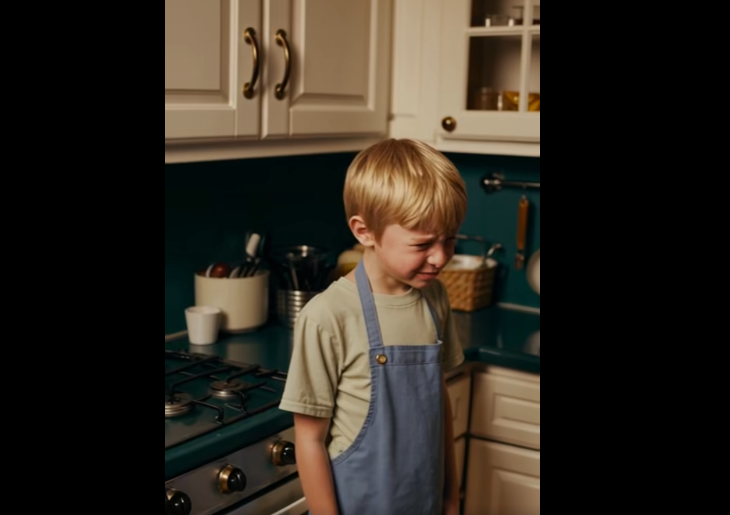
Recently, she visited us for a few days right before my son’s birthday. When I came home from work one day, I found my son distraught and IN TEARS. I asked what happened.
Sobbing, he said, “Dad, just look what grandma did.”
I followed him into the kitchen. The cake he had spent all afternoon working on—layers of delicate sponge, chocolate ganache, strawberries he’d picked himself—was smashed. Completely flattened, as if someone had pressed down on it with both hands. Crumbs and frosting were everywhere, and the mixer bowl was in the sink, half-filled with water like someone had tried to wash away the evidence.
I was stunned. I asked if maybe it had just slipped or fallen. But he shook his head. “She told me it was a waste of time. That I should be outside playing football like a normal boy. Then she pushed the cake pan off the counter.”
My fists clenched. My mom’s old-school views had always rubbed me the wrong way, but this—this crossed a line.
I found her sitting on the couch, flipping through one of her church newsletters like nothing had happened. I asked her directly. She didn’t even deny it. Just sniffed and said, “You spoil that boy. All this baking nonsense—it’s embarrassing. He needs discipline, not sprinkles and sugar.”
My wife wasn’t home yet, and I was thankful for that. She would’ve lost it. I told my mom she had crossed a boundary, and until she apologized to her grandson, I didn’t want to speak to her.
She scoffed and went to her guest room.
That night, my son didn’t want dinner. He stayed in his room, headphones on, sketching cake designs in his little notebook. That notebook was his sanctuary—pages full of scribbled recipes, flavor experiments, doodles of tiered cakes with wild themes. I could tell he was trying to hold it together, but he looked smaller somehow.
The next morning, I made him pancakes. He didn’t touch them.
“Are you gonna bake again?” I asked gently.
He shrugged. “What’s the point if people just ruin it?”
That cut deep.
So I sat beside him and said, “Your baking makes people happy. Even when you’re sad or tired, you still create something beautiful. That’s not weakness. That’s strength. Don’t let anyone take that from you.”
He looked at me for a second, then nodded slowly.
A few days later, he came to me with a plan. He wanted to bake something for the community center bake-off that was coming up next week. It wasn’t a competition—just a fundraiser for local shelters. But the town showed up big every year, and he’d never entered.
“I want to make something grandma can’t ignore,” he said, with just the tiniest spark back in his eyes.
He worked for days on his idea. He was tight-lipped about it, even with me. All I knew was that it involved pistachios, cardamom, and rosewater.
“Going for bold?” I asked.
He grinned. “Going for unforgettable.”
The night before the bake-off, he stayed up until almost midnight. I offered to help, but he waved me off. “I got this, Dad.”
I peeked once—he was brushing syrup over a golden cake, stacking layers with meticulous care. The kitchen smelled like a Persian bakery.
My mom, meanwhile, acted like nothing was happening. She had extended her stay without asking, claiming she “needed to make sure the birthday party wasn’t another baking circus.”
I nearly told her to leave, but my son said, “Let her come. I want her to see.”
The day of the bake-off, the town center was buzzing. Long tables stretched across the hall, filled with cookies, pies, banana breads, and brownie towers. And then, at the very end, stood my son’s cake.
Three layers. Pale green sponge. Creamy filling that shimmered slightly with rose glaze. On top, hand-piped flowers and crushed pistachios. He called it “Persian Spring.”
People started gravitating toward it immediately. It wasn’t just pretty—it was different.
One lady in a flowered hijab took a bite and literally closed her eyes. “My grandmother used to make something like this,” she whispered. “But this is better.”
An older man with a Vietnam veteran hat went back for a second slice, then a third.
My mom stood a few feet away, arms folded.
A volunteer asked who made it. I pointed to my son. Her eyes widened. “He’s the one? It’s incredible. You’ve got real talent, sweetheart.”
My son blushed, but he looked taller.
That night, the organizer called us and said someone had anonymously donated $500 to the fundraiser—with the request that it be noted as “inspired by the boy who made Persian Spring.”
I shared that with my son. He just said, “That’s the best birthday gift ever.”
My mom didn’t say a word until two days later. We were cleaning up after his birthday dinner. No cake—he had made saffron cupcakes with rose frosting instead.
She stood at the kitchen doorway, watching him hum as he washed dishes. Then, almost too quietly, she said, “I was wrong.”
We both turned to look at her.
“I was wrong to say those things. To ruin your cake. I thought I was protecting you, but I see now I was just hurting you.”
He didn’t say anything right away. Just kept rinsing a spoon. Then he said, “You don’t have to like baking. But you don’t get to destroy what I love.”
She nodded. “You’re right.”
Later that night, I found a note on my son’s desk. It just said: “Grandma asked me to teach her how to make frosting tomorrow. She said she wants to bring cupcakes to her church group.”
The next afternoon, the two of them stood side by side at the counter, arguing over how many drops of food coloring made the perfect pink.
That night, after they left to deliver the cupcakes, I got a text from my mom. Just one line: “Your son is stronger than I ever was.”
And I believed her.
That whole week taught me something big. People don’t always change because you fight them. Sometimes they change because of what you build in spite of them.
My son didn’t yell, didn’t give up, didn’t hide. He let his cake do the talking.
So yeah, my boy bakes. And now, even the woman who tried to shame him for it? She brags about him to her church ladies and carries his lemon shortbread in a floral tin.
People can surprise you. Even the ones who break your heart sometimes come back and ask how to make buttercream.