
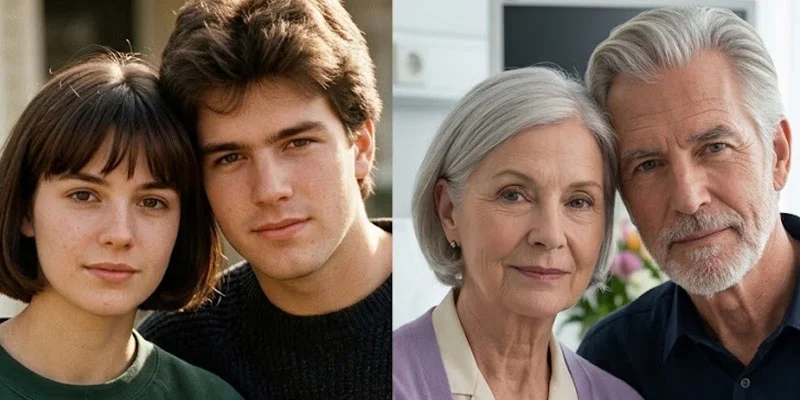
For most of my life, I convinced myself that some people were meant to remain in the past, no matter how badly you once wished they could have stayed in your future.
For most of my life, I told myself that certain people were supposed to stay behind in the past, regardless of how desperately you once wanted them to remain part of your future.
Then, after forty-one years, I heard someone speak my name.
“Ruthie.”
And in that single moment, all forty-one years between us seemed to vanish.
I stood outside a hospital room, one hand resting against the door.
Forty-one years.
That was the amount of time that had passed since I had last seen Jeffrey.
Forty-one years since I had received his final letter.
Forty-one years since he had asked me never to reach out to him again.
Now his son, Peter, stood beside me.
“He keeps asking whether you’ve arrived yet,” Peter said.
I looked at him.
He had Jeffrey’s eyes.
“Is he awake?”
“He’s trying to stay awake until you get here.”
For a moment, I nearly walked away.
I was sixty years old.
I had spent most of my adult life figuring out how to live without Jeffrey.
And less than an hour earlier, I had been sitting by myself in my childhood home when the old landline suddenly rang.
Now I was about to enter a room and face the person I had once believed would remain in my life forever.
I finally pushed the door open.
Jeffrey was lying in the hospital bed.
He was thinner than I remembered.
His hair had turned white, and the passing years had altered nearly every feature on his face.
Yet somehow, there was no mistaking him.
His eyes immediately met mine.
“Ruthie.”
My throat tightened.
Then I saw something resting on the chair beside his bed.
A wooden box.
The instant I recognized it, I forgot how to breathe.
It had belonged to my father.
And I had not seen it since the year he died.
—
Jeffrey and I became best friends when we were seventeen.
We weren’t boyfriend and girlfriend.
We were simply Jeffrey and Ruth.
At least, that was what we always told everyone.
He dated other girls.
I went out with other boys.
I even went to prom with someone else, although Jeffrey ended up taking me there after my date’s car broke down.
Everyone around us thought we were ridiculous.
Our families were certain that eventually we would recognize what they already considered obvious.
My mother, Erica, would often watch us at the kitchen table while we argued over homework.
“One day,” she would tell us, “you two are finally going to understand this.”
Jeffrey would grin.
“Understand what?”
Mom would only smile.
“You know exactly what.”
Then Jeffrey would glance at me, and I would roll my eyes.
“We’re friends, Mom.”
And technically, she was right.
The truth beneath that friendship was something neither of us was courageous enough to confront.
I think we were both more frightened of losing what we already had than we were excited about the possibility of becoming something more.
So we kept everything exactly the way it was.
Until one summer night when we were nineteen.
We had both been on awful dates.
My date had spent almost the whole evening talking about himself.
Jeffrey’s date had gone home early after the two of them argued about some movie.
Later that night, Jeffrey and I met at our old high school football field.
The gates were still open, so we slipped underneath the bleachers and sat down in the grass.
Jeffrey leaned back against one of the metal supports.
“We’re terrible at this.”
I laughed.
“At dating?”
“At choosing people.”
“That might be true.”
He fell silent.
Then he asked,
“What if we never figure it out?”
“We’ll survive.”
“What if we’re both still single when we’re old?”
I looked over at him.
Jeffrey extended his pinky.
“If we’re both single at sixty, we stop being idiots and find each other.”
I stared at his hand.
He wasn’t kidding.
“Jeffrey.”
“I mean it.”
“Why sixty?”
“Because if we still haven’t figured out our lives by then, it’s obvious we need help.”
I laughed and linked my pinky with his.
“Deal.”
“Deal.”
For one unusual second, neither of us moved.
I remember wanting to say something more.
Something that mattered.
But I didn’t.
Two months later, Jeffrey left for college three states away.
—
At first, the distance barely changed anything.
We wrote to each other constantly.
Long letters.
Birthday cards.
Pages filled with ordinary details that somehow seemed important simply because they came from one another.
Jeffrey complained about his roommate, who apparently considered cleaning optional.
I told him about working at the library while studying to become a teacher.
He complained about the cafeteria food.
I complained about people returning library books covered in coffee stains.
During that first year, I probably knew more about Jeffrey’s everyday life than many of the people living in his dorm.
Then, little by little, the letters became less frequent.
Every week became every two weeks.
Every two weeks became once a month.
I assumed college was changing him.
But my own life was changing too.
I was training to become a teacher.
I made new friends.
I went on dates.
Still, whenever something important happened, Jeffrey remained the first person I wanted to tell.
Then, during his second year, he wrote about someone named Margaret.
She was studying nursing.
He said she was funny.
Smart.
Strong-willed.
He even said he thought I would like her.
That was when I finally understood something I should have realized years earlier.
I loved Jeffrey.
I sat on my bedroom floor with his letter in my hands and cried.
Not because he had done anything wrong.
But because I had waited for someone else to appear before finally admitting the truth to myself.
That night, I started writing him a letter.
I filled several pages.
I told him that I loved him.
I told him that I suspected I always had.
Then I tore the whole thing to pieces.
If Jeffrey was happy, I couldn’t bring myself to interfere.
So I remained his friend.
Until the summer of 1986.
That was when his final letter arrived.
I knew something was wrong as soon as I opened it.
Jeffrey normally started every letter with a joke.
This one began simply:
“Ruth,
Margaret and I are getting married. The wedding is in August.”
I sat at the kitchen table, staring at those words.
I continued reading.
He explained that the ceremony would be small and that Margaret’s family was helping them begin their life together.
I told myself I could accept it.
Then I reached the final paragraph.
Jeffrey asked me not to contact him anymore.
He explained that Margaret knew how close we had been and that he wanted to give his marriage the strongest possible beginning.
He said our friendship meant too much to him to allow it to become something that could hurt another person.
At the bottom, he wrote:
“I hope you have a wonderful life, Ruthie.
I’m sorry.
Jeffrey.”
I cried for weeks.
But I respected what he had chosen.
I didn’t write back.
I didn’t call.
I never attempted to see him.
For a while, people we both knew occasionally gave me updates.
Jeffrey and Margaret had a son.
His career was going well.
Eventually, even those little pieces of information stopped reaching me.
I never married.
I dated.
I had relationships.
Some were good.
One nearly became permanent.
Whenever people asked why I had never settled down, I gave them the answer that required the least explanation.
“I just never met the right man.”
That wasn’t completely true.
I had met him when I was seventeen.
Last Tuesday, I turned sixty.
By that point, I was living in my childhood home again.
After my parents died, I kept the house.
I had spent enough years moving from one apartment to another that returning there somehow seemed right.
That evening, I ate dinner alone and cut myself a piece of birthday cake.
At 9:17 p.m., the old landline rang.
Almost no one used that number anymore.
I nearly allowed it to keep ringing.
Instead, I answered.
“Hello?”
A man’s voice said,
“Is this Ruth?”
“Yes.”
“My name is Peter. I’m Jeffrey’s son.”
I sat down immediately.
For several seconds, I couldn’t say anything.
“Jeffrey’s son?”
“Yes.”
My stomach tightened.
“What happened?”
Peter hesitated.
“My father wants to speak with you. He… doesn’t have much time.”
My hand tightened around the receiver.
Before I could answer, I heard movement on the other end.
Then another voice came through.
Weak.
Older.
But instantly recognizable.
“Ruthie.”
Tears filled my eyes.
Then I heard the faintest laugh.
“Jeffrey?”
“You remembered.”
“Of course I remembered.”
Forty-one years disappeared inside a single conversation.
Then Jeffrey’s voice cracked.
“Ruthie, there’s something I need you to know before I die.”
I closed my eyes.
“What?”
“I was in love with you when we made that promise.”
I stopped breathing.
“Jeffrey…”
“And I had already bought the ring.”
My eyes opened.
“What ring?”
“The ring I planned to give you before I left for college.”
The room seemed to move around me.
“Then why didn’t you?”
He began to cry.
“That’s what I’ve spent forty years wishing I could explain.”
His voice became quieter.
“I need you to come here.”
“Jeffrey…”
“Please come to the hospital.”
His breathing sounded strained.
“There’s something you need to see. Once you see it, maybe you’ll finally understand why I walked away.”
I grabbed my coat.
“Where are you?”
—
Forty minutes later, I walked into Jeffrey’s hospital room.
He looked at me and smiled.
“Hey, Ruthie.”
I started crying before I could stop myself.
“Hey, idiot.”
Then I noticed the wooden box beside him.
I recognized it immediately.
It had belonged to my father, Thomas.
When I was growing up, he kept important papers inside it.
After Dad died, I searched everywhere for that box but never found it.
I looked at Jeffrey.
“Why do you have my father’s box?”
“Open it.”
My hands shook as I raised the lid.
Inside were letters.
Dozens of them.
Some had been written by my father.
Underneath them was a small ring box.
I opened it.
Inside was a simple diamond ring.
I stared at Jeffrey.
“You bought this?”
He nodded.
“Why didn’t you give it to me?”
He pointed toward another envelope.
Jeffrey’s name was written across its front.
The handwriting was my father’s.
I unfolded the letter.
My father had written to Jeffrey shortly before he left for college.
He explained that I was likely to be accepted into a teaching program close to home.
That I had an opportunity to create a future of my own.
Then he asked Jeffrey not to make me choose between that future and following him.
Dad believed that if Jeffrey proposed, I would immediately leave with him.
He asked Jeffrey to step aside.
To allow me the chance to become my own person.
I looked up through my tears.
“My father sent this to you?”
“Before I left. He knew about the ring.”
“How?”
“I showed it to him. I went to ask for his blessing.”
I sat down.
“What did he tell you?”
“That we were too young. That you were so loyal to me that you would give up anything if I asked.”
I stared at the stack of letters.
“So you left and eventually built another life.”
“I tried to stay close to you. But eventually, I convinced myself your father was right. I thought staying away was helping you.”
Anger began rising inside me.
“You never asked what I wanted.”
“I know.”
His response was barely audible.
Jeffrey turned his gaze toward the window.
“When your letters began coming less often, I assumed your father had been right. I thought you were moving forward.”
“My letters slowed down because yours did.”
He nodded.
“I know that now.”
Then he stopped for a moment.
“Actually, I knew before I married Margaret.”
I stared at him.
“What do you mean?”
“Your father came to see me.”
“What?”
“He came to tell me he had been wrong.”
My father died the following year after a long illness.
According to Jeffrey, Dad had started regretting what he had done.
He realized that he had interfered in a decision that should have belonged to the two of us.
During that visit, he gave Jeffrey the wooden box.
Inside were old letters my father had written to my mother before they married.
My father had once faced almost exactly the same situation.
My mother’s parent had believed Dad wasn’t right for her.
If my father had listened back then, I would never have existed.
“Why didn’t you come back?” I asked.
Jeffrey looked at me.
“Because by then, I had already promised my life to Margaret.”
He swallowed.
“And I loved her too, Ruth.”
Strangely, hearing that didn’t hurt.
I thought it would.
Instead, I asked,
“What you had with her… it was real?”
“Yes.”
“Then I’m glad.”
He looked surprised.
“I wouldn’t want another woman’s entire marriage to become some mistake simply because you and I were too afraid to say what we wanted when we were nineteen.”
Jeffrey reached for my hand.
“I wrote that final letter because I knew that if we kept talking, there was a chance I would run back to you.”
“And cutting me out completely seemed better?”
“No.”
A sad smile appeared on his face.
“I thought it was the responsible thing to do.”
He sighed.
“I was wrong.”
I held his hand.
“Did Margaret know?”
“Eventually.”
“What did she say?”
Jeffrey smiled.
“She said we were two of the stupidest people she had ever heard of.”
I laughed.
Jeffrey laughed too.
Even Peter smiled.
“She sounds smart,” I said.
“She was.”
Margaret had died several years earlier.
After she died, Jeffrey considered contacting me many times.
But every time, he stopped himself.
“I didn’t know if I had the right anymore.”
“You could have tried.”
“I know.”
I shook my head.
“So we lost more than forty years because everyone kept deciding what was best for everyone else.”
“Pretty much.”
“That might be the dumbest thing I’ve ever heard.”
“Also true.”
We sat silently for a moment.
Then something occurred to me.
“Jeffrey.”
“What?”
“I’m sixty.”
His eyes widened.
Then, slowly, he smiled.
“So you are.”
“We had a deal.”
Jeffrey raised his hand.
His fingers were trembling.
“If we’re both single at sixty…”
I wrapped my pinky around his.
“We stop being idiots and find each other.”
Tears rolled down his face.
“Still single?”
“Yes.”
“Me too.”
My eyes drifted toward the ring.
—
I stayed beside Jeffrey throughout the following day.
We talked for hours.
More than I had thought two people could possibly talk.
He told me about Peter and his daughter, Anna.
I told him about my students and the decades I had spent teaching.
We talked about Margaret.
My mother.
My father.
Even the mistakes every one of us had made.
I was angry with Dad.
Part of me probably always would be.
But at sixty, I could understand something nineteen-year-old Ruth never could.
My father had been afraid for me.
Just as my mother’s father had once been afraid for her.
Dad had made the wrong decision because he believed he was protecting my future.
Jeffrey had done the same thing.
And so had I.
Every one of us had stayed silent because we convinced ourselves that silence would hurt less.
It didn’t.
—
Two days later, Jeffrey was released from the hospital.
Peter arranged for him to stay with family and receive care at home.
No one knows exactly how much time Jeffrey has left.
I have decided that I don’t want to count it.
Yesterday, Peter drove him to my house.
Jeffrey and I sat together on the same porch where we used to work on our homework as teenagers.
He held my hand.
The wooden box rested beside us.
Finally, Jeffrey smiled.
“I never officially asked you.”
He glanced down at the ring box.
“Ruth, would nineteen-year-old you have said yes?”
I thought about the girl I used to be.
Then I looked at the man sitting beside me.
“Yes.”
He smiled.
“And what about sixty-year-old Ruth?”
I squeezed his hand.
“She’s smarter.”
Jeffrey laughed.
“So that’s a no?”
“No.”
I leaned closer.
“It means she understands that we don’t need another forty years to prove something we already know.”
Jeffrey took out the ring.
Then, forty-one years after buying it, he slipped it onto my finger.
It fit.
I looked at him.
He gently rested his head against mine.
For most of my life, I believed our story had ended in 1986.
It hadn’t.
We had simply stopped writing it.
Now Jeffrey calls me every morning.
Peter visits often.
His daughter Anna has already started calling me Aunt Ruth, even though I told her she doesn’t have to.
Jeffrey and I will never get back the decades we lost.
I’ve accepted that.
But I refuse to spend whatever time remains grieving over years neither of us can change.
For most of my life, I believed that meeting the right person at the wrong time meant the opportunity had disappeared forever.
Now I understand that timing isn’t always the end of the story.
Sometimes life opens the same door twice.
You only have to be brave enough to walk through it the second time.