
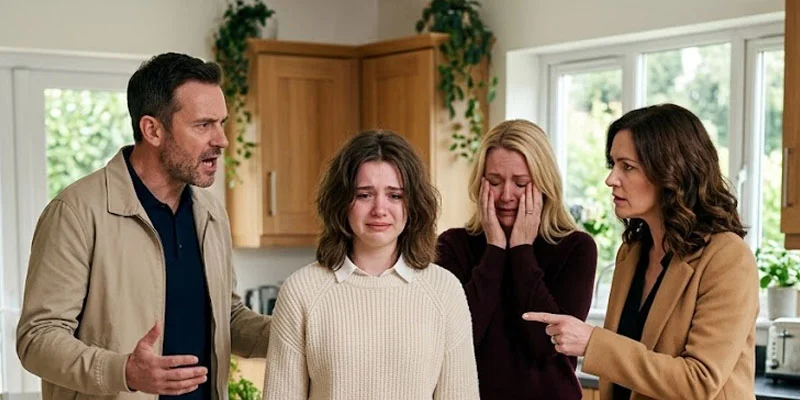
“Mom, Dad, you have to make a choice. Either she leaves this house, or I do.”
My sister, Vanessa, stood in the middle of our parents’ kitchen in Columbus, Ohio, her arms folded firmly across her chest and a determined look on her face.
I was twenty-two, struggling financially after losing my first full-time job, and living in my childhood bedroom while applying for work.
Vanessa was twenty-six, recently engaged, and had moved back home temporarily while she and her fiancé saved enough money to purchase a house.
My mother looked at me first.
At that moment, I knew what was coming.
“Claire,” she said softly, “maybe it would be better if you stayed somewhere else for a while.”
I stared at her. “Are you actually serious?”
Dad wouldn’t meet my eyes.
Vanessa exhaled as if she had just won the argument.
The disagreement had started because of money, but not money that belonged to me. I had discovered that Vanessa had been charging wedding deposits, expensive furniture, and even part of her fiancé’s truck payment to Dad’s credit card.
When I confronted her privately, she simply shrugged and claimed Dad had agreed to help her.
He hadn’t.
I showed my parents the statements.
Vanessa became upset.
Then she accused me of being jealous, unreasonable, and “determined” to interfere with her life.
By dinner, the unauthorized charges had somehow transformed into a family argument about my behavior.
And somehow, I was the person being told to leave.
“What about the credit card?” I asked.
Dad rubbed his forehead. “We’ll handle it.”
“You mean you’ll pay it off.”
“Claire,” Mom said firmly, “don’t make the situation worse.”
Vanessa leaned against the kitchen counter. “She always does this. She can’t stand seeing anybody else happy.”
I went upstairs, packed two suitcases, and came back downstairs forty minutes later.
No one attempted to stop me.
Mom gave me an envelope with sixty dollars inside.
“That’s all?” I asked.
She looked uneasy. “Vanessa needs help with the wedding.”
Those words stayed with me longer than being told to leave.
I spent three nights sleeping in my car. Then, after finding temporary office work, I stayed on a coworker’s couch. I learned to shower at a gym before sunrise. For weeks, I survived mostly on peanut-butter sandwiches.
Every time my phone rang, I hoped it would be my parents finally calling.
They never did.
Three months later, Vanessa married Ryan in a country club ceremony paid for by our parents.
I wasn’t invited.
Within a year, Mom and Dad transferred ownership of their second property—a small rental duplex worth nearly $180,000—to Vanessa and Ryan “to help them begin their life.”
I received nothing.
Eventually, I stopped waiting for them.
Ten years later, on a rainy Tuesday morning in Seattle, my receptionist walked into my office and said, “Claire, there’s a woman here who says she’s your sister.”
I looked up.
Vanessa had found me.
For several seconds, I said nothing.
Through the glass wall of my office, I could see Vanessa sitting in the reception area with both hands wrapped around a paper coffee cup. She looked smaller than I remembered. Her blond hair had darker roots and was tied into a hurried ponytail, and the expensive clothes she had once worn like armor had been replaced by a plain gray sweater and jeans.
“Did she say why she’s here?” I asked.
My receptionist, Maya, shook her head. “Only that it’s a family matter.”
For a moment, I thought about telling Maya to send Vanessa away.
Instead, I said, “Give me five minutes.”
Ten years had changed my life in ways nobody back in Columbus knew about.
That temporary office position eventually turned into an operations job. I attended classes at night, earned a business degree, moved west, and eventually started a logistics consulting company with one client and a borrowed desk.
By thirty-two, I had eighteen employees.
Success had not come quickly.
There had been overdue rent notices, eighty-hour workweeks, a failed partnership, and one year when I came dangerously close to closing the company.
But everything in my office—from the framed copy of my first contract to the chipped ceramic mug sitting beside my computer—represented a life I had built without my family.
When Vanessa walked in, her eyes immediately moved around the room.
“So it really is true,” she said.
“What is?”
“You own this company.”
I gestured toward the chair across from my desk. “Why are you here?”
She sat down carefully, perched near the edge of the chair.
“Dad had a stroke.”
The words affected me more than I expected.
I kept my face composed. “When?”
“Six weeks ago. He’s home again, but he can’t work. Mom is taking care of him.”
“I’m sorry.”
Vanessa lowered her gaze to the coffee cup. “They’re having problems.”
I waited.
“The house has unpaid taxes. There are medical bills. And the duplex is gone.”
That caught my attention. “What do you mean, gone?”
She swallowed. “Ryan borrowed against it.”
Of course he had.
Vanessa explained the situation in pieces. Ryan’s construction company had grown too quickly. He borrowed heavily, used the duplex as collateral, and eventually did the same with their house.
When his company failed, the bank took both properties. He had also built up credit-card debt and owed money to suppliers.
“Where is Ryan now?” I asked.
Her expression tightened. “Nevada.”
“With you?”
“No.”
I understood immediately.
“He left?”
“With someone else.”
For the first time, I felt something other than anger.
It wasn’t exactly sympathy. Maybe it was recognition. Vanessa had once watched me leave our parents’ house with two suitcases after they chose her.
Now she was sitting across from me with nowhere comfortable to hide her pride.
She pulled a folded piece of paper from her purse and slid it toward me.
It was a list of debts.
At the bottom, written in blue ink by hand, was one number: $146,800.
“I need you to loan me money,” she said.
For a moment, I nearly laughed.
Instead, I asked, “Why are you asking me?”
“Because the bank turned me down.”
“That’s not what I meant.”
Her eyes finally met mine.
“Mom said you would help.”
There it was—the same old assumption that my life could still be rearranged whenever Vanessa needed something.
I leaned back in my chair.
“Did Mom ever tell you what happened the night I moved out?”
Vanessa frowned. “We all know what happened.”
“No. You know the version where I was jealous and difficult. I’m asking whether she remembers giving me sixty dollars while you got a wedding and a duplex.”
Her cheeks became red.
“That happened years ago.”
“It did.”
“So now you’re going to make Dad pay for it?”
“I never said that.”
“Then what are you saying?”
I folded the debt sheet and slid it back toward her.
“I’m saying I’m not giving you $146,800.”
Her expression changed immediately.
“Claire—”
“But I am willing to speak directly with Mom and Dad.”
Vanessa stared at me.
“Not through you,” I continued. “And before I contribute even one dollar toward anything, I want every bill, every loan agreement, every property record, and every bank statement from the last three years.”
“Why?”
“Because ten years ago, you gave our parents one version of what happened and pressured them to choose before they checked the facts. I’m not making that mistake again.”
She stood so quickly that the chair scraped against the floor.
“You’re exactly the same.”
I looked at her calmly.
“No, Vanessa. That’s the point. I’m not.”
Vanessa left my office without saying goodbye.
That evening, I called my mother for the first time in almost nine years.
Her voice sounded different. Thinner. More cautious.
“Claire?”
For several moments, neither of us spoke.
Then she began crying.
I remained silent.
I asked about Dad. She told me that the stroke had weakened his left side and affected his speech, although therapy was helping him improve. Medicare covered some of his treatment, she said, but not everything. Their savings were nearly gone.
“Vanessa told me you could lose the house,” I said.
Mom paused.
“We’re behind on the property taxes.”
“How far?”
“Two years.”
“What about the mortgage?”
“There isn’t one.”
That surprised me. My parents had paid off the house years earlier.
“Then why is Vanessa asking for almost one hundred fifty thousand dollars?”
Silence.
“Mom?”
“I honestly don’t know.”
I closed my eyes.
Clearly, Vanessa’s version of events wasn’t the whole story.
I asked Mom to send me copies of every bill related to Dad’s treatment, every tax notice, and every letter they had received from the county. I also asked for all the paperwork available concerning the duplex.
She immediately became cautious.
“Why do you need all of that?”
“Because Vanessa asked me for $146,800.”
My mother gasped.
“She told us she was going to ask you for twenty thousand.”
There it was.
The first contradiction.
During the following week, my parents sent me everything they could locate. I hired an attorney in Ohio and paid an accountant to examine the records. I still sent Vanessa no money.
The figures revealed a much simpler situation than the one she had described in my office.
My parents owed approximately $13,400 in property taxes and penalties. Dad’s remaining medical costs were just under $18,000, and some of those expenses could likely be reduced through hardship programs and structured payment arrangements.
The duplex really had been lost after Ryan’s construction company failed, but Vanessa had signed the loan documents with him.
She had been involved in those financial decisions.
More importantly, the $146,800 amount had very little to do with my parents’ circumstances.
Most of it belonged to Vanessa herself: credit-card debt, a private loan, unpaid legal bills related to her divorce, and money she had borrowed from one of Ryan’s former business partners.
When I confronted her over the phone, she became quiet.
Finally, she said, “I planned to pay you back.”
“With what?”
“I’ll find a job.”
“You don’t have one?”
“I’ve been helping Mom take care of Dad.”
I checked that claim too.
Vanessa had been staying with our parents for less than two weeks.
Before that, she had been living near Las Vegas and working intermittently at a boutique owned by a friend.
“You wanted me to pay your debts,” I said, “and you used Dad’s stroke to make everything seem more urgent.”
“That’s not fair.”
“That’s exactly what happened.”
“You have no idea what I’ve been dealing with.”
I almost responded immediately, but stopped myself.
Then I said, “Actually, I know something about what it feels like to lose your home.”
She ended the call.
Two weeks later, I flew back to Ohio.
I hadn’t seen the house where I grew up in ten years.
The blue shutters had faded. The maple tree Dad planted when Vanessa started kindergarten had grown enormous, with its roots lifting one corner of the driveway. My old bedroom window remained on the second floor, although the curtains were different.
Mom opened the front door.
She looked twenty years older.
She hugged me before I had time to decide whether I wanted her to.
For one second, I stood stiffly, then put my arms around her.
Dad was sitting in a recliner in the living room, noticeably thinner than I remembered, with a cane beside him. When he saw me, his mouth trembled.
“Claire.”
His speech was slower now, but I could still understand him.
I knelt beside his chair.
“Hi, Dad.”
He reached out and held my hand.
“I’m sorry.”
Three simple words.
For ten years, I had imagined hearing that apology in countless different forms.
In some versions, I shouted.
In others, I simply turned around and walked away.
Instead, I looked at him.
“For which part?”
Mom flinched.
Dad lowered his gaze to the floor.
“All of it.”
Vanessa arrived about twenty minutes later.
She stopped immediately when she saw me sitting at the dining-room table with folders spread across it in front of Mom.
“What are you doing here?”
“I came to deal with the actual problem.”
Her eyes moved toward the paperwork.
Mom answered before I could.
“Claire paid the property taxes this morning.”
Vanessa’s expression changed.
I had paid the county directly. I had also arranged for Dad’s remaining medical expenses to be reviewed and created a separate account to cover six months of physical therapy. My parents would not receive cash directly.
Neither would Vanessa.
“That’s all?” Vanessa asked.
Mom stared at her.
“What do you mean, that’s all?”
Vanessa looked directly at me. “You know creditors are still calling me.”
“Yes.”
“And you’re just going to leave me to deal with that?”
The statement was so unexpected that Dad raised his head.
I said, “I’m not leaving you anywhere. You’re thirty-six years old.”
“You have money.”
“That doesn’t make your debt my responsibility.”
“You think you’re better than me because you own some company?”
“No.”
“Yes, you do. You flew here, hired lawyers, demanded financial records—”
“Because you weren’t honest.”
“I was desperate!”
“So was I when you pressured Mom and Dad to make me leave.”
Her face reddened.
“Oh, here we go again.”
“No,” I said. “We’re not discussing the past because I can’t move on. We’re discussing it because you’re repeating the same pattern. You create an emergency, give everyone one version of events, demand an immediate decision, and make people feel that refusing you means they’ll lose you.”
Vanessa turned toward our parents.
“Are you really going to let her talk to me like this?”
Neither answered.
That silence was different.
Vanessa’s eyes widened.
“Mom?”
My mother slowly sat down.
“Claire showed us the records.”
The color drained from Vanessa’s face.
“What records?”
“The loan from Mark Ellis,” Dad said.
Vanessa opened her mouth.
The accountant had uncovered something I had not completely understood at first.
The private loan from Ryan’s former business partner had been taken out after Ryan had already left. Vanessa had claimed the money was intended for legal expenses and basic living costs.
But the bank statements showed that nearly half of it had been spent on online purchases, a deposit for an upscale apartment, and a used BMW.
Mom’s voice shook.
“You told us you were staying on a friend’s couch.”
“I was, at first.”
“You told me you had nothing.”
“I was overwhelmed, Mom. I wasn’t making good decisions.”
“And the car?”
“I needed transportation.”
“You bought a BMW.”
“It wasn’t new.”
Dad closed his eyes.
For years, my parents had treated Vanessa’s bad decisions as evidence that she needed additional support.
Every time they rescued her, it seemed to become another reason to rescue her again.
With me, they had done the opposite. Because I managed to survive after leaving, they convinced themselves that I must have needed less help.
That was how our family had always operated.
Vanessa looked at me.
“So what do you want? An apology? Do you want me to beg?”
“I don’t want anything from you.”
“That’s not true.”
“It is.”
I gathered the folders.
“I came because Dad is sick and because Mom and Dad were at risk of losing their home. I dealt with the tax problem. I’m helping with Dad’s medical care. I also spoke with an estate attorney.”
Vanessa gave a bitter laugh.
“Of course you did.”
Mom looked at her.
“We changed our will.”
The room became completely silent.
Vanessa stared at her.
“What?”
Dad spoke slowly.
“The house will be sold after we’re gone. Half will go to you. Half will go to Claire.”
Vanessa suddenly looked almost like a child.
“But you said the house would be mine.”
“We said many things we shouldn’t have,” Mom replied.
“You already gave her the duplex.”
“It’s gone,” Vanessa said sharply.
“Because you and Ryan borrowed against it,” Dad replied.
His voice was weak, but his words carried weight.
Vanessa looked between our parents, clearly expecting one of them to give in.
Neither did.
Then she turned toward me.
“You caused this.”
“No.”
“You came here and turned them against me.”
“I asked them to examine their own finances.”
“You’ve always wanted revenge.”
I stood.
“If revenge were what I wanted, I would have ignored you when you came to my office, allowed the county to take their house, and never answered another call.”
For once, she had nothing to say.
I stayed in Ohio for four days.
Dad and I talked more during those four days than we had in years.
The conversations weren’t dramatic. There was no perfect explanation for why he and Mom had treated us differently. They had favored Vanessa for years because she was louder, more demanding, and more likely to react emotionally when they refused her. I had always been quieter. They mistook that quietness for strength and used it as justification for giving me less support.
On my last night there, Mom brought me a small cardboard box.
Inside were old photographs, school certificates, birthday cards, and a silver bracelet my grandmother had given me when I was sixteen.
“I kept all of this,” she said.
“I thought you threw it away.”
“I couldn’t.”
I ran my thumb over the bracelet.
Mom sat across from me.
“I should have stopped you from leaving that night.”
“Yes.”
She winced, but I didn’t soften my response.
“I kept thinking you would call,” she said.
“I kept thinking you would.”
That single exchange came closer than anything else to explaining the ten years we had lost.
Before flying back to Seattle, I gave my parents clear conditions for any financial help in the future.
Their house could not be transferred to Vanessa.
Nobody could use it as collateral.
I would pay approved medical or property expenses directly, never through another family member.
And if Vanessa moved back in, she would have to contribute toward groceries and utilities once she found a job.
Mom agreed. Dad agreed.
Vanessa said nothing to me for seven months.
During that time, she filed for bankruptcy.
She sold the BMW.
She rented a small apartment in Dayton and found a job managing a dental office.
It wasn’t the life she had once believed she deserved, but it was the first life she had lived in years that wasn’t being paid for by someone else.
My parents began calling me every Sunday.
At first, those calls felt awkward. Mom explained everything in excessive detail. Dad apologized far too often.
Eventually, I told him that if we were going to rebuild our relationship, it couldn’t revolve around him repeatedly apologizing until I felt responsible for reassuring him.
So instead, we started talking about ordinary things.
His therapy. My company. The Mariners.
The neighbor who always parked slightly too close to their mailbox.
A year after Vanessa first appeared at my office, Dad could walk short distances without his cane.
That Thanksgiving, I flew back to Ohio.
Vanessa was there too.
She had brought a pumpkin pie from the grocery store.
For the first hour, we hardly made eye contact.
After dinner, I went outside to get some fresh air. The backyard seemed much smaller than I remembered from childhood.
Vanessa followed me outside.
She stopped beside the old fence and placed both hands inside the pockets of her coat.
“I hated you,” she said.
I turned toward her.
“When?”
“When you came back.”
“That’s not what I expected you to say.”
She gave a quiet laugh that contained little humor.
“I thought I’d won ten years ago.”
The word hung between us.
“Won what?”
“Everything.”
She looked toward the house.
“Mom and Dad always gave me what I wanted. You left. I got the wedding. The duplex. Help whenever I asked for it. I thought that meant I mattered more.”
I said nothing.
“And then everything collapsed,” she continued. “Ryan left. The properties were gone. I had debts everywhere. And you had built this entire life that I knew nothing about.”
“So you came to me.”
“I thought you would still be the same person.”
“The one who walked away with sixty dollars?”
“The one who would do almost anything to be welcomed back into the family.”
That answer hurt more because, during the first few years, it was probably true.
Vanessa lowered her eyes.
“When you refused, I was angry because you weren’t the person I remembered leaving behind.”
I breathed out slowly.
“Do you regret what happened?”
She remained silent for a long time.
“I regret believing that love was something you could force people to prove by making them choose sides.”
It wasn’t the apology I had once imagined hearing.
But it felt genuine.
Then she added, “And I’m sorry I pushed things until you had to leave.”
I nodded once.
“I believe you mean that now.”
She studied my face.
“That isn’t forgiveness.”
“No.”
“Maybe someday?”
“Maybe.”
I made no promise beyond that.
Then we went back inside.
Nothing became perfect after Thanksgiving.
Real families rarely transform completely because of a single conversation.
Vanessa and I didn’t suddenly become close friends. We sent each other birthday messages. Sometimes we talked about our parents.
Once, when my company needed a recommendation for an administrative position in Ohio, I asked for her opinion because I knew she was good at running an office.
She gave me a thoughtful recommendation and asked for nothing in return.
Two years later, Mom called and told me Vanessa had received a promotion.
I congratulated her.
Three years after Dad’s stroke, my parents decided to sell their Columbus house and move into a smaller condominium near his physical therapy clinic.
With advice from a financial adviser, they placed the remaining proceeds into retirement accounts.
Neither daughter owned their home. Neither daughter controlled their money.
That mattered.
Ten years earlier, my sister had stood in our parents’ kitchen and demanded that they choose between us.
They chose her.
For years, I believed that was the moment I lost my family.
Eventually, I came to see it differently.
That night, I lost the version of my family that expected me to accept less so Vanessa could continue receiving more.
The sixty dollars lasted three days.
What I learned from that experience lasted much longer.
I learned to carefully review contracts before signing them, keep emergency savings, build friendships that weren’t based on blood, and stop confusing being needed with being loved.
Most importantly, when Vanessa entered my office ten years later, I finally possessed something she could not demand from me, borrow against, inherit, or persuade our parents to give away.
A life that belonged completely to me.