
My husband created the garden during the summer of 1997. He never asked whether I wanted one.
One Saturday morning, Roy pulled into the driveway without warning, the back of his truck piled high with fresh soil, trays of red and yellow flowers, gardening equipment, and—judging by the confidence in every movement—a plan he had obviously been considering for quite a while.
I stood on the porch and watched him.
Roy was fifty-three that summer.
He still resembled very much the man I had married at twenty-six, though age had altered the way he carried himself. His movements were more economical now. Every step appeared intentional, as if he knew precisely how much energy each job demanded and had no interest in wasting any of it.
He worked for nearly the entire day.
By six that evening, he finally walked up the porch steps and came to stand beside me.
Together, we looked over what he had made.
From the street, the garden looked almost as though it had formed itself.
Red and yellow flowers flowed naturally into one another, but from my slightly higher position, I could see that every part of the design had been carefully considered.
When the late-afternoon sun landed on the petals, the entire flower bed seemed to shine.
“Roy,” I said.
He looked at me.
“Do you like it?”
“Why red and yellow?”
He smiled.
“Because those are the flowers I always bring you.”
He said it as though there could hardly have been another answer.
That was Roy.
He had a habit of explaining things that seemed obvious with a quiet smile, as though he found it slightly amusing that I needed an explanation in the first place.
It was the same smile I had seen when we first met at a church social in 1968.
Every anniversary, Roy gave me red and yellow flowers.
Every single year.
For forty-one years.
I looked back at the garden.
“This may be the most beautiful thing anyone has ever made for me.”
Roy shrugged.
“It’s just a garden.”
“No,” I said. “It isn’t.”
And despite his words, I knew he understood exactly what I meant.
Roy died in March of 2011.
He was sixty-seven.
Even now, that seems far too young.
Of course, I suppose no age would ever have seemed old enough to lose him.
If he had lived to seventy-five, I would have wanted eighty.
If he had reached eighty, I would have wanted ninety.
There would never have been an age at which losing him felt acceptable.
He was still completely himself when he died.
Still making plans for Saturdays.
Still noticing things that needed to be repaired.
Still wearing that slow, familiar smile.
He suffered a heart attack while working in the garden.
Saturday morning.
Exactly where he had spent countless Saturday mornings before.
The doctors told me it happened quickly.
A long time ago, I decided I would believe them.
After Roy died, I kept the garden as close as possible to the design he had created.
Or at least as close as anyone can keep a living garden.
Gardens change.
Flowers fade and die.
Winter arrives.
Soil has to be replaced.
Plants need to be moved or planted again.
But each spring, I recreated the same design.
Red flowers.
Yellow flowers.
The same sweeping curve Roy had laid out in 1997.
Every year, I spent one afternoon kneeling in the dirt, putting everything back where I remembered it belonging.
And every year, once I stood up, brushed the dirt from my jeans, and looked over the completed garden, I felt as though Roy were close.
Not literally.
I knew better.
But there are certain routines you perform beside someone you love for so many years that, once they are gone, repeating those rituals can make some part of them feel as though they have returned to the room.
Or the yard.
The garden had no great financial value.
The flowers cost perhaps forty or fifty dollars each spring.
Some new soil.
A little fertilizer.
Nothing extravagant.
But what the garden cost in love, memory, and time could never be calculated.
Neither could the value of what it returned to me.
My name is Eleanor Marsh.
Most people around the neighborhood call me Ellie.
Roy began calling me that decades ago, and, like so many things Roy started, the name continued long after he was gone.
I was seventy-one and had lived in that house for twenty-nine years.
I knew almost everyone on the street.
I knew which families had lived there longer than we had.
I knew which houses had changed hands three times.
I knew the people who walked in the mornings, the dogs they took with them, and the children whose lives I had watched progress from bicycles to driver’s licenses.
And I knew the Hauser family.
Dennis Hauser lived three houses away.
He had lived there for roughly twelve years.
Dennis had done quite well for himself.
Commercial property.
Restaurant supply.
Several other businesses I never completely understood.
Whatever his work involved, it had made him wealthy.
He drove an expensive silver sedan and carried himself with the easy confidence of someone who had been financially secure for so long that money no longer required much thought.
Dennis was not a terrible neighbor.
His lawn was always cared for.
His house was quiet.
He waved whenever we passed.
Once, after a storm sent a large branch crashing into my yard, he had his groundskeeper come remove it without me even asking.
Then his son Kyle came home from college.
Kyle was twenty-two.
Within two weeks, I had learned something about the young man.
Dennis had made a mistake in raising him.
Not because he had given Kyle too much.
There is nothing wrong with giving children opportunities.
The problem was that, somewhere along the way, providing things had taken the place of teaching responsibility.
Kyle had grown up with everything he needed and nearly everything he wanted.
Worse, he knew it.
And he appeared to have built much of his personality around the idea that consequences were for everyone else.
He was loud because nobody had ever insisted that he lower his voice.
He was careless because somebody else had always been around to repair whatever he damaged.
And he owned a motorcycle.
A very expensive motorcycle.
He rode it with the confidence of someone who had considerably less experience than he wanted others to think.
The neighborhood put up with him all summer.
Not because anybody liked it.
Because neighborhoods are complicated little social systems.
Sometimes people decide that confronting a problem will cause more trouble than simply tolerating it.
Dennis was wealthy, connected, and fiercely protective of his son.
Mrs. Patterson, who lived on the corner, once went to Dennis’s door after Kyle blocked her driveway late at night.
Dennis apologized politely.
Kyle did it again.
The Nguyen family saw him cut across the edge of their carefully maintained lawn more than once.
Eventually, they stopped complaining.
I watched.
I remembered.
And I kept notes.
Roy used to joke that I had an auditor’s mind.
He meant it affectionately.
I always watched before acting.
I gathered information.
I waited until separate incidents began to reveal a pattern.
By the end of summer, Kyle’s pattern was obvious.
Eventually, he was going to damage something that mattered to someone.
And when it happened, he would shrug.
I simply had no idea that the important thing would be mine.
It happened on a Saturday afternoon toward the end of September.
The garden was still beautiful.
Autumn had begun to change the quality of the light, but the first frost had not yet arrived.
The red and yellow flowers were enjoying their final weeks of brilliant color.
I was making tea when I heard Kyle’s motorcycle.
The engine became louder.
Far too loud.
He was accelerating at a point where he should have been slowing down.
By the time I reached the window, I already knew something was wrong.
Kyle came around the corner too fast.
Rather than making the turn properly, he cut straight across my front lawn.
The rear tire went directly through Roy’s garden.
It took perhaps two seconds.
But I remember every detail.
The tire tearing through the flowers.
Dark earth flying behind it.
Several plants being flattened beneath the wheel.
The curve Roy had designed nearly three decades earlier suddenly interrupted by a muddy track.
I put my tea down.
Then I went outside.
Kyle had stopped in his own driveway.
He was taking off his helmet.
I crossed the damaged portion of my lawn until I reached the property line between our homes.
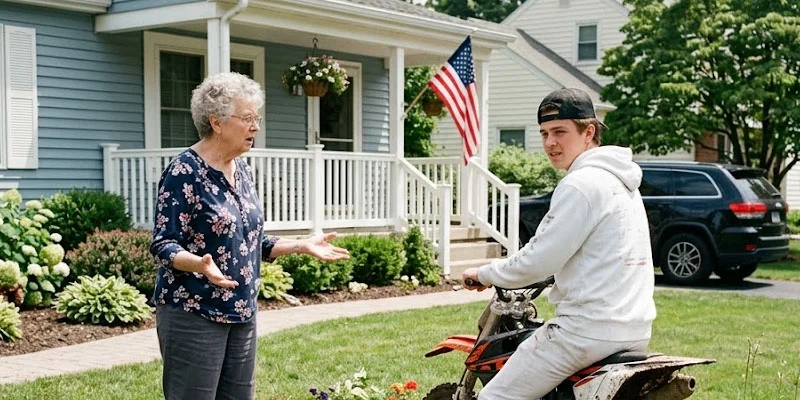
“Those flowers were for my husband,” I told him. “He passed away.”
Kyle looked toward the garden.
He saw the tire mark.
He saw the flowers crushed against the soil.
Then he shrugged.
“It’s just grass and flowers. They’ll grow back.”
There was no anger in his voice.
No intentional cruelty.
That almost made it worse.
Cruelty at least requires someone to recognize that something matters before choosing to hurt it.
Kyle simply had no understanding that anything significant had happened.
He could see flowers.
He could not see the garden.
Not the real garden.
He could not see Roy spending an entire Saturday in 1997 moving soil.
He could not see forty-one anniversaries.
He could not see the Saturday morning in 2011 when my husband never walked back inside.
He saw flowers.
Flowers that could be replaced.
Across the street, my neighbor Janet stood on her porch.
She had seen everything.
Our eyes met for a moment.
Then she quietly went indoors.
Kyle checked his phone.
When he realized I was still standing there, he gave me a small smile that felt more dismissive than friendly.
Then he went inside his house.
I did not yell.
I did not threaten him.
I went back indoors and closed the door.
For several minutes, I stood silently in the kitchen.
I was not trembling.
I was not trying to hold back tears.
I was thinking.
The tire had cut roughly three feet into the flower bed.
Seven or eight plants had either been crushed or pulled completely from the ground.
The pattern Roy had created was damaged along the southern side.
Kyle had admitted that he caused the damage.
He had not apologized.
He had offered nothing.
He had simply told me that the flowers would grow back.
I walked to the small writing desk near the living room.
Then I opened a drawer.
Inside was a folder I had been keeping since June.
Because, as I said, I notice things.
And Kyle had provided me with plenty to notice.
Dates.
Times.
Photographs.
Descriptions.
For four months, I had been recording his behavior.
Not because I was preparing for revenge.
Because by August, I was reasonably certain something would eventually happen that would require more than a conversation across the driveway.
I picked up my phone and called Patricia Delgado.
Patricia was an attorney and junior partner at a local firm that handled property and neighborhood disputes.
A friend had recommended her to me.
According to Agnes, Patricia had a particular gift for making people realize—usually halfway through a meeting—that they had entered a situation far less prepared than they had assumed.
I had retained Patricia in August.
Not to sue Kyle.
Not yet.
I simply wanted someone available who understood the law in case the pattern I had been watching developed into something more serious.
Patricia answered quickly.
“Mrs. Marsh. Has something happened?”
“Yes.”
I told her about the motorcycle.
The lawn.
The garden.
Kyle’s response.
She listened without interrupting.
Then she asked, “Documentation?”
“I have photographs from August showing the garden intact. I’ll photograph the damage from today.”
“Do it immediately,” she said. “Before rain, wind, or anyone else changes the scene.”
“I will.”
“Witnesses?”
“Janet Kowalski. Across the street. She saw everything.”
Patricia paused.
Then she said, “I want to separate two things here.”
I listened.
“The physical damage to the flower bed is straightforward. Replacement plants, repairing the soil and lawn. Financially, it probably won’t amount to much.”
“I understand.”
“But the pattern you’ve been recording may matter much more.”
That was exactly what I had expected her to say.
She asked me to go through everything I had collected since June and identify incidents with definite dates, times, descriptions, or photographs.
“I’ve already done that,” I said.
Patricia gave a soft laugh.
“Of course you have.”
Then her voice became more serious.
“There may also be another approach.”
“What kind?”
“Not every effective response is a lawsuit.”
She explained that people like Kyle often relied on the silence around them.
One neighbor decided that complaining was not worth the trouble.
Then another did the same.
Then another.
Eventually, disruptive behavior became ordinary because every individual person had decided that speaking up would cost more than staying quiet.
“But if several people speak at once,” Patricia said, “the equation changes.”
She had a colleague who worked in community mediation.
That colleague knew people at the local newspaper and at the city council office.
There were ways, Patricia explained, to transform a private nuisance into a documented community concern.
Dennis Hauser was a businessman.
He served on local boards.
His reputation mattered.
A property-damage claim involving a few flowers would mean almost nothing to him.
A public record showing repeated neighborhood complaints could mean considerably more.
“I understand,” I said.
“Let me make some calls.”
I thanked her.
Before ending the call, Patricia paused.
“Mrs. Marsh?”
“Yes?”
“The flowers. I’m sorry.”
She understood what they represented.
“Thank you, Patricia.”
Then I went outside with my camera.
I photographed everything.
Wide shots.
Close-ups.
The tire track.
The crushed plants.
The broken curve in the flower arrangement.
Then I compared those photographs with pictures I had taken earlier that summer.
Afterward, I added everything to the folder on my computer.
June 15.
Kyle’s motorcycle at the edge of the Nguyens’ lawn.
June 22.
Kyle’s motorcycle blocking Mrs. Patterson’s driveway shortly before eleven at night.
July 8.
Kyle revving the engine in the street shortly before midnight.
There were more.
July.
August.
September.
Times.
Dates.
Descriptions.
Photographs whenever I could get them.
The file was extensive.
Roy would have called it excessive.
Then he would have smiled because he would have understood perfectly why I had done it.
Patricia called the next morning at eight.
She had already spoken with several people.
“There are city ordinances concerning excessive residential noise and interference with property,” she told me. “Your documentation appears to show repeated violations.”
The city council member’s office was willing to accept a formal complaint.
The community section of the local newspaper had also been examining neighborhood quality-of-life concerns.
My street could serve as a useful local example.
“It doesn’t have to become a story specifically about Kyle,” Patricia explained. “The broader pattern may be more significant.”
Then she mentioned Dennis.
“He sits on the chamber of commerce board. He has business connections throughout the city. Public records have a way of getting people’s attention.”
There was something else.
Patricia had investigated Kyle’s motorcycle permit.
Apparently, an incident when he was eighteen had resulted in specific conditions being attached to his riding privileges.
Certain conduct in residential neighborhoods could potentially violate those conditions.
“That part belongs to the traffic division,” she said.
Then, after a pause:
“I know someone there.”
“Patricia.”
“Yes?”
“You’ve been busy.”
“You paid me a retainer, Mrs. Marsh. I prefer my clients to get something for their money.”
I almost smiled.
“What do you need from me?”
She needed my signature on the formal complaint.
She also wanted to send a notice to my property.
Nothing threatening.
Nothing dramatic.
Simply a legal notice explaining that recent incidents involving the property were being formally documented and that any future damage would be added to the existing record.
“In other words,” she said, “something Kyle will see when he walks outside.”
“I understand.”
The notice arrived shortly after nine.
A young employee from Patricia’s office placed it beside my front walkway.
The wording was straightforward.
The property was under active legal review because of recent incidents.
Further damage to landscaping or other property would be documented and could lead to formal claims.
Legal counsel had been retained.
Everything written on the sign was true.
I went back into the kitchen and made tea.
At 10:15, Kyle came outside.
He was wearing his motorcycle jacket.
He headed toward the driveway while looking at his phone.
Then he stopped.
He had noticed the sign.
He read it.
Then he read it again.
Finally, he looked straight toward my house.
His expression was not remorse.
Not yet.
It was surprise.
The expression of someone who had assumed an event would vanish the moment it ended and had suddenly discovered that it had not.
Kyle had expected silence.
He had received it from the neighborhood throughout the summer.
But this time, the silence had been broken.
I sat at the kitchen table where he could not see me.
I watched him go back inside.
Twenty minutes later, Dennis came outside.
He read the notice as well.
He stared toward my house for longer than Kyle had.
Then he went inside.
Forty minutes later, he knocked on my door.
“Mrs. Marsh.”
“Dennis.”
“I’d like to discuss the notice.”
“Of course.”
He stood carefully, keeping his hands visible at his sides.
It was the posture of someone making a determined effort not to appear confrontational.
“I understand there was an incident yesterday.”
“Yes.”
“Kyle told me this morning.”
“Did he?”
Dennis nodded.
“He understands that what he did was inappropriate.”
I noticed the wording.
Not wrong.
Not disrespectful.
Inappropriate.
Carefully selected language from a man accustomed to resolving problems without admitting more than necessary.
“I’d like to make it right,” he continued.
“The flowers. Whatever they cost, I’ll pay for them.”
“Yes,” I said.
“You will.”
Dennis blinked.
“I just said I would.”
“I know.”
I waited.
“Dennis, the flowers are the smallest part of what needs to be addressed.”
His expression shifted slightly.
“I don’t understand.”
“Have you heard from the city council member’s office yet?”
That caught his attention.
“No.”
“You probably will.”
I told him about the formal complaint.
Then I told him Patricia was contacting the traffic division about Kyle’s existing permit conditions.
Dennis became very still.
“There are permit conditions?”
“There was an incident when he was eighteen. You should probably discuss the details with your lawyer.”
“Mrs. Marsh, I’m sure we can resolve this without involving—”
“I know you believe that.”
Then I told him what I had observed throughout the summer.
Mrs. Patterson’s driveway.
The Nguyens’ lawn.
The late-night engine noise.
The other incidents.
“I have photographs,” I said.
Dennis looked at me.
“Photographs?”
“Since June.”
For the first time since he arrived, he had no answer.
“The garden was planted by my husband,” I continued.
“I heard that. I’m sorry for your loss.”
“He planted it in 1997. I’ve maintained it since he died.”
Dennis listened.
“Yesterday, your son rode a motorcycle through it and told me the flowers would grow back.”
I paused.
“And he’s right.”
Dennis looked confused.
“They will grow back,” I said. “I’ll plant new ones next spring.”
“But the complaints will continue.”
“The city will review the ordinance violations.”
“The traffic division will review the permit conditions.”
“The council member will walk through the neighborhood.”
“And the newspaper reporter will write whatever article she decides to write.”
I watched his face.
“Those things are no longer dependent on this conversation.”
Dennis finally asked the question I had been expecting.
“What do you want?”
“Kyle.”
His eyebrows rose.
“I want Kyle to come to my door.”
“I’ll send him over.”
“No.”
Dennis frowned.
“Then when?”
“When he’s ready to mean it.”
He looked at me as though I had asked for something unreasonable.
“You have a lawyer, the city council, possibly a newspaper involved, and what you really want is an apology?”
“A genuine one.”
“Not something you make him say.”
Dennis fell silent.
“What makes you think he’ll ever give you one?”
“I don’t know if he will.”
That was the truth.
“But nothing you can offer me matters as much as him understanding what he did.”
Dennis looked toward the damaged garden.
“And the flowers?”
“I’ll plant them again.”
“It won’t be exactly the same.”
“No.”
I looked toward the yard.
“But it will still be the garden.”
“And Kyle?”
“That part belongs to him.”
Dennis stood quietly for several seconds.
Then something in his expression softened.
“Mrs. Marsh, I owe you an apology too.”
This time, his voice sounded different.
Less rehearsed.
“I knew about the noise,” he said.
“And the blocked driveways.”
“I kept telling myself he was home for the summer and would eventually settle down.”
He looked uncomfortable.
“That was easier than dealing with him.”
Then he said, “I’m sorry.”
I nodded.
“Thank you.”
Dennis went back home.
Three days later, the city council member arrived with a member of her staff.
They walked through the neighborhood.
At first, it was only me.
Then Janet came outside.
Then the Nguyens.
Then Mrs. Patterson.
Soon seven more neighbors were gathered along the street.
One by one, they described the same problems.
Noise.
Blocked driveways.
Damaged edges of lawns.
Motorcycles where motorcycles should not have been.
But underneath all those complaints was something else.
They had remained silent because each person believed that speaking alone would cause more trouble than it solved.
The council member listened.
She asked questions.
Then she looked through my records.
“This is extremely thorough.”
“I started in June.”
“Why June?”
“Because that was when I realized a pattern was developing.”
“And you waited?”
“I waited until something happened that shouldn’t simply be absorbed.”
Her eyes moved toward my flower bed.
“The garden.”
“Yes.”
Two weeks later, the newspaper article appeared.
It was not a scandal story.
Kyle was not named.
Neither was Dennis.
Instead, the reporter wrote about neighborhood quality of life.
About the way repeated small actions from one household could gradually affect an entire block.
About why residents often stayed silent.
About how documentation and civic participation could sometimes achieve what individual complaints could not.
My name appeared.
So did the garden.
And so did Roy.
That mattered more to me than anything else in the article.
Dennis called after reading it.
“I saw the article.”
“Yes.”
“It was accurate.”
“Yes.”
He paused.
“Kyle wants to speak with you.”
I said nothing.
“I didn’t tell him to,” Dennis continued. “He came to me after reading the article.”
“When?”
“Whenever you’re willing.”
“Saturday morning.”
Kyle came that Saturday.
No motorcycle jacket.
No helmet tucked beneath his arm.
Just jeans and an ordinary shirt.
Without the things he usually used to make his presence known, he looked younger than twenty-two.
“Mrs. Marsh.”
“Kyle.”
“Can I come inside?”
“Yes.”
We sat at the kitchen table.
He looked uncomfortable.
Good apologies often begin that way.
“I read the newspaper article.”
“I know.”
“I didn’t understand…”
He stopped.
Then started again.
“I didn’t understand everything.”
I waited.
“I read about your husband.”
His eyes moved toward the front window.
“And the garden.”
“And what I said.”
“Yes.”
He swallowed.
“I came to apologize.”
Then he quickly added:
“Not because my dad told me to.”
I believed him.
“I said something stupid.”
He stared down at his hands.
“I didn’t look.”
I waited.
“I mean, I looked at the garden. But I didn’t really look at what it was.”
He raised his eyes.
“I saw flowers and grass.”
“And you saw something else.”
“Yes.”
He nodded slowly.
“I keep thinking about what it would feel like if someone destroyed something important to my dad and then treated it as though it meant nothing.”
His voice had become quieter.
“And I think I’ve been doing that a lot.”
“With the garden?”
“With everything.”
He looked down again.
“I’ve treated things like they don’t matter simply because they don’t matter to me.”
He took a breath.
“And nothing I did ever really had consequences.”
“Until now.”
“Yes.”
That was the first moment I believed he might truly have learned something.
I asked him a question.
“Why did you come here?”
“Because of what the article said.”
“About Roy?”
He nodded.
“And because of what I said afterward.”
His face tightened slightly.
“I told you the flowers would grow back.”
“Yes.”
“And now I keep thinking about what that actually meant.”
He searched for the right words.
“Like if something can be replaced, then it doesn’t matter.”
“Like I only have to care about what something costs instead of what it means.”
He paused.
“And I think maybe I’ve done that with people too.”
Not just gardens.
I looked at him.
There was nothing polished about his apology.
No speech written by Dennis.
No lawyer’s wording.
Kyle had reached that realization on his own.
“Yes,” I said.
“I think you have.”
He nodded.
Then he told me he would pay to have the damaged lawn professionally repaired.
Not his father.
Him.
A landscaper would properly restore the soil before winter.
Then he hesitated.
“And next spring…”
“Yes?”
“When you plant the flowers again…”
He rubbed his hands together.
“If you’d let me help, I’d like to.”
I studied him.
Two weeks earlier, this young man had driven through Roy’s garden and shrugged.
Now he was sitting at my kitchen table asking permission to help restore it.
“Yes,” I said.
“You can help.”
He nodded.
“Thank you.”
Neither of us spoke for several seconds.
Then Kyle surprised me.
“Mrs. Marsh?”
“Yes?”
“What was your husband like?”
I had not expected that question.
I thought for a moment.
“Roy was the kind of man who would come home one Saturday with an entire truckload of topsoil without telling me what he intended to do with it.”
Kyle almost smiled.
“He didn’t tell you about the garden?”
“No.”
“Why?”
“He wanted me to see it once he was finished.”
Kyle thought about that.
“That sounds like someone who knew what mattered.”
“Yes.”
“He knew what mattered to you.”
“Yes.”
Another silence.
Then Kyle said something I still remember.
“I’d like to become someone who knows what matters to other people.”
He gave a small, embarrassed laugh.
“I don’t think I’m that person yet.”
“You’re twenty-two.”
“That sounds like an excuse.”
“It isn’t.”
I shook my head.
“It’s simply a fact.”
“You have time.”
“What you do with that time is your responsibility.”
He nodded.
Eventually, he stood.
“Next spring?”
“Saturday morning.”
He smiled slightly.
“I’ll be here.”
“Bring gloves.”
“Yes, ma’am.”
Then he left.
I remained at the kitchen table after the door closed.
Outside, the garden had already settled into its winter state.
The flowers were gone.
The soil was dark and still.
Waiting.
Roy planted that garden in the summer of 1997.
He spent an entire Saturday making sure everything was exactly where he wanted it.
He chose red and yellow because those were the colors he had given me on every anniversary.
He never asked whether I wanted a garden.
He simply knew.
I maintained it for twenty-nine years.
And I intended to keep maintaining it for however many years remained to me.
The following spring, a twenty-two-year-old young man would kneel beside me wearing borrowed gardening gloves.
Together, we would place red and yellow flowers into the pattern Roy had created decades earlier.
Kyle would not understand everything the garden represented.
Not completely.
Perhaps no one except me ever could.
But he would understand more than he had before.
And perhaps that would be enough.
Understanding rarely comes all at once.
We collect pieces of it throughout our lives.
We plant things.
We look after them.
We watch them grow.
Sometimes they are damaged.
Sometimes we have to start over.
And eventually, if we pay attention, their meaning becomes easier to understand.
Roy had known that long before I did.
Maybe that was why he planted the garden in the first place.
The garden Kyle said would grow back.
The garden that did grow back.
The garden that, in every way that mattered, had never truly gone away.