
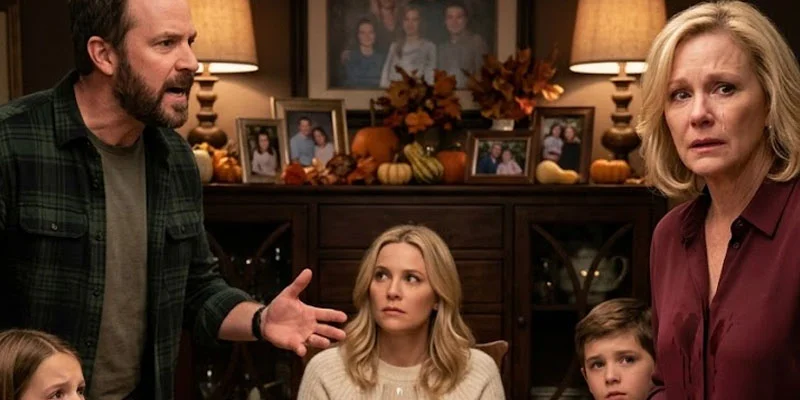
I Stood Frozen as Gravy Streaked Down My Favorite Blue Blouse
I stood completely still as gravy soaked into my favorite blue blouse—the one I had carefully ironed that very morning.
Stuart’s cruel words seemed to remain suspended in the sudden silence around the Thanksgiving table.
My hands trembled as I tried to clean myself with a napkin that was far too small to deal with the mess.
My name is Inz Morrison. I am 65 years old, a retired elementary school teacher who spent 35 years teaching children, a widow for five years, and, according to my own son, apparently a useless old woman.
Until that moment, Thanksgiving dinner had been wonderful.
I had spent three full days preparing the meal.
I baked pumpkin and pecan pies from scratch, rolled the dough for my famous cranberry tarts by hand, and roasted a twenty-pound turkey until its skin was perfectly golden.
The dining table was decorated with my late mother’s china and crystal glasses—the ones I saved for special occasions.
Stuart had been drinking since he arrived with Jennifer, his wife of fifteen years. I had noticed his slightly unsteady movements and unusually loud laughter, but I chose not to say anything.
I had stopped commenting on his drinking years ago.
Especially after Christmas five years earlier, when he told me to stop nagging him.
Halfway through dinner, Stuart suddenly looked at me.
“Mom, when are you planning to sell this ridiculous house?”
I looked up.
“It’s much too big for one person,” he continued.
“I’m not planning to sell it,” I answered quietly while passing the mashed potatoes to my granddaughter, Lily. “This is my home.”
Jennifer joined the conversation almost immediately.
Her voice was pleasant, but there was something cold in her expression.
“It’s really not practical, Inz. Think about the maintenance and property taxes. At your age, you should probably be thinking about downsizing.”
“At my age?” I repeated.
I felt a familiar tightness in my chest.
“I’m sixty-five, Jennifer. Not ninety-five.”
Stuart gave a short laugh.
“You can barely take care of yourself. Last week you couldn’t even remember where you left your glasses.”
“They were on top of my head,” I admitted with a small laugh, hoping to ease the tension. “That can happen to anyone.”
“Not to everyone,” Jennifer replied. “Mostly to people who should start considering assisted living.”
My appetite disappeared.
I slowly placed my fork on the table.
“I’m not going to a nursing home. I’m perfectly capable of living independently.”
“For now,” Stuart muttered.
Then he leaned back in his chair.
“But we need to be realistic. Dad left you this house, but he didn’t leave you enough money to maintain it forever. Your teacher’s pension isn’t going to cover everything indefinitely.”
That statement wasn’t true.
Robert had left me financially secure.
There were investments Stuart knew nothing about, and I had intentionally kept those details private.
I rarely discussed money with him anymore because it seemed to be the one subject he genuinely cared about.
Instead of arguing, I tried to change the subject.
“I was thinking maybe we could all go see the Christmas lights in the park next weekend. They’re putting together a special display this year.”
“Christmas lights?”
Stuart laughed.
“Mom, are you even listening to us? We’re talking about your future. Our future. This house is the only real asset you have.”
“My future isn’t something we’re going to debate over Thanksgiving dinner,” I said firmly.
Then I smiled and reached for the cranberry sauce.
“Now, who wants some more?”
That was when everything changed.
Stuart’s face became bright red.
He stood so abruptly that his chair slammed backward.
Before I could understand what he was doing, he grabbed the platter holding the remaining turkey.
Then he threw it at me.
“Go back to the nursing home, you useless old woman!” he shouted.
His words were slightly slurred.
“You’re nothing but a burden to everyone!”
The platter struck my chest.
Gravy, stuffing, and pieces of turkey covered my blouse and spilled into my lap.
The china platter crashed onto the floor but, incredibly, didn’t break.
Silence filled the room.
Lily and Max stared at me with wide eyes, their forks frozen in their hands.
Jennifer didn’t look horrified.
She looked almost amused.
One corner of her mouth lifted.
Nobody came to help me.
Nobody told Stuart that what he had done was wrong.
I slowly stood, clutching the tiny napkin in my trembling hand.
“Excuse me,” I whispered.
My voice was barely audible.
“I need to change.”
As I walked toward my bedroom, Jennifer spoke behind me.
“See? She can’t even handle a simple family discussion without falling apart.”
Inside my bedroom, I took off the ruined blouse and sat on the edge of the bed.
I expected to cry.
But I couldn’t.
The tears simply refused to come.
Instead, an unexpected calm settled over me.
I changed into a clean sweater, washed my face, and returned downstairs.
Everyone had gone back to eating as though nothing had happened.
Stuart had poured himself another glass of wine.
Jennifer was looking at her phone beneath the table.
Only Lily and Max seemed uncomfortable. They avoided looking directly at me.
I quietly took my seat.
Then I picked up my fork.
“Who wants dessert?” I asked.
I smiled, although the smile never reached my eyes.
That night, after everyone had gone home, I stood alone in the kitchen surrounded by dirty dishes and leftovers.
The house felt emptier than it had during the entire five years since Robert’s death.
I picked up an old framed photograph of Stuart as a little boy.
In the picture, he was smiling with missing front teeth while I held him in my arms.
“What happened to you?” I whispered.
“When did you start looking at me as nothing more than a house and a bank account?”
The photograph gave me no answer.
But I knew something had changed inside me.
Something had finally broken.
Years of polite smiles, excuses, and pretending could no longer repair it.
For the first time, a cold determination settled over me.
I would never allow anyone to humiliate me like that again.
Not my son.
Not anyone.
A week passed after the Thanksgiving disaster, but I still couldn’t stop replaying that evening in my mind.
I remembered the gravy running down my blouse.
I remembered Stuart’s voice.
I remembered everyone sitting there in silence.
I barely slept.
I hardly ate.
The betrayal hurt much more deeply than I wanted to admit.
Then, one Tuesday afternoon, I was dusting the shelves in my living room when the front door opened.
I wasn’t expecting anyone.
Then I remembered that Stuart still had the emergency key I had given him years earlier.
My body immediately tensed.
I wasn’t ready to see him.
Instead of entering the living room, I heard voices in the foyer.
Stuart and Jennifer were whispering.
“I don’t think she’s home,” Jennifer said.
“Her car isn’t here.”
My car was actually at the mechanic for routine maintenance. A neighbor had dropped me home after lunch.
“Good,” Stuart replied.
“I need to check something in Dad’s old office anyway.”
I froze.
They walked toward Robert’s study.
I moved quietly behind the wall separating the living room from the hallway.
Robert’s study had remained almost unchanged since his death.
It was my sanctuary.
His books were still there, along with the faint scent of pipe tobacco that somehow seemed to linger in the room.
I moved closer, careful not to make a sound.
Their voices became clearer.
“The sooner we get her into Cedar Grove, the better,” Jennifer said.
“My cousin says there’s an opening next month in their assisted-living wing.”
Cedar Grove.
The expensive retirement community outside town.
I had driven past it many times.
I had never once imagined living there.
“Mom won’t agree to it,” Stuart answered.
“You saw how she reacted at Thanksgiving.”
Jennifer laughed softly.
“Well, your little turkey tantrum didn’t exactly make things easier.”
“I lost my temper,” Stuart said defensively.
“But you have to admit she’s getting worse. The forgetfulness. The stubbornness.”
“We only need to document the incidents,” Jennifer replied.
Her calm, practical tone made my stomach turn.
“Dr. Campbell is willing to evaluate her. Once we establish diminished capacity, the power of attorney takes effect.”
I pressed my hand against the wall.
Power of attorney.
After Robert died, I had signed documents naming Stuart as my agent if I ever became incapacitated.
But I was not incapacitated.
Not even close.
“The house should sell quickly,” Stuart continued.
“The market in this neighborhood is hot. We could probably get seven hundred thousand, maybe more.”
“And after paying the Cedar Grove entrance fee and setting aside enough for her monthly care, the rest is ours,” Jennifer said.
She sounded almost pleased.
“We could finally renovate the kitchen and take that European vacation.”
My knees felt weak.
They weren’t trying to help me.
They were planning how to use my house to pay for their own lives.
“What about her pension?” Jennifer asked.
“It’s decent for a teacher,” Stuart answered. “Around four thousand a month. It won’t be enough to maintain this place, but it’s more than enough for her basic needs at Cedar Grove. Whatever is left can go toward Max’s college fund.”
I bit my lip to keep myself from making a sound.
They had planned my entire future without asking me.
A small room at Cedar Grove.
The sale of my home.
My money paying for their kitchen and vacation.
Then Jennifer said something that made my blood run cold.
“We should start moving the valuable things out gradually. The silver. The antiques. She probably won’t even notice.”
“Next week,” Stuart agreed.
“I’ll tell her I’m taking them to be appraised for insurance.”
I had heard enough.
I quietly backed away and returned to the kitchen.
My hands shook as I filled the kettle.
Twenty minutes later, I heard them preparing to leave.
I turned on the radio.
I wanted them to know I was home.
Stuart appeared in the doorway and looked startled.
“Mom. I didn’t know you were home. Where’s your car?”
“At the shop,” I replied calmly.
“Jane dropped me off after lunch.”
For a moment, he looked uncomfortable.
“We just stopped by to see if you needed anything.”
“How thoughtful,” I said, meeting his eyes.
“I’m fine, thank you.”
After they left, I sat at the kitchen table until my tea became cold.
The betrayal felt almost physical.
My own son was planning to have me declared incompetent, sell my home, and put me into a retirement community.
That evening, I walked into Robert’s study.
I opened his desk drawer.
Behind several old folders was the small fireproof box where we kept important documents.
I unlocked it with shaking hands.
Inside were things Stuart knew nothing about.
Robert had understood finances far better than our son realized.
There were investment accounts, stock certificates, and insurance policies.
During our marriage, I had trusted Robert to manage most of those matters.
After his death, I had simply continued maintaining them.
Now I spread the papers across his desk and started calculating.
My teacher’s pension was indeed around four thousand dollars a month.
But Robert’s investments had grown considerably.
When I added everything together, I had nearly one million dollars in assets, not counting the house.
I wasn’t a helpless old woman depending on her son.
I was financially independent.
The next morning, I called my bank and arranged a meeting with my financial adviser.
Then I contacted Martha Reynolds, a realtor I had known for years because I had once taught her children.
“Inz!” Martha exclaimed when I walked into her office.
“What a wonderful surprise. How can I help you?”
I took a deep breath.
“I want to sell my house.”
Martha stared at me.
“Your Victorian?”
“Yes.”
“But you’ve lived there for decades.”
“It’s time for a change.”
Then I lowered my voice.
“And Martha, I need complete discretion. I don’t want my son to know until everything is finalized.”
She looked confused but nodded.
“Of course. It’s your house. We can begin with a private listing and keep the publicity to a minimum.”
When I walked out of her office, I felt something I hadn’t experienced in years.
Power.
For too long, I had allowed Stuart to control our relationship.
I had tolerated the disrespect from him and Jennifer.
I had made excuses for them.
That was over.
They believed I was weak.
They thought they could manipulate me.
They were about to discover that they were wrong.
For the next week, I lived two separate lives.
On the surface, everything appeared normal.
I went grocery shopping.
I attended book club.
I answered Stuart’s calls politely.
But behind the scenes, I was preparing for a completely different future.
Martha quietly listed the house.
Three days later, she called.
“Inz, you’re not going to believe this. I found a couple, the Hendersons. They’ve been searching for a historic Victorian in this neighborhood for months.”
She continued.
“They saw your house and fell in love with it. They’re offering full asking price, cash, and they’re flexible about the closing date.”
I tightened my grip around the phone.
“That’s wonderful, Martha.”
“They want to see it again tomorrow.”
She paused.
“And they don’t want to change anything. They love the original woodwork, the stained glass, everything.”
My eyes filled with tears.
Robert had spent years restoring those details.
He had stripped old paint from the banisters and repaired damaged stained glass.
Knowing that someone else would appreciate the house made leaving a little easier.
“Tomorrow afternoon works,” I told her.
“Stuart never visits on Wednesdays.”
After the call, I sat at the kitchen table with my tea.
I knew I needed somewhere Stuart would never think to look.
I opened my address book.
Under the letter R was the name Rose Tillman.
Rose had been my college roommate.
She now lived in a retirement community in Florida.
We had stayed in touch over the years through Christmas cards and occasional phone calls.
I hadn’t seen her since Robert’s funeral.
But several months earlier, she had mentioned that she had a spare bedroom.
I picked up the phone.
“Rose, it’s Inz Morrison.”
“Inz! What a wonderful surprise. How are you?”
I hesitated.
“I think I need a change, Rose. I remember you telling me about the spare room.”
“Say no more,” she replied warmly.
“The room is yours for as long as you want it. Sunshine Village is wonderful. You’ll fit right in.”
“When can I come?”
“How about three weeks from now? I have some things to take care of first.”
After hanging up, I made a list.
Movers.
Donations.
Mail forwarding.
A P.O. box.
Banking arrangements.
And my will.
The house Stuart and Jennifer wanted so desperately would soon be gone.
And they would not receive the proceeds.
The following day, the Hendersons came back.
They were a pleasant couple in their forties with two teenage children.
They walked through every room carefully, asking questions about the history of the house.
I watched them admire the craftsmanship.
It made me feel certain I was making the right decision.
“We can close in two weeks,” Mr. Henderson said.
“Our lease ends at the end of the month, and we’d really like to move in.”
“Two weeks is perfect,” I replied.
That evening, Stuart called.
“Mom, Jennifer and I are coming over Sunday. There’s something important we need to discuss.”
I already knew what it would be.
Cedar Grove.
Brochures.
Pressure.
And probably another speech about why I was supposedly incapable of living alone.
“That sounds lovely,” I said.
“I’ll make your favorite pot roast.”
“Great. And Mom, don’t mention it to the kids yet. It’s more of an adult conversation.”
Of course.
They didn’t want Lily and Max watching them pressure me into giving up my independence.
After the call, I scheduled the movers.
I arranged for most of my furniture to be donated to a local women’s shelter.
I also scheduled the closing of my local bank accounts.
Every step made the plan more real.
Sometimes, doubts crept in.
Was I being unfair to Stuart?
Was I overreacting?
Then I remembered the turkey.
I remembered the gravy on my blouse.
I remembered everyone watching while my son humiliated me.
And I remembered the conversation I had overheard in Robert’s study.
No.
I wasn’t overreacting.
For once, I was protecting myself.
Sunday arrived.
Stuart and Jennifer came carrying a bottle of wine and wearing forced smiles.
I served the pot roast I had promised.
We made small talk about the weather and Jennifer’s garden club.
After dessert, Stuart cleared his throat.
“Mom, we’ve been worried about you living alone in this huge house.”
I continued eating calmly.
Jennifer reached into her purse.
“We’ve been researching some options.”
She placed a glossy brochure on the table.
“There’s a wonderful place called Cedar Grove. And it’s not a nursing home,” she quickly added.
“It’s a luxury retirement community with different levels of care.”
I picked up the brochure.
Smiling seniors were pictured playing golf and relaxing in an elegant lounge.
“They have an opening next month,” Stuart said.
“We already put down a refundable deposit to hold it for you.”
I pretended to study the brochure.
“That was thoughtful.”
“It makes financial sense,” Stuart continued.
“This house is worth a lot, but it costs a fortune to maintain. At Cedar Grove, everything would be taken care of.”
“And you’d have people around you,” Jennifer added.
“People your age.”
I nodded.
“And what would happen to the house?”
They exchanged a quick glance.
“We’d help you sell it,” Stuart said smoothly.
“The proceeds would pay for Cedar Grove and leave you with a nice nest egg.”
“I see.”
I smiled.
“I appreciate you thinking about me. Let me consider it.”
They looked surprised.
Then pleased.
As they left, Stuart placed a hand on my shoulder.
“You’re making the right decision, Mom. You’ll be happier there.”
I smiled until their car disappeared down the road.
They had no idea that in ten days the Hendersons would own this house.
And I would be heading toward Florida.
The next two weeks passed in a blur.
Every day, I prepared quietly.
Before sunrise, I spent an hour sorting through decades of belongings.
I was amazed by how little I truly needed.
My wedding china would eventually go to Lily.
It would not become part of Stuart and Jennifer’s kitchen renovation.
I arranged storage through a trusted book-club friend.
Closing was scheduled for Thursday.
On Tuesday, I met with Benjamin Lewis, the attorney who had handled Robert’s estate.
“This is a significant change, Inz,” Benjamin said after I explained everything.
“Are you certain?”
“More certain than I’ve been about anything in years.”
He nodded.
“And you want to remove Stuart as a beneficiary?”
“Not completely,” I explained.
“I’m creating a trust for my grandchildren’s education. But Stuart and Jennifer will no longer be primary beneficiaries.”
Benjamin became serious.
“They could contest the will and claim you weren’t mentally competent.”
I gave him a small smile.
“That’s exactly why I want an independent psychological evaluation.”
By Wednesday evening, I had a notarized letter from a respected geriatric psychiatrist confirming that I was mentally competent.
My will was updated.
The closing was the following morning.
Almost everything I owned had either been packed, donated, or placed in storage.
That night, I walked through my home one final time.
I touched the wallpaper.
I remembered Christmas mornings when Stuart was little.
I remembered birthday celebrations.
Dinner parties.
And Robert’s final days upstairs, when I held his hand as we said goodbye.
In the master bedroom, I opened my jewelry box.
I removed the locket Robert had given me on our first anniversary.
Inside was a tiny photograph of us when we were young.
I fastened it around my neck.
Then I returned to Robert’s desk and took out his small leather journal.
I had discovered it after his death but had never read it.
It felt too private.
But now I opened it.
One entry was dated October 15, 1995.
Robert had written about Stuart bringing home another poor grade.
He described how I spent hours helping our teenage son with his homework.
He wrote that I had endless patience with Stuart and that he worried about the boy.
He had noticed a selfish streak in Stuart even then.
I turned several pages.
Another entry, from June 3, 2005, described Stuart and Jennifer purchasing a house they couldn’t really afford.
Robert wrote that Stuart seemed to expect us to help with the down payment.
I remembered wanting to help because that was what parents did.
Robert had agreed to the loan but had carefully documented it.
He had worried that we were teaching Stuart to depend on us financially.
My throat tightened.
Robert had seen something I refused to see.
Stuart’s sense of entitlement.
His expectation that someone would always rescue him.
I closed the journal.
Some truths hurt.
But sometimes the truth has to be faced.
Thursday morning was bright and clear.
I dressed in an old blue suit.
It seemed appropriate for selling the home where I had spent forty years.
The closing went smoothly.
The Hendersons were excited.
The lawyers handled everything efficiently.
When the paperwork was finished, Mrs. Henderson handed me a sealed envelope.
“We wanted you to have this,” she said.
“Just a little thank-you for trusting us with your beautiful home.”
Inside was a handwritten note promising that they would cherish the house.
There was also a gift certificate for a local nursery.
“For your next garden,” the note said, “wherever that may be.”
I smiled through tears.
I returned to the house one final time.
The movers would arrive the following morning.
A rental car was already waiting in the driveway for my trip south.
That evening, Stuart called.
“Mom, I was thinking about coming over tonight. Maybe we can talk about Cedar Grove again.”
I kept my voice casual.
“I’m afraid tonight won’t work. My book club is meeting late.”
“How about Sunday dinner?”
“Perfect,” he replied.
“Jennifer found some excellent information about retirement living.”
“That sounds lovely.”
“I’ll see you Sunday at five.”
I hung up.
Then I looked around the nearly empty house.
By Sunday at five, I would be hundreds of miles away.
That evening, I walked through every room one final time.
The kitchen where I had cooked thousands of meals.
The living room where we celebrated birthdays and Christmases.
The bedroom Robert and I had shared.
I wasn’t simply leaving a building.
I was leaving decades of memories.
But the memories weren’t staying behind.
They were coming with me.
After dark, I sat on the porch swing.
The familiar creak of the wood mixed with the sounds of the garden.
Fireflies appeared between the plants.
For the first time in weeks, I felt peaceful.
My phone chimed.
It was Rose.
“Everything is ready for you. The weather is beautiful. I can’t wait to see you.”
I smiled.
“Looking forward to it. I’ll call when I’m on the road.”
Nobody knew about my plan.
Not my neighbors.
Not my former colleagues.
Not even my closest book-club friends.
I wanted my departure to remain private.
While the kettle whistled in the kitchen, I caught myself humming.
I hadn’t done that in years.
Tomorrow, for the first time in decades, I would answer only to myself.
The thought frightened me.
But it also gave me hope.
Friday morning arrived with soft sunlight filtering through the bedroom windows.
Technically, those windows no longer belonged to me.
Yet I had slept surprisingly well.
Maybe because my life finally felt like it belonged to me again.
The movers arrived at eight.
Two young men quickly loaded the few belongings I had chosen to keep.
My reading chair.
My grandmother’s small writing desk.
Three boxes of books.
Five boxes of personal possessions.
That was all.
Everything else had been donated, given away, or placed in storage.
“Is that really everything?” one mover asked.
“That’s everything,” I replied with a smile.
“I’m downsizing dramatically.”
By ten, the movers were gone.
My belongings were taken to a storage facility in another town, deliberately chosen about two hours away.
I didn’t expect Stuart to look there.
I walked through the empty house one last time.
In the kitchen, I left the Hendersons a bottle of wine and a note wishing them happiness.
On the mantel, I placed an envelope addressed to Stuart.
Inside was a short message.
Stuart,
By the time you read this, I will be gone.
I sold the house and moved away.
Please don’t try to find me. When I am ready, I will contact you.
I know about your plans for Cedar Grove.
I know what you intended to do with my home.
I know everything.
I raised you better than this.
Mom
That was all.
No dramatic accusations.
No emotional speech.
Just the truth.
At noon, I locked the house.
The key was left beneath the mat for the Hendersons, exactly as arranged.
My rental car contained one suitcase, some road snacks, and a small bag with medications, important papers, and Robert’s journal.
As I backed out of the driveway, emotion washed over me.
Forty years of memories were inside that house.
I had raised Stuart there.
I had loved Robert there.
I had built a life there.
But the house was no longer my life.
It was simply a building that would soon belong to another family.
My first stop was the bank.
I closed my remaining local accounts and collected the cashier’s check for the house proceeds.
Combined with my existing investments, I now had more than enough to live comfortably for the rest of my life.
Then I went to the post office and forwarded my mail to a Florida P.O. box.
The clerk smiled.
“Moving somewhere warm for retirement?”
“Something like that,” I answered.
My last stop was the cemetery.
For five years, I had visited Robert’s grave regularly.
I talked to him about my worries, my days, and even my small victories.
That day, I placed yellow roses beside his headstone.
They had always been his favorite.
“I’m leaving, Robert,” I whispered.
“Not just the house. Stuart, too.”
I touched the cold stone.
“You saw what he was becoming long before I did. I kept making excuses for him.”
A breeze moved gently through the trees.
I chose to think of it as his approval.
“I don’t know when I’ll come back,” I said.
“But I’ll carry you with me.”
My fingers touched the locket around my neck.
“Wish me luck.”
By two o’clock, I was driving south.
Rose’s Florida address was programmed into the GPS.
With every mile, I felt lighter.
I had never been particularly adventurous.
I had spent 35 years teaching elementary school in the same town.
But at 65, I was beginning the biggest adventure of my life.
I imagined Stuart arriving on Sunday.
He and Jennifer would expect me to be home.
They would expect dinner.
They would expect another conversation about Cedar Grove.
Instead, strangers would open the door and hand him my letter.
I wondered how he would react.
Anger, certainly.
Disbelief, probably.
Maybe concern.
Although I suspected that concern would have more to do with losing the inheritance than losing me.
I pushed the thought away.
Stuart’s emotions were no longer my responsibility.
For decades, I had put his needs ahead of mine.
That chapter was finished.
That night, I stayed in a modest hotel in Virginia.
After checking in, I called Rose.
“I’m about halfway there,” I told her.
“If traffic cooperates, I should arrive tomorrow evening.”
“I can’t wait to see you,” Rose replied.
“I’ve prepared the guest room. We’re even having a welcome dinner with some neighbors.”
“I’m sure I’ll love it.”
And I realized I meant it.
Later, sitting alone on the hotel bed, I suddenly felt overwhelmed.
I had left my home.
My community.
My familiar life.
Ahead of me was a future in a place where I knew only one person.
For a moment, doubt returned.
Was this reckless?
Should I have confronted Stuart?
Was I simply running away?
Then I opened Robert’s journal again.
One entry caught my attention.
It was dated May 10, 2010.
Robert had written that I gave too much of myself.
To my students.
To the community.
To Stuart.
Everyone took from me, he said, and I kept giving.
He had worried about what would happen after he was gone.
Who would protect my interests when I was always too busy protecting everyone else?
I closed the journal.
The doubt disappeared.
I wasn’t running away.
After all these years, I was finally choosing myself.
Robert would have understood.
Sunday arrived.
At exactly five o’clock, I looked at my watch and imagined what was happening hundreds of miles away.
Stuart and Jennifer were probably pulling into the driveway.
Perhaps they noticed a strange car.
Perhaps Stuart tried his old key.
Perhaps they stood there confused when it no longer worked.
Then they would meet the Hendersons.
And eventually, Stuart would read my letter.
His carefully constructed plan would be gone.
The house was gone.
The mother he had considered helpless had made her own decision.
As I drove the final stretch toward Florida, I didn’t feel happy about hurting my son.
Mostly, I felt sad.
Sad about what our relationship had become.
But beneath that sadness was something stronger.
I wanted to reclaim whatever years I had left.
I wanted to live them on my own terms.
Three weeks after Thanksgiving, I had sold my house and disappeared.
Stuart had thrown a turkey at me and called me useless.
Now he would discover just how capable I was.
One Year Later
One year later, I sat on the balcony of my Florida condominium, watching the sunset paint the sky in shades of orange and pink.
A glass of iced tea rested beside me.
A gentle breeze carried the scent of jasmine from the garden below.
This had become my favorite part of the day.
Life at Sunshine Village was far better than I had imagined.
Within weeks of arriving, I made new friends.
I joined the community chorus.
I began volunteering at a nearby elementary school, helping children who struggled with reading.
My years as a teacher made the work feel natural.
And being around children again brought me a kind of happiness I hadn’t expected.
My new condo was much smaller than the Victorian house.
But it was completely mine.
I had bought it outright using part of the proceeds from the house.
The rest remained carefully invested.
My financial independence was secure.
Rose had been right.
I loved Florida.
The community was full of active older adults who completely contradicted the assumptions Stuart and Jennifer had made about aging.
We took classes.
Visited museums.
Went to concerts.
Had weekly movie nights.
And, to my own surprise, I had even started dating.
I was 66.
Six months after arriving, I met Arthur Williams, a retired history professor with kind eyes and a quick sense of humor.
Our relationship developed slowly.
There was no pressure.
No control.
Just mutual respect and shared interests.
The previous week, Arthur had taken me sailing on his small boat.
We stayed on the water until sunset, talking about books, travel, and second chances.
My phone buzzed.
It was Arthur.
“Still on for dinner at seven? I made reservations at that new Italian restaurant.”
I smiled and replied yes.
Then I placed my phone beside me.
My thoughts returned to the previous year.
Stuart had tried to find me.
The day after I left, my phone filled with calls and messages.
Some were angry.
Others pretended to be concerned.
One message said:
“Mom, what the hell? Where are you? You can’t just sell the house. That was my inheritance.”
Another said:
“We’re worried about you. This erratic behavior proves you need help.”
I answered none of them.
I blocked Stuart and Jennifer.
I changed my email address.
I asked Rose to screen calls to her home.
I wasn’t hiding.
I had simply stepped away from a relationship that had become unhealthy for me.
Eventually, Stuart found me.
Martha had innocently mentioned Florida when he confronted her about the house sale.
Two months later, he appeared at Sunshine Village.
He somehow persuaded the security guard to let him inside.
I was returning from a walk when I saw him standing in my building’s lobby.
His face was flushed with anger.
“Do you have any idea what you’ve done?” he demanded.
“You sold our family home without telling me. You disappeared without a word.”
“Stuart, I left you a letter explaining everything.”
“A letter?”
He sounded incredulous.
“A three-sentence letter after abandoning your family? After destroying our plans?”
“Your plans?” I asked calmly.
“The plans you made without consulting me. The plans to have me declared incompetent and take control of my assets.”
His face changed.
“That’s not—”
“Please don’t lie to me.”
I looked directly at him.
“I overheard you and Jennifer in your father’s study. Cedar Grove. Power of attorney. Selling my house. Renovating your kitchen.”
Arthur was nearby.
He raised his eyebrows but said nothing.
Stuart suddenly seemed aware that other people were watching.
“Can we talk privately?” he asked.
I considered refusing.
Then I decided perhaps closure would help both of us.
We walked to a small community garden where we could speak privately but still remain in sight of others.
“What you did was cruel,” Stuart said after we sat down.
“Disappearing like that. Do you know how worried we were?”
“Were you worried about me?” I asked.
“Or were you angry because your plans failed?”
He looked away.
“You don’t understand. We were trying to help you.”
“By declaring me incompetent?”
I paused.
“By taking control of my home? By putting me in a facility against my wishes?”
“Cedar Grove is a nice place,” he protested.
“And you’re getting older. Living alone isn’t practical.”
I studied his face.
For a moment, I searched for the little boy I had raised.
The child who once brought me dandelions.
The boy who made handmade Mother’s Day cards.
Somewhere along the way, that child had become a man who saw me as an asset to manage instead of a mother deserving respect.
“Stuart,” I finally said, “I am not moving to Cedar Grove.”
“I am not moving anywhere you choose for me.”
“I live here now. I have friends. I have a life I enjoy.”
“I am financially secure.”
“And I’m mentally competent. An independent geriatric psychiatrist evaluated me, and that documentation is on file with my attorney.”
His expression hardened.
“And what about us? Your family?”
“My grandchildren are always welcome.”
I paused.
“As for you and Jennifer, that depends on whether you can accept me as I am.”
He stared at me.
“An independent woman who can make her own decisions.”
“Not the helpless burden you’ve decided I have become.”
He left soon afterward.
He said he would think about everything.
Six months passed.
Then, finally, I heard from him.
This time, he sent an email.
It was stiff and awkward, but he apologized for the way he had handled my living situation and asked if we could communicate again.
I cautiously agreed.
We started with occasional phone calls.
They weren’t easy.
They weren’t warm.
But they were a beginning.
I made one condition clear.
Any relationship between us would have to be based on mutual respect.
Not obligation.
Jennifer rarely joined those calls.
I didn’t ask about her.
Some bridges, once badly damaged, cannot be rebuilt exactly as they were.
And I had learned to accept that.
My phone buzzed again.
This time it was a video call from Lily.
I smiled and answered.
“Grandma!”
Her face filled the screen.
“Guess what? I got the lead in the school play!”
“That’s wonderful, sweetheart!”
I listened as she excitedly told me about rehearsals, costumes, and everything happening at school.
A deep sense of peace settled over me.
Whatever had happened with Stuart, my relationship with my grandchildren remained intact.
I made sure of that.
I stayed in regular contact with both Lily and Max through calls, messages, and visits whenever they came to Florida with their father.
After saying goodbye to Lily, I went inside to get ready for dinner with Arthur.
I changed into a new blue dress.
It was more stylish than anything I would have chosen during my old life.
I looked at myself in the mirror.
The woman staring back at me was not the same woman who had stood in her dining room one year earlier, covered in turkey gravy and humiliation.
She stood a little straighter.
She smiled more easily.
She lived more completely.
Stuart’s cruel words had been intended to make me feel small.
They were meant to reinforce his belief that I was helpless.
Instead, those words became the beginning of my freedom.
I fastened Robert’s locket around my neck.
It was the one piece of my former life I still wore every day.
“You would be proud,” I whispered to his memory.
Then I left for dinner with Arthur.
As I walked through the community, neighbors greeted me warmly.
Here, I wasn’t simply Stuart’s mother.
I wasn’t only Robert’s widow.
I was a friend.
A volunteer.
A chorus member.
A book-club leader.
And a woman who had found the courage to begin again at sixty-five.
The Thanksgiving turkey incident was supposed to be the lowest moment of my life.
Instead, it became the event that opened the door to the best chapter yet.
Stuart called me useless.
But by walking away, I discovered my strength.
I found my voice.
And, perhaps most importantly, I found myself.
Now I want to ask you something.
If you had been in my position, what would you have done?
Have you ever experienced a situation where someone you trusted made decisions about your life without asking you?
Share your thoughts in the comments.
And before you go, stay until the final screen to discover two more stories our viewers have loved. They may surprise you.
Thank you for watching all the way to the end.