
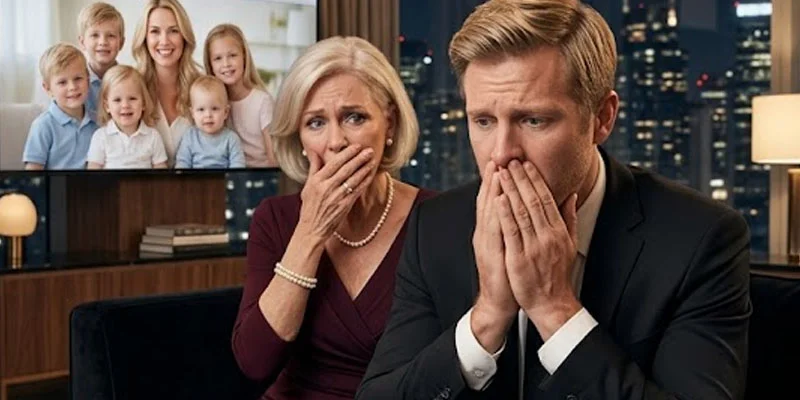
“Ask Elena why four embryos were already there before either of you had ever set foot inside that clinic.”
For several seconds, I found myself unable to respond.
I was still alone in my mother’s study, the phone pressed to my ear, staring at the photographs spread across her desk.
Noah asleep in a hospital bassinet. Sophie gripping Elena’s finger tightly. Lucas taking his first uncertain steps. Grace sitting on a playground swing, smiling at something outside the frame.
My children.
Photographed by someone I had never known was watching.
On the other end of the call, my father breathed quietly.
Seven years earlier, I had stood beside an empty coffin while a minister spoke about Thomas Vance’s devotion to his family.
Now the man I had believed was dead was questioning me.
“What are you talking about?” I finally asked.
“You heard me.”
“Elena and I never created embryos before going to that clinic.”
“I never said that you did.”
The room suddenly felt unstable.
I caught hold of the edge of my mother’s desk.
“Then who did?”
My father remained silent long enough for me to hear a faint mechanical noise behind him.
A ventilation system. An elevator.
Maybe a car.
I couldn’t identify it.
“Dad.”
“You need to stop digging through records you don’t understand.”
“You went into Elena’s office.”
“I recovered something that should never have been there.”
“You took my children’s birth records.”
“For their protection.”
“Protection from whom?”
Once again, silence.
I pressed my hand firmly onto the desk.
“Stop doing that.”
“Doing what?”
“Deciding which truths I’m permitted to know.”
His voice became gentler.
“Alex, some truths don’t set people free.”
“That explanation sounded better when I believed you were dead.”
He inhaled slowly.
For the first time, I heard something change in his voice.
Weariness.
“I know what you think of me.”
“I don’t know what to think of you. You’re supposed to be buried.”
“The grave was necessary.”
“For seven years?”
“Yes.”
“You let me grieve you.”
“I know.”
“You let Mom grieve you.”
A bitter laugh escaped him.
“Your mother knew.”
I went completely still.
Across the room, Beatrice stood beside the window.
She had been listening.
The color drained from her face.
I lowered the phone.
“You knew he was alive.”
She closed her eyes.
That was enough of an answer.
I raised the phone again.
“You both lied to me.”
“We protected you,” my father said.
“No. You controlled me.”
“Alex—”
“You intercepted Elena’s letter. You altered medical records. You watched four children grow from a distance. You let me believe my father was dead, and now you want me to believe all of that was protection?”
“I never told your mother to take Elena’s letter.”
Beatrice turned abruptly toward me.
“Thomas.”
“I warned her not to involve you until I understood what Mercer had done.”
“You told me Alex needed to stay away from them.”
“I said until we knew.”
“You already knew enough!”
For the first time since entering my mother’s house, Beatrice sounded less like the polished, commanding woman who had ruled every room during my childhood and more like someone imprisoned by the consequences of her own decisions.
My father heard it too.
“Beatrice.”
“You disappeared,” she answered sharply. “You left me to deal with everything.”
“I disappeared because Mercer was looking for leverage.”
“And you expected me to know which danger was real?”
I looked from the phone in my hand to my mother.
“What danger?”
Neither of them answered.
I moved toward her.
“What did Dr. Mercer do?”
Beatrice’s lips shook.
Then my father said, “Ask Elena about the blue folder.”
I frowned.
“What blue folder?”
But the call ended.
I stared at the screen.
Then I looked at my mother.
She refused to look at me.
“What blue folder?”
“I don’t know.”
The answer came far too quickly.
Far too smoothly.
I had been raised by Beatrice Vance.
I knew every form her lies could take.
That particular one came from fear.
My phone rang again.
Elena.
I answered at once.
“Alex?”
Something was wrong.
Her voice was quiet.
Controlled.
“Elena, what happened?”
“The police are still here.”
“I’m coming.”
“No. Listen to me first.”
I stopped.
“I found something.”
My father’s words immediately returned to me.
Ask Elena about the blue folder.
My throat tightened.
“What did you find?”
She hesitated.
“A blue folder.”
I shut my eyes.
Of course.
“Where?”
“Behind the rear panel of my old filing cabinet. Whoever searched my office must have loosened it.”
“What’s inside?”
“I haven’t looked through all of it.”
“Elena.”
“I said I haven’t looked through all of it.”
Her voice had become sharper.
Not anger.
Panic.
Then, quietly:
“It has my name on it.”
I was already moving toward the door.
“And yours.”
The drive to Elena’s office took twelve minutes.
I broke no laws, although every instinct in me urged me to drive faster.
The police were leaving when I arrived.
Elena stood behind the glass doors of Little Nests, her arms wrapped around herself.
She had always done that when she was frightened.
Not when she was sad. Not when she was angry.
Frightened.
Six years vanished in that instant.
I remembered her sitting on our kitchen floor after our second unsuccessful fertility treatment, her arms wrapped around her knees.
I had sat beside her.
Neither of us said anything.
Back then, silence had felt like companionship.
Later, silence became what kept us apart.
The security guard unlocked the door.
Elena remained still as I walked inside.
On the conference-room table sat a faded blue folder.
There was no label. No clinic logo.
Only two names written in black ink.
ELENA MARQUEZ.
ALEXANDER VANCE.
She looked at me.
“Your father knew about this?”
“He told me to ask you.”
“Your de@d father.”
“Apparently he’s very committed to making the word ‘dead’ complicated.”
That almost made her smile.
Almost.
I pulled out a chair.
“Did you open it?”
“Partly.”
Inside were copied medical documents.
Lab reports. Consent forms. A handwritten chart filled with dates.
Elena pushed one page toward me.
I recognized Dr. Nathan Mercer’s signature.
The same looping N I had seen on countless fertility documents.
At the top of the page was a date.
Three years before Elena and I had even met.
Below it:
CRYOPRESERVATION INVENTORY: FOUR VIABLE EMBRYOS.
I read it twice.
“This doesn’t make sense.”
“I know.”
“You and I didn’t even know each other then.”
“I know.”
I turned the page.
A genetic compatibility report.
Two columns.
PATERNAL SOURCE.
MATERNAL SOURCE.
Both identifying fields were blacked out.
But beneath them was a note.
Projected compatibility with designated recipients: A. Vance / E. Marquez.
I stared at Elena.
“Designated recipients?”
She shook her head.
“I’ve never seen this.”
Neither had I.
“Maybe it was forged.”
“That was my first thought.”
She slid another page across the table.
A laboratory transfer record.
Patient: Elena Marquez.
Procedure date: the year we began treatment.
Number transferred: four.
My heart began racing.
“Elena.”
Her face had gone pale.
“The clinic told me they transferred two.”
I looked at her.
“What?”
“Every document they gave us said two embryos.”
I remembered that day.
Elena had held my hand so tightly that her fingernails had marked my palm.
Mercer had told us not to expect miracles.
We went home and spent two weeks measuring our lives through whispered hope.
Then the negative result came.
Or what we thought was a negative result.
Three months later, another cycle.
Six months after that, another.
Years of appointments.
Medication.
Hope.
Disappointment.
Except now, the records in front of us suggested that during one of those visits, four embryos had been transferred.
Embryos that had existed before we had even met.
“That’s impossible,” I whispered.
Elena opened another page.
Four identification codes were listed.
Every one began with V.
I felt cold.
“Did you know?” I asked.
Her eyes immediately found mine.
“No.”
“I’m not accusing you.”
“It sounds like you are.”
“I’m trying to understand.”
“And I’m telling you I didn’t know.”
She stepped away from the table.
“For six years, everyone has treated me as though I’m hiding something. Your mother decided I was a trap. Your father entered my office. Mercer lied straight to my face for years. And now you look at me and ask whether I knew?”
“I’m sorry.”
She walked toward the window.
Rain had begun outside.
Boston was blurred behind the glass.
I stayed in my chair.
Sometimes following someone only makes them retreat farther away.
It had taken me six years to learn that.
“Elena.”
She didn’t turn.
“I believe you.”
Her shoulders loosened slightly.
“I should have begun with that.”
She looked back at me over her shoulder.
“Yes.”
“I’m sorry.”
A long silence followed.
Then she said, “There’s more.”
I stood.
She came back to the table and opened the folder’s inner pocket.
Inside was a photograph.
Four incubators inside a laboratory.
Each contained a small labeled dish.
The codes matched those in the file.
On the back, someone had written a date and three words.
FOR THE VANCE LINE.
Elena looked at me.
“What does that mean?”
“I don’t know.”
“You keep saying that.”
“Because for the first time in my life, I’m realizing how much I truly don’t know.”
She studied me.
Something changed in her expression.
For years, I had imagined that if I ever saw Elena again, I would ask her to forgive me.
I thought I would explain myself.
Defend myself.
Tell her my mother had influenced me, that the doctors had discouraged us, that I had been afraid.
But sitting there, with my children’s existence suddenly tied to a mystery that had begun before our first date, I understood something painfully simple.
The reasons I left mattered less than the fact that I had left.
So I said the one thing I should have said years earlier.
“I failed you.”
Elena blinked.
I continued before fear could push me back into excuses.
“My mother lied to me, but she didn’t make me pack that suitcase.”
Her eyes filled with tears.
I forced myself to keep looking at her.
“Mercer manipulated our records, but he didn’t make me stop fighting for us.”
I swallowed.
“And even if I never knew you were pregnant, I knew you were hurting.”
The rain tapped quietly against the windows.
“I told myself I was being practical. I told myself I wanted a future. But the truth was, I was afraid of building a life that didn’t look the way I had imagined.”
Elena slowly sat down.
“So you left.”
“Yes.”
“You made me believe I wasn’t enough.”
My chest tightened.
“I know.”
“No, Alex. I don’t think you do.”
I nodded.
“Then tell me.”
Her face faltered for a second before she regained control.
“I spent months believing my body had ruined everything. Even after I learned I was pregnant, even after they told me there were four babies, part of me still remembered your silence that night.”
She rested one hand against the table.
“I would wake at three in the morning terrified I might lose them. And then I would feel guilty because another part of me was afraid I might not.”
“Elena…”
“I had twenty dollars left in my checking account the week Noah and Sophie came home from the hospital.”
I stared at her.
“You never told me.”
“I wrote to you.”
The words struck exactly where they needed to.
Not cruelly. Simply.
Truth never needed help to hurt.
She wiped her cheek.
“I wrote because I believed that whatever happened between us, you would still want to know them.”
“I would have.”
“I understand that now.”
That surprised me.
She took a slow breath.
“When you appeared after the interview, I thought you had known all along.”
My throat tightened.
“You thought I ignored them?”
“For six years.”
I sat opposite her.
“And now?”
“Now I don’t know what to believe.”
“That’s fair.”
Her eyes searched mine.
“Why aren’t you angry?”
“I am.”
“At me?”
“No.”
“Your mother?”
“Yes.”
“Your father?”
“Yes.”
“Mercer?”
“Very.”
She paused.
“And yourself?”
I looked down at the blue folder.
“More than anyone.”
Elena said nothing.
I leaned forward.
“But I don’t want to spend another six years living with anger.”
For the first time, she looked at me without the defenses she had carried since I appeared outside her office.
“What do you want?”
The answer came easily.
“To know my children.”
Her eyes immediately became guarded again.
“Elena, not to take them away from you.”
She turned aside.
“I already have lawyers preparing documents,” I said.
Her head snapped back toward me.
“What documents?”
“Documents giving you primary custody.”
She stared at me.
“I don’t want to enter their lives carrying a DNA test and demanding weekends.”
“You’re their father.”
“Biologically.”
“That still matters.”
“Yes.”
I glanced at the photograph of the four incubators.
“But they already have a life. A home. Routines. A mother who built everything around them.”
My voice softened.
“I’ve already been part of the reason your life became unstable once.”
Her expression softened.
“I won’t do that again.”
For a moment, neither of us spoke.
Then Elena whispered, “Noah asked about you.”
My heart seemed to stop.
“When?”
“After the interview.”
“What did you tell him?”
“That you were someone I once knew.”
I nodded, even though it hurt.
“He said you look like him.”
I laughed once.
Of course he did.
“He’s very observant.”
“He’s impossible.”
“That too.”
A faint smile touched the corner of her mouth.
It was the first one I had seen that was meant for me.
Not polite. Not guarded.
Real.
It vanished quickly, but I had seen it.
“What did the others say?” I asked.
“Lucas wants to know whether you can throw a baseball.”
“I can.”
“Not according to your college friends.”
I stared at her.
She almost smiled again.
“Sophie didn’t ask anything. She watched the interview three times.”
“And Grace?”
Elena’s expression changed.
“Grace asked whether you knew her birthday.”
The answer rang through me like a bell.
I looked down.
“No.”
“Alex.”
“I know the date now.”
“But you didn’t before.”
“No.”
“That’s what she meant.”
I pressed my fingers against my eyes.
Five birthdays. Four children. Twenty birthday mornings.
I had been alive through every single one.
Working. Traveling. Going to dinners. Complaining about flights. Buying presents for other people’s children.
While mine blew out candles I never knew existed.
“Elena.”
“Yes?”
“Can I meet them?”
She drew in a long breath.
“I don’t know.”
I nodded.
“Okay.”
Her eyebrows lifted.
“That’s it?”
“You said you don’t know.”
“You’re not going to argue?”
“I spent enough time making decisions for both of us when we were married.”
Something opened in her expression.
Not forgiveness. Not yet.
But perhaps the possibility of forgiveness.
Then her phone rang.
She looked at the screen.
“The babysitter.”
She answered.
“Hi, Mia.”
Her expression changed almost instantly.
“What?”
She stood.
“No, no, you did the right thing.”
My body tensed.
“What happened?” I whispered.
Elena raised one hand.
“Are the kids okay?”
A pause.
Then she closed her eyes.
“Okay. I’m coming home.”
She ended the call.
“What?”
“Someone was outside my house.”
My chest tightened.
“Who?”
“Mia doesn’t know.”
“Police?”
“She called them.”
Elena grabbed her coat.
“What did the person do?”
“Nothing.”
“Elena.”
“They left a box.”
By the time we reached Elena’s house in Brookline, two police cruisers were outside.
I had never been there before.
That affected me more than I expected.
The house was modest compared with the Vance family properties where I had grown up.
White siding. Blue shutters.
A bicycle lay on its side beside the porch.
Four pairs of tiny rain boots stood beneath the awning.
I stopped walking.
Elena noticed.
“What?”
I looked at the boots.
Yellow. Red. Green. Purple.
Those ordinary little shoes nearly overwhelmed me.
“They’re theirs.”
She followed my gaze.
“Yes.”
I laughed quietly at myself.
“Sorry.”
Her voice softened.
“You don’t have to apologize for everything.”
“I have quite an inventory.”
Despite everything, she smiled.
Then the front door opened.
A young woman stepped outside.
Behind her came a boy.
He had my eyes.
There is no easy way to explain what it feels like to see your child looking directly at you for the first time.
The world didn’t stop.
There was no music. No dramatic rush.
A police radio crackled nearby.
Rain fell from the gutters.
A car passed at the end of the street.
And somehow, everything still changed.
The boy stared at me.
I knew immediately which child he was.
“Noah,” Elena said softly.
He glanced toward her.
Then back at me.
“You’re the television man.”
Elena closed her eyes.
I almost laughed.
“Yes.”
He stepped down one porch step.
“You were looking at us funny.”
“I probably was.”
“Why?”
I looked at Elena.
She gave me the smallest nod.
I crouched so Noah and I were closer to eye level.
“Because I was surprised.”
“Why?”
Children never seem to run out of follow-up questions.
“Because I didn’t know about you.”
He frowned.
“All four of us?”
“All four.”
He considered that.
“That’s a lot to not know.”
I swallowed.
“Yes, it is.”
Another boy appeared behind him.
Lucas.
He looked at me. Then at Noah. Then back at me.
“Mom says we’re not supposed to talk to strangers.”
“That’s an excellent rule.”
“Are you a stranger?”
The question hung between us.
Elena stepped beside me.
“For now,” she said, “Alex is someone we’re getting to know.”
Lucas accepted that more easily than I did.
Then the girls appeared.
Sophie stood with her arms folded, studying me so carefully that I felt like someone under examination.
Grace remained partly hidden behind Elena.
Her eyes traveled across my face.
I noticed the dimple.
My dimple.
It appeared when she pressed her lip between her teeth.
“Hi,” I said.
Sophie spoke first.
“You’re taller on television.”
“No, he isn’t,” Noah said.
“Yes, he is.”
“That doesn’t make sense.”
“You don’t make sense.”
“Elena,” I whispered.
She covered her mouth.
She was trying not to laugh.
Four children.
Arguing. Interrupting. Existing.
I wanted to remember every moment.
Grace finally stepped forward.
“Do you know my birthday?”
Elena froze.
So did I.
I looked at Grace.
“April seventeenth.”
Her eyes widened.
“And Sophie’s?”
“April seventeenth.”
She looked doubtful.
“That was easy.”
“Fair.”
“Noah?”
“April seventeenth.”
“Lucas?”
“April seventeenth.”
Lucas groaned.
“We’re quadruplets, Grace.”
“I know that.”
“Then why did you ask?”
“I was testing him.”
I nodded seriously.
“That seems reasonable.”
She studied me for another second.
Then said, “Okay.”
One word.
It felt like a gift I had not earned yet.
A police officer stepped onto the porch.
“Ms. Marquez?”
Elena turned.
“We cleared the package.”
“What is it?”
“Photographs.”
Her hand tightened around the porch railing.
The officer held up a clear evidence sleeve containing a small envelope.
“Do you recognize the handwriting?”
Elena looked at it.
Then at me.
“No.”
I did.
My father’s.
The photographs documented the previous six years.
Birthday parties.
School drop-offs.
Visits to the aquarium.
Elena pushing a stroller.
The children sleeping in the back seat of a car.
At first glance, they looked like surveillance images.
Then I noticed something.
The angles.
The distance.
The timing.
Whoever took them had never moved close.
Never entered the house. Never photographed through windows.
Most had been taken at public events.
School fairs. Parks. Restaurants.
Places where someone could watch from a distance.
On the back of every photograph was a date.
And a handwritten number.
Then combinations.
1-3.
2-4.
All four.
“What do those numbers mean?” Elena asked.
“I don’t know.”
The police documented everything and left the originals in a sealed bag because, technically, there had been no direct thre@t.
No message. No demand.
Only photographs.
Somehow, that made them more disturbing.
Mia took the children upstairs to get ready for bed.
I stayed in the living room with Elena.
Family photographs covered the walls.
All the years I had missed.
Four newborns wearing matching knitted hats.
Elena holding all of them with the exhausted smile of someone who had barely slept for weeks.
Noah covered in birthday cake.
Sophie missing her two front teeth.
Lucas dressed as an astronaut.
Grace wearing fairy wings with rain boots.
“You did all of this,” I said quietly.
Elena followed my gaze.
“Not alone.”
“No?”
“Friends. Employees. Neighbors. Mia. Half of Boston, some weeks.”
I smiled faintly.
“My mother?”
Her expression changed.
“What?”
I looked at the photographs on the coffee table.
“She said the trust sent money to Little Nests.”
“Yes.”
“You really didn’t know?”
“No.”
“Did you ever have a landlord unexpectedly reduce your rent?”
She stared at me.
“Twice.”
“Loans approved when they probably shouldn’t have been?”
“A bank approved our first expansion even though our numbers looked terrible.”
“My father.”
“Maybe.”
I leaned back.
That complicated something I desperately wanted to keep simple.
I wanted villains.
My mother, who hid the letter.
My father, who watched from a distance.
Mercer, who altered records.
I wanted each person to fit neatly into the role I had given them.
But whoever my father had become, he had also quietly helped keep Elena’s business alive.
Why?
Elena seemed to arrive at the same question.
“If Thomas wanted us protected, why didn’t he simply tell me?”
“I don’t know.”
“There’s that answer again.”
“You’re going to get tired of saying that.”
“I already have.”
I smiled.
She looked toward the staircase.
“Alex.”
“Yes?”
“Do you honestly want to know them?”
I sat straighter.
“Yes.”
“Even if everything becomes complicated?”
“Yes.”
“Even if they don’t like you?”
“That would hurt.”
“That wasn’t what I asked.”
“Yes.”
She studied me carefully.
“Even if I never forgive you?”
That answer took longer.
Not because I didn’t know it.
Because I wanted to say it correctly.
“Yes.”
Her eyes glistened.
“I hope someday you will.”
“I don’t know if I can.”
“I know.”
“But you still want to stay?”
“I’m their father whether you forgive me or not.”
I looked toward the staircase.
“And once, I made my love conditional.”
Elena’s expression became still.
“I won’t make that mistake again.”
A floorboard creaked.
We both looked upstairs.
Noah stood halfway down the staircase.
“How long have you been standing there?” Elena asked.
“Not long.”
“Noah.”
“Medium long.”
Elena sighed.
“What did you hear?”
He came down two more steps.
“That he’s our dad.”
The room became silent.
Elena looked at me.
Then at him.
“Noah—”
“Is he?”
He was watching her, not me.
She sat on the bottom step.
“Come here.”
He walked toward her.
She wrapped both hands around his.
“Yes.”
Noah looked at me.
“My real dad?”
The words struck harder than anything else had.
Elena answered carefully.
“He is your biological father.”
Noah frowned.
“What does that mean?”
“It means some things about you came from him. Maybe your eyes. Maybe the way you smile.”
“Maybe baseball?”
I laughed.
“Elena says probably not.”
Noah didn’t laugh.
“Why weren’t you here?”
There it was.
The question no adult explanation could make simple.
I moved closer but stayed several feet away.
“Because I didn’t know about you.”
“But Mom did.”
“Yes.”
“Why didn’t she tell you?”
“She tried.”
He looked at Elena.
She nodded.
Noah turned back toward me.
“Then why didn’t you know?”
Because my grandmother intercepted a letter because of a mystery involving my supposedly dead father, a fertility doctor, and four embryos created before your mother and I had even met.
That wasn’t an answer for a five-year-old.
So I gave him the truth he could understand.
“A letter got lost before it reached me.”
“Mail gets lost?”
“Sometimes.”
“You should use email.”
Elena covered her face.
I laughed.
“That is excellent advice.”
Noah thought about it.
Then he crossed the room.
He stopped directly in front of me.
I stayed completely still.
“You have my eyes.”
I blinked.
“I was about to tell you that you have mine.”
“That doesn’t make sense. I’m younger.”
I glanced at Elena.
“He gets that from you.”
“No,” she said. “Absolutely not.”
Noah watched me for another moment.
Then he held out his hand.
Adults shake hands when they don’t know what else to do.
Apparently children do the same.
I took it.
His small hand disappeared inside mine.
“I’m Noah.”
My vision blurred.
“I’m Alex.”
“I know.”
Of course he did.
Then the others came downstairs because, apparently, secrets shared in a house with four five-year-olds remained secret for about eleven seconds.
Lucas appeared first.
“Is he actually our dad?”
Sophie followed.
“Did Noah already ask?”
Grace came last, carrying a stuffed rabbit.
Elena stood surrounded by all four children.
For the first time, she looked overwhelmed.
Not weak. Never that.
Simply human.
I thought about all the nights she must have handled alone.
Questions. Fevers. Fear. Lunch boxes. Tears. Shoelaces.
Four different personalities needing her at once.
I stepped beside her.
Not in front of her.
Beside her.
“Yes,” Elena said.
“He is your biological father.”
Lucas looked fascinated.
“Do you live here now?”
“No,” Elena and I answered together.
The children immediately burst out laughing.
Even Sophie.
The tension vanished.
Grace pointed at me.
“Do you have toys?”
“A few.”
“What toys?”
“I don’t think anything very interesting to five-year-olds.”
“Then why do you have toys?”
“Grace,” Elena said.
“What? It’s a question.”
I crouched again.
“I have a model train.”
All four faces changed instantly.
“You have a train?” Lucas asked.
“Yes.”
“A big one?”
“Pretty big.”
“Does it go around?”
“That is generally the main idea of a train.”
Elena stared at me.
“They’re five.”
“Right.”
“Yes,” I told Lucas. “It goes around.”
“When can we see it?”
I looked at Elena.
Every child turned toward her.
For one alarming moment, I realized I had accidentally created a four-person pressure campaign.
Elena narrowed her eyes at me.
“Tomorrow afternoon.”
I forgot how to breathe.
“Really?”
She nodded.
“One hour.”
“Two,” Sophie said.
“One.”
“One and a half,” Noah countered.
I stared at Elena.
“They negotiate?”
“They’re mine too.”
I smiled.
She rolled her eyes.
“Fine. Ninety minutes.”
The children cheered.
And for the first time since the television camera pulled back, the impossible reality of my life stopped feeling entirely like grief.
For ninety minutes tomorrow, I would be their father inside a room with a train.
It felt almost painfully small.
And enormous.
I left Elena’s house shortly after ten.
Before I reached my car, my phone buzzed.
A message from an unknown number.
YOU ARE LOOKING IN THE WRONG DIRECTION.
Attached was a photograph.
Dr. Nathan Mercer.
He was walking into Logan Airport.
Timestamped forty-three minutes earlier.
I called the number.
Disconnected.
Then another message appeared.
YOUR FATHER DID NOT CREATE THE EMBRYOS.
My pulse quickened.
A third message arrived.
NEITHER DID MERCER.
Then came one final photograph.
A woman standing beside Mercer outside the fertility clinic fifteen years earlier.
Younger. Smiling.
I recognized her.
My mother.
I returned to Beatrice’s house at eleven.
She was still awake.
Of course she was.
Women like my mother didn’t sleep while everything around them was coming apart.
She sat in the library with an untouched glass of water beside her.
No wine. No whiskey.
That unsettled me more than an empty bottle would have.
I placed the photograph in front of her.
She stared at it.
Her expression changed.
“Where did you get this?”
“Who created the embryos?”
She glanced toward the hallway.
“No one can hear us.”
“That isn’t reassuring.”
“Answer me.”
“Who created them?”
She remained completely still.
“Your father told you too much.”
“My father told me almost nothing.”
“Then leave it that way.”
“No.”
“Alex.”
“No.”
I pulled a chair across from her.
“For six years, you kept me away from my children because you believed you knew what was best for me.”
Her eyes filled.
I continued.
“Tonight I met them.”
Her mouth opened slightly.
“Noah shook my hand.”
A tear rolled down her cheek.
“Lucas wants to see my train.”
Despite herself, she smiled.
“Sophie watches everything carefully before deciding whether she trusts it.”
“That sounds like Thomas.”
“And Grace asked whether I knew her birthday.”
My mother turned away.
“I did.”
She pressed her lips together.
“I knew because Elena told me today. Not because I was there.”
Her eyes closed.
“You took that from me.”
“I know.”
“No.”
My voice became firmer.
“I need you to understand it.”
She opened her eyes.
“You took six years.”
I let the silence remain.
Then, more quietly:
“But I don’t want to lose the next six.”
She stared at me.
“I’m angry with you.”
“I know.”
“I don’t trust you.”
“I understand.”
“But you’re still my mother.”
That broke through her composure.
Beatrice covered her mouth.
I had seen my mother cry only twice in my entire life.
At my grandfather’s funeral. And at my father’s.
Now I understood that the second time had been a performance wrapped around a truth too complicated to explain.
“I don’t know what happens between us,” I said.
“But if you want any chance to know those children, it begins with telling the truth.”
She wiped her cheeks.
Then nodded.
“Fine.”
I waited.
“The embryos were created through a research program.”
“What program?”
“A private genetic-screening project funded through Vance Holdings.”
My stomach tightened.
“For what?”
“Originally? Disease prevention.”
“Originally?”
She looked at the old photograph.
“Your grandfather believed the Vance family carried an inherited heart condition.”
I already knew that.
My grandfather had died at fifty-eight.
His brother at fifty-one.
An uncle at forty-nine.
“So he funded research.”
“Yes.”
“With Mercer?”
“Mercer became involved later.”
“Who started it?”
My mother hesitated.
“Your father.”
I leaned back.
“He told me he didn’t create the embryos.”
“He didn’t.”
“Then who did?”
“The laboratory did.”
“That isn’t an answer.”
She stood and walked toward the fireplace.
“Your father provided genetic material when he was younger. Several other family members did too.”
My skin went cold.
“Dad is the paternal source?”
“No.”
I stared at her.
“Then who is?”
“I don’t know.”
“You expect me to believe that?”
“Yes.”
“What about the maternal source?”
Her silence lasted too long.
“Mom.”
She looked toward me.
“I was told it came from an anonymous donor.”
“Were you involved?”
“Not in creating them.”
“In choosing Elena?”
Her expression changed.
There it was.
The answer to a question I hadn’t known enough to ask.
“You knew Elena before I met her.”
“No.”
“You knew about her.”
My mother lowered her eyes.
“That’s different.”
I stood.
“You arranged our marriage?”
“No.”
“Did you arrange for us to meet?”
“No.”
“Did Mercer?”
“I don’t know.”
I walked away from her.
My entire life seemed to be unraveling backward.
Elena and I had met at a charity auction.
She spilled sparkling water across my jacket.
I made a joke.
She laughed.
We talked for three hours.
For years, I had believed it was coincidence.
“What did Elena have to do with this research?”
“Her family.”
I turned around.
“What about them?”
“Her mother participated in a medical study in Argentina before Elena was born.”
My pulse slowed.
“Was it connected?”
“We believe it was.”
“We?”
“Your father and I.”
“Does Elena know?”
“No.”
“You’re certain?”
“Yes.”
“Then why were the embryos designated for us?”
My mother shook her head.
“That’s the part I never understood.”
“Mercer understood.”
“Yes.”
“And Dad?”
“Eventually.”
“What did he discover?”
Her expression tightened.
“That the embryos had not been created for fertility treatment.”
The room suddenly felt completely silent.
“What were they created for?”
“To preserve something.”
“What?”
“I don’t know.”
“Stop saying that.”
“I don’t.”
Her voice broke.
“Alex, I genuinely don’t.”
I stared at her.
For the first time that night, I believed her.
She walked toward the safe again.
Behind the photographs, beneath the trust documents, was a slim metal box.
She opened it.
Inside was a single envelope.
No stamp. No address.
Only my name.
“This belonged to your father,” she said.
“When?”
“The night he disappeared.”
I took it.
“Why didn’t you give this to me?”
“Because he told me not to unless the children were found.”
I stared at her.
“Found?”
She nodded.
“He knew there were four.”
“But Elena wasn’t pregnant yet.”
“I know.”
That unsettled me more than anything else.
I opened the envelope.
Inside was a handwritten letter.
Alex,
If you are reading this, then all four survived.
Do not assume their existence began with Elena’s pregnancy.
Do not assume it began with you.
Your mother will tell you the research concerned inherited disease. She is telling the truth as she understands it.
Mercer will tell you that he was following instructions.
He will also be telling the truth.
The person who began the embryo project was neither of them.
I stopped reading.
My mother watched me.
“What?”
I continued.
There is one record I could not destroy and could not allow Mercer to discover.
It identifies the original biological sources.
I placed it somewhere only a Vance child would think to search.
If all four survived, then the record must remain hidden until you know whether Elena carries the marker.
My hands began to shake.
Marker?
What marker?
I read the final paragraph.
If she does, everything we believed about the children is wrong.
Not their parentage.
Their purpose.
I lowered the letter.
My mother whispered, “What does it say?”
Before I could answer, my phone rang.
Elena.
I answered.
“Alex.”
She sounded breathless.
“What happened?”
“I’m at the hospital.”
Every muscle in my body tightened.
“Which child?”
“None.”
I closed my eyes.
“Then why are you there?”
“I found my old pregnancy records.”
“Elena—”
“There was another test inside the blue folder.”
My father’s letter trembled in my hand.
“What test?”
“A genetic marker panel.”
My mother moved closer.
I could hear hospital announcements behind Elena.
“They took new blood tonight,” she said. “I asked them to repeat the test.”
My throat tightened.
“And?”
“The doctor just returned.”
I looked down at my father’s handwriting.
Until you know whether Elena carries the marker.
“Elena.”
Her voice dropped almost to a whisper.
“I tested positive.”
I couldn’t move.
“For what?”
“That’s the problem.”
She took an unsteady breath.
“The doctor says the marker isn’t connected to any disease in their database.”
My mother gripped the edge of the desk.
Then Elena said the words that changed everything.
“But Alex, they found that same marker somewhere else.”
“Where?”
“In all four children.”
My heart hammered.
“That could make sense. They’re yours.”
“No.”
Her voice cracked.
“You don’t understand.”
A hospital door closed somewhere near her.
“The lab retrieved their newborn genetic screening records.”
I said nothing.
“They all carry the marker.”
“Yes.”
“But I don’t.”
I froze.
“Elena, you just told me you tested positive.”
“I did.”
“Then what are you saying?”
“I’m saying the blood sample from six years ago—the one collected while I was pregnant—doesn’t match the blood they took from me tonight.”
The room became silent.
Even my mother seemed to stop breathing.
I looked at the blue-folder photograph on my phone.
Four embryos.
Four labels.
Four children carrying something Elena apparently did not.
“Could the earlier sample have been mislabeled?”
“That’s what I asked.”
“And?”
Elena’s breathing became uneven.
“The hospital checked.”
My grip tightened around the phone.
“Checked what?”
“The DNA.”
I already knew I didn’t want to hear the answer.
“The blood from my pregnancy records belongs to a woman genetically related to me.”
I stared into empty space.
“How closely related?”
There was a pause.
Then Elena whispered:
“Identical.”
My mother dropped the glass in her hand.
It landed on the carpet and rolled harmlessly beneath the desk.
“Elena,” I said, “you don’t have a twin.”
“I know.”
Then someone spoke in the background beside her.
A nurse, perhaps.
Elena replied, “Yes, that’s me.”
More silence.
Then she returned to the call.
“Alex.”
“What?”
“The hospital just found the name connected to the original sample.”
My father’s letter slipped from my fingers.
Elena sounded as though she could barely force the words out.
“The woman’s name was Eva Marquez.”
I closed my eyes.
Elena’s mother had died when Elena was eleven.
She had never mentioned a sister.
Never mentioned twins.
Never mentioned anyone named Eva.
“Elena…”
But she wasn’t finished.
“They checked the birth date.”
My mother whispered, “No.”
I turned toward her.
Her face had gone completely pale.
On the phone, Elena spoke the final words slowly.
“Eva Marquez has the same birthday as me.”
I stared at my mother.
Her lips formed a word before any sound came out.
I immediately knew she recognized the name.
“Mom?”
She stepped backward.
“No.”
“You know who Eva is.”
“No.”
“You know.”
Her eyes filled with a fear I had never seen in her before.
And when she finally answered, her voice was barely audible.
“Alex… Eva wasn’t Elena’s sister.”
I stopped breathing.
“Then who was she?”
My mother looked toward the dark window, almost as if she expected someone to be standing outside.
When she spoke again, every certainty I still possessed disappeared.
“Eva was the woman your father married before me.”