
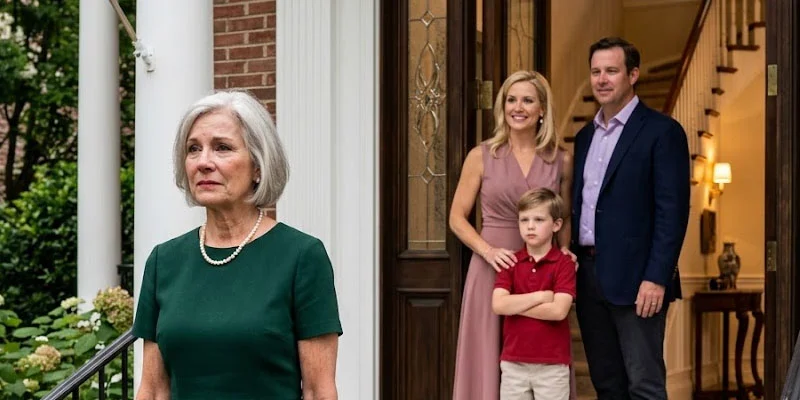
I never thought purchasing an $800,000 home for my son would become the most degrading experience of my sixty-five years.
Yet there I was, standing on the marble steps of 800 Willow Creek Drive, looking at the mansion I was preparing to pay for, while my seven-year-old grandson stood directly in the doorway and refused to let me enter.
“You can’t come inside,” Damon said firmly. “Mom says this house is for elite people, not peasants like you.”
For several seconds, I was completely speechless.
I had spent forty-three years working, saving, and going without luxuries so my only son, Trent, could enjoy opportunities I had never been given. This house was meant to be my final gift—a beautiful place for him, his wife Norah, and Damon to live.
Instead, I was being told that I wasn’t worthy of stepping inside.
Behind Damon stood Norah, champagne glass in hand.
She made no attempt to correct him.
She smiled.
“Remember what we discussed, sweetheart,” she said. “This home is for people who appreciate quality.”
That was when I understood that Damon hadn’t come up with those words himself.
Someone had taught them to him.
Then Trent came into view.
My son looked at me, heard what his child had said, and did absolutely nothing.
Even worse, I noticed the slightest hint of a smirk on his face.
“Hi, Mom,” he said casually. “We weren’t expecting you this early.”
“The walkthrough was scheduled for two.”
He shrugged.
It was exactly two o’clock.
No one asked me to come inside.
No one apologized.
So I turned and walked away.
My knees ached as I descended those costly marble steps, but I refused to let them watch me cry.
Once I reached my car, I sat behind the wheel and stared back at the house.
For decades, I had believed that love was about sacrifice. I thought being a good mother meant giving freely without ever keeping track.
Then my phone vibrated.
A message from Trent.
Payment still due tomorrow.
I stared at the screen.
There was no apology.
No concern.
Only money.
I typed two words.
Ask the elites.
Then I drove home.
That night, sitting in my late husband David’s old recliner, I began thinking about all the things I had spent years refusing to acknowledge.
Trent had begun relying on my money while he was in college. Whenever he needed textbooks, rent, tuition, or money for an emergency, I paid.
By the time he graduated, I had given him almost $120,000.
David always told me that helping our son succeed was an investment in his future.
Then Trent met Norah.
She loved expensive things.
When they began planning their wedding, apparently there was no room for anything modest. Norah wanted a prestigious venue, imported flowers, hundreds of guests, an elaborate reception, and a costly honeymoon.
She came to me with a sweet smile.
“Mrs. Henderson, Trent said maybe you could help with a few things.”
Those “few things” became $50,000.
After the wedding, their apartment was suddenly no longer suitable.
They needed a house.
I gave them another $80,000 toward the down payment.
Then came vehicle repairs, taxes, business ventures, medical expenses, and one emergency after another.
Fifteen thousand here.
Twenty thousand there.
Every time, Trent promised that things would get better.
Every time, I trusted him.
Now, looking back, I could see how much our relationship had transformed.
I wasn’t being treated as his mother anymore.
I had become a source of funding.
Norah frequently corrected me in front of others as though I didn’t understand what was happening. She rearranged things in my kitchen without permission. At family gatherings, she treated me as though I were unpaid household help.
Trent began canceling our visits more often.
They spent holidays with Norah’s family.
There were even anniversaries of David’s death when my own son never called.
Still, I continued giving.
I was afraid that if I stopped being useful, I might stop being included.
That evening, Norah called.
I allowed the call to go to voicemail.
“Mrs. Henderson, I think there was a misunderstanding today. Damon is only a child. Maybe we could have lunch tomorrow and talk about the house as a family.”
A misunderstanding.
Still no apology.
I deleted the message.
Then I stared at the $800,000 check lying on my kitchen table.
It represented nearly everything I had spent my entire life building.
And suddenly, I knew exactly what I was going to do.
I called the bank.
“I need to cancel payment on a check.”
For the first time in years, saying no didn’t fill me with guilt.
It made me feel liberated.
The next morning, Trent called over and over.
On his fourth attempt, I answered.
“Mom! The bank says the check has been canceled.”
“That’s correct.”
“We’re supposed to close today! The movers are coming. We’ve already packed!”
“That sounds unfortunate.”
“Mom, we had an agreement!”
“I agreed to purchase an $800,000 house for your family. Yesterday, your son called me a peasant at the entrance while your wife smiled and you stood there doing nothing.”
“He’s seven! Children say stupid things.”
“And what did you say, Trent?”
Silence.
Then Norah took the phone.
She began by trying to sound sweet.
“We can’t allow a silly misunderstanding to ruin everything we’ve worked for.”
I nearly laughed.
Everything they had worked for?
It was my money.
“You found a house you couldn’t afford and expected me to purchase it,” I said. “Then you made it perfectly clear that I wasn’t respectable enough to step inside.”
Norah’s tone became sharp.
“Do you realize how humiliating this is? We’ve already told everyone about the house.”
That one sentence explained everything.
She wasn’t concerned about hurting me.
She was concerned about being embarrassed.
“Then maybe you should have considered that yesterday.”
“You’re family! Family doesn’t abandon one another over petty disagreements.”
“You’re right,” I said. “Family shouldn’t abandon or humiliate one another. Remember that.”
I ended the call.
Messages immediately began pouring into my phone.
One came from an unknown number:
This is what happens when old people become bitter and senile.
I saved the message.
Three days later, my bank contacted me.
Janet, an employee who had known me for years, asked me to come in because there had been unusual activity concerning my accounts.
When I arrived, she shut the conference-room door.
“Patty, have you given anyone power of attorney over your finances?”
“No.”
She put several documents on the table in front of me.
Someone had contacted the bank seventeen times during the previous six months, asking about my balances, beneficiaries, transfers, and access to my accounts.
The number belonged to Trent.
Then Janet showed me another document.
It was a power of attorney that supposedly carried my signature.
It gave Trent authority over my financial accounts.
“That isn’t my signature.”
“We didn’t believe it was.”
My stomach dropped.
Canceling the mansion hadn’t caused this.
Trent had been preparing something much more serious.
Janet explained that there had also been inquiries about my life insurance, property, and estate paperwork.
When I returned home, I immediately opened the safe where I kept my will.
After David died, Trent had brought a lawyer named Marcus Webb to the house. I had been so overwhelmed by grief that I signed several papers without fully understanding every provision.
Now I read them carefully.
One clause gave Trent considerable control if I were ever declared incapable of managing my own affairs.
Suddenly, Norah’s earlier comments took on a different meaning.
“You’re becoming forgetful.”
“Maybe you shouldn’t be living alone.”
“Are you sure you remember that correctly?”
They hadn’t merely been insulting me.
They had been creating a story about me.
I contacted Marcus Webb’s former law firm.
The receptionist told me that he no longer worked there.
He had been dismissed for professional misconduct.
That was all I needed to hear.
I called Eleanor, an old friend who was also an attorney.
Within an hour, she was sitting in my living room going through everything.
Her expression became more serious with each page.
“Patty, this is dangerous. With documents like these, someone could potentially claim that you were unable to manage your own affairs and attempt to take control of your assets.”
I felt sick.
“My own son?”
Eleanor looked at me with compassion.
“It appears he was preparing for that possibility.”
We immediately started changing everything.
A new will.
Revocation of questionable powers of attorney.
Additional protections at my bank.
Records of every call, message, and forged document.
“I want the forgery reported,” I said.
Eleanor looked carefully at me.
“You understand this could have serious consequences for Trent?”
“He knew right from wrong when I raised him.”
That afternoon, I understood something I had never wanted to admit.
I had spent years being terrified that I would lose my family.
But somewhere along the way, I had lost myself instead.
Two weeks later, Norah tried a different approach.
She sent Damon.
I was caring for David’s roses when I noticed my grandson standing near the sidewalk.
“Grandma Patty, please don’t be mad at me.”
My heart immediately softened.
Whatever his parents had done, Damon was only seven.
“I’m not angry with you.”
“Mommy says you took away our house because you don’t love us.”
There it was.
Norah was using her own child to put pressure on me.
“I love you very much,” I said. “But loving someone doesn’t mean giving them everything they ask for.”
Damon lowered his eyes.
“Daddy says you’re old and sad, and sometimes old people get confused.”
I forced myself to swallow my anger.
“Do I seem confused right now?”
He studied me carefully.
“No. You seem like Grandma Patty.”
I smiled.
“Exactly.”
Then he quietly said something that meant far more than he probably realized.
“I’m sorry I called you a peasant. Mommy told me to say it. I didn’t like saying it.”
I hugged him.
“Thank you for telling me the truth.”
Across the street, Norah sat watching from her car.
Her expression told me everything I needed to know.
Three days later, Trent came himself.
He looked exhausted.
They were staying in a motel after leaving their rental in preparation for moving into Willow Creek Drive.
“Mom, we need to talk.”
“No, we don’t.”
“Five minutes.”
Eventually, I allowed him inside.
He started with the same argument.
I was destroying the family.
Norah was struggling.
Damon was confused.
We could still make everything right.
I listened without interrupting.
Then I said, “Tell me about the power of attorney.”
His face changed immediately.
“What power of attorney?”
“The forged one. And the seventeen calls to my bank.”
He tried to deny everything.
Then I brought up Marcus Webb.
His shoulders sank.
For the first time, I saw fear in his eyes.
“It wasn’t stealing,” he insisted. “We were trying to make sure your affairs were taken care of. Norah was worried about you living alone.”
“Stop.”
My voice startled both of us.
“You didn’t do this to protect me.”
His embarrassment quickly became anger.
“You’re going to regret this. You think you’re independent, but you’re a lonely old woman. Nobody else cares about you.”
“If that’s true,” I answered, “what does that say about my only son?”
His face became hard.
Then he said something I would never forget.
“We gave you purpose. Without your family, what exactly do you have?”
That sentence shattered the final illusion I had been holding onto.
In Trent’s mind, my life had value because it benefited him.
My money.
My house.
My time.
My savings.
Even the reason I supposedly had to wake up every morning belonged to him.
“Get out.”
“Mom—”
“Get out of my house.”
Before he left, he warned me not to expect help when I became sick or old.
I shut the door behind him.
Instead of being afraid, I felt lighter.
That evening, Eleanor called with additional information.
Trent had more than $60,000 in credit-card debt.
He had also lost his marketing job three months earlier after allegations involving falsified expense reports.
Now the desperation surrounding my money finally made sense.
The mansion had never been merely about luxury.
They were falling apart financially.
Not long afterward, investigators became involved because of the forged paperwork and attempts to access my accounts.
Norah sent one last message:
You’re a bitter old woman who will die alone.
I deleted it.
Six months later, I stood on the deck of a Mediterranean cruise ship, watching the sun disappear over the horizon.
By then, I was sixty-six.
For the first time in decades, I had spent money on something simply because I wanted to.
No emergency.
No guilty phone call.
No son asking for help.
No daughter-in-law explaining why an expensive purchase was absolutely necessary.
Just me.
The legal consequences unfolded exactly as Eleanor had warned.
During his panic, Trent attempted to use one of the fraudulent documents to obtain direct access to my accounts.
The bank had records.
There was evidence.
Eventually, he was convicted of fraud and forgery and received an eighteen-month sentence in a minimum-security facility.
Norah filed for divorce after his conviction became public.
She took Damon and moved back to California to live with her mother.
I felt no happiness watching their marriage collapse.
And I worried about Damon.
He was still a child dealing with consequences he had never caused.
So Eleanor helped me create an education trust for him. Once Damon became an adult, the funds would be available for his education, but neither Trent nor Norah would be able to access them.
That was the distinction I had finally learned.
Love and enabling were not identical.
On the cruise, I met other widows and retirees who had spent most of their lives caring for everyone but themselves.
One of them became a close friend—Margaret, a retired teacher from Ohio.
One afternoon, she noticed me holding a letter.
“From Trent?” she asked.
I nodded.
He had written from prison.
For once, there were no demands.
No excuses.
No request for money.
He said he had spent months reflecting on what he had done.
He admitted that he had been selfish.
He apologized for hurting me.
He said I had been right to protect myself and hoped that one day I might forgive him.
At the bottom, he had written:
I love you, Mom.
Margaret asked whether I planned to respond.
I carefully folded the letter.
“Maybe.”
And that was enough.
Months earlier, I would have answered immediately.
I would have worried about his feelings.
I would have wondered what a good mother was supposed to do.
Now I understood something more important.
If I responded, it would be because I chose to.
Not because of guilt.
Not because of fear.
Not because being his mother meant I had to erase myself.
That evening, I wrote another letter.
This one was for Damon.
His ninth birthday was coming soon.
I told him about the places I had traveled and the people I had met. I told him stories about his grandfather David and how much David would have loved knowing him.
I wanted Damon to know that adulthood didn’t have to resemble what he had witnessed at home.
People could make mistakes and still change.
Families could love one another without controlling one another.
And boundaries were not the same as hatred.
I ended the letter by telling him that when he was older, if he ever wanted a relationship with me, my door would remain open.
The following morning, our ship reached Rome.
Our tour guide took us through ancient streets, churches, markets, and eventually the Vatican.
Standing inside St. Peter’s Basilica, surrounded by centuries of art and history, I thought about the woman who had stood outside that mansion less than a year before.
She had believed that losing her family would be the worst thing that could ever happen to her.
She hadn’t understood that losing herself was worse.
I still missed David.
I still loved Trent, despite everything.
And I would always love Damon.
But loving them no longer meant giving myself away.
The $800,000 I had nearly spent on Willow Creek Drive was still mine.
So was my home.
My independence.
My choices.
My future.
After the cruise, I decided I would continue traveling.
I would meet people.
I would try things I had always put off.
I would spend the rest of my years living rather than waiting for someone else to need me.
That evening, I sat at a restaurant table in Rome with Margaret and several new friends.
We laughed over dinner and wine.
Nobody cared how much money I had.
Nobody expected me to fix a crisis.
Nobody judged my worth by what I could give them.
They simply enjoyed having me there.
My phone vibrated with a message from an unfamiliar number.
For once, I didn’t reach for it.
Whatever it was could wait.
I looked around the table, listened to everyone laughing, and realized I had finally discovered something I had once believed could only come from blood.
Family.
Not the kind created by obligation.
The kind created through respect.
Less than a year earlier, my grandson had stood in the doorway of a mansion bought with my money and told me that I wasn’t worthy of entering.
At the time, I believed that having that door shut in my face was one of the cruelest moments of my life.
Now I saw it differently.
That door needed to close.
Because when it did, another one opened.
And this time, I was the one deciding whether to walk through it.
I was sixty-six years old.
And for the first time in a very long time, my life belonged completely to me.