
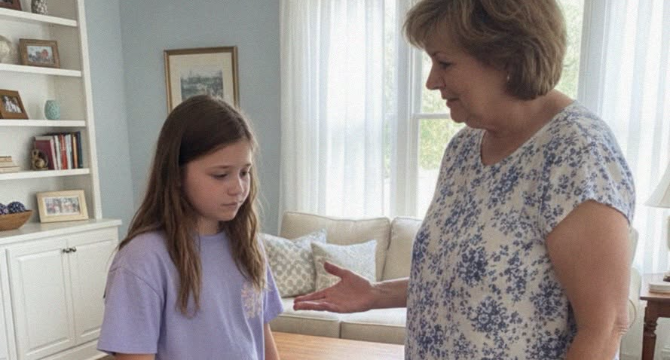
I knew something was off when my ten-year-old stopped talking about Grandma’s pancakes. By lunchtime, she was staring at a bowl that had been made just for her.
“Where’s mine?”
My daughter stood beside the kitchen table, looking at two sandwiches and a bowl of lettuce.
My mother didn’t hesitate.
She pointed at the bowl.
“Right there, sweetheart.”
Mia looked at me.
Then at Grandma.
The bowl had lettuce, six cucumber slices, and half a tomato.
Nothing else.
My mother pulled her own plate closer.
Turkey sandwich. Chips. Pickle.
Exactly the same lunch she’d made for me.
Mia still hadn’t moved.
“But you said we were having sandwiches.”
“We are.”
Grandma smiled. “You’re having something healthier.”
I picked up Mia’s bowl.
My mother frowned. “What are you doing?”
“Changing the menu.”
“Rachel.”
“No.”
I opened the refrigerator.
Behind me, Mia asked quietly, “Did I do something?”
That was the moment my anger stopped feeling hot.
It became very calm.
“No, honey.”
I pulled out the bread.
“You didn’t do anything.”
My mother sighed.
“Don’t turn this into a drama.”
I put turkey and cheese on the counter.
“You made lunch for three people and gave one of them lettuce.”
“Because one of us doesn’t need a sandwich.”
Mia looked down at her shirt.
Her fingers caught the fabric near her stomach.
I knew that movement.
I’d done it myself for years.
And suddenly I wasn’t standing in my mother’s kitchen at 38.
I was 11 again.
My name is Rachel. My daughter, Mia, is ten.
Every summer, we spend two weeks at my mother’s house.
My dad died four years ago, but we kept the tradition.
Mia loves it.
Or she did.
Mom has a pool.
A huge backyard.
A creek behind the property.
And, most importantly, according to Mia, a pancake griddle large enough to “feed an army.”
She’d talked about those pancakes for most of the four-hour drive.
“Do you think Grandma still has chocolate chips?”
“Probably.”
“Blueberries?”
“Probably.”
“Can we do both?”
“Sounds illegal.”
“Grandma lets me.”
“I know. That’s why I have concerns.”
She laughed.
Twenty minutes later, we pulled into Mom’s driveway.
My mother came outside before I’d turned off the engine.
Mia jumped out. “Grandma!”
Mom opened her arms. Then stopped.
Her eyes moved over Mia.
Face. Shoulders. Stomach.
Then she laughed. “Wow, Mia. What a little piggy you’ve become.”
Mia’s smile disappeared.
I froze with one hand on the trunk. “Mom.”
“Oh, don’t make that face.”
She hugged Mia anyway. Mia’s arms stayed at her sides.
My mother leaned back and pinched the fabric near her waist.
“You’re filling out everywhere.”
“Mom.”
“What?”
“Stop.”
“I’m her grandmother.”
As if that explained anything. Then she bent toward Mia.
“Don’t worry, sweetheart. Two weeks with Grandma and we’ll get some of that weight off you.”
“We?”
Mom straightened.
“I’ll get her eating properly.”
Mia looked at me.
She didn’t cry.
That almost made it worse.
Upstairs, she sat on the edge of the guest bed while I unpacked.
“Mom?”
“Yeah?”
“Am I fat?”
I stopped.
She stared at the floor.
I sat beside her. “No.”
“But Grandma said I was.”
“Grandma said something she shouldn’t have.”
Mia pinched the bottom of her shirt. “Would you tell me if I was?”
I chose my words carefully.
“I’d tell you if your doctor thought there was something we needed to care for. I would not make you ashamed of your body.”
She was quiet.
Then, “Grandma called me a pig.”
“I know.”
“Why?”
I knew the answer.
My mother had been doing versions of it for as long as I could remember.
At 13, she asked, “Are you really having seconds?”
At 15, she said, “That skirt looked better before you gained those five pounds.”
At 17, before prom, “If you stand sideways, your waist will look smaller.”
She never called herself cruel.
She called it honesty.
Concern.
Helping.
For years, I believed her.
I didn’t tell Mia all that.
I just said, “Sometimes Grandma thinks saying something mean is the same as helping.”
“That’s stupid.”
“Yes.”
From downstairs, Mom called, “Lunch!”
That’s how we ended up with two sandwiches and one bowl of lettuce.
I made Mia a sandwich. Turkey. Cheese. Mustard. Chips beside it.
Mom stared at me. “You’re making a mistake.”
“Eat your lunch.”
“Rachel, I’m trying to help her.”
“She didn’t ask for help.”
“Children don’t always know what they need.”
Mia looked between us.
“We’re not discussing her body at this table.”
Mom rolled her eyes. “Fine.”
For about 30 seconds, we ate in silence.
Then Mom reached for a chip.
“Oh, and new house rule.”
I looked up. “What rule?”
“No sweets between meals. No second helpings at dinner. Nothing after seven.”
Mia stopped chewing. “Who’s that rule for?”
“Everyone.”
Too fast. I looked at her plate.
Cookies sat beside her coffee.
“Everyone?”
Mom followed my eyes.
“Those are different.”
“How?”
“I already had them out.”
I almost laughed. Mia didn’t.
After lunch, she went upstairs.
Mom followed me into the kitchen. “You’re undermining me.”
“In what universe are you in charge of Mia’s diet?”
“This is my house.”
“Then make rules about wet towels.”
“Rachel.”
“Or shoes on the sofa.”
“I’m trying to stop a problem before it becomes one.”
“What problem?”
She lowered her voice. “You’ve seen her.”
That sentence did something to me. “Yes. I see my daughter every day.”
“You know what I mean.”
“I want you to say it.”
Mom crossed her arms. “She’s gaining too much weight.”
“According to who?”
“According to my eyes.”
“You’re not her pediatrician.”
“I don’t need a medical degree.”
I stared at her.
Then she said the sentence she’d used on me my entire childhood.
“One day she’ll thank me.”
Something clicked. I pulled out my phone.
Mom frowned. “What are you doing?”
“Nothing.”
I sent one text. Then another.
She shook her head. “You’re being ridiculous.”
“Maybe.”
“What are you texting?”
I put my phone away. “You’ll find out.”
That afternoon, Mia stayed close to me.
She didn’t swim.
Didn’t ask about pancakes.
At five, she came into the guest room.
“Can we go home tomorrow?”
That hurt. “You don’t want to stay?”
She shrugged. “I just don’t want Grandma watching me eat.”
There it was.
My ten-year-old daughter was already thinking about who might be watching her put food in her mouth.
“We’re going to fix this.”
“How?”
“You trust me?”
She nodded.
“Then give me until tomorrow.”
The next morning, Mom was making coffee when the doorbell rang.
She looked at me. “Are you expecting someone?”
“Yes.”
I opened the door.
My older sister, Megan, walked in carrying two grocery bags.
Behind her came Aunt Carol, Mom’s younger sister.
Mom stared. “What are you two doing here?”
Megan kissed her cheek. “Good morning.”
Aunt Carol set down her purse. “Rachel invited us.”
“For what?”
“Breakfast.”
Mom looked suspicious.
Then Megan started unloading groceries.
Eggs. Bacon. Fruit. Bread. Chocolate chips. Pancake mix.
Mia came downstairs.
Her face changed. “Pancakes?”
Megan smiled. “I’ve been told Grandma owns industrial equipment.”
Mia smiled for the first time since we’d arrived.
Mom didn’t.
She pulled me aside. “What is this?”
“A family breakfast.”
“You know my rule.”
“I remember.”
“Then why are there chocolate chips?”
Before I could answer, Aunt Carol called from the table.
“Which rule?”
Mom’s face changed.
I smiled. “The new one.”
“What new one?” Megan asked.
Mom looked at me.
I said, “No sweets between meals. No seconds. Nothing after seven.”
Megan slowly turned toward Mom.
“For everyone?”
“Rachel is twisting this.”
“How?”
Mom lowered her voice. “This was supposed to be about Mia.”
The kitchen went quiet.
Megan put down the spatula.
Aunt Carol stopped pouring coffee.
Mom realized what she’d said.
Mia stood near the stairs.
Megan asked, “Why is there a food rule specifically for Mia?”
Mom sighed.
“Oh, please. You’re acting like I starved her.”
“No one said that,” I said.
“She needs to lose a little weight.”
Megan looked at Mia. Then at Mom.
“She’s ten.”
“And?”
Aunt Carol leaned back. “Margaret, do you remember putting Rachel on grapefruit diets?”
Mom went still. “That’s not relevant.”
“It seems extremely relevant.”
I hadn’t asked Aunt Carol to say that.
Mom said, “Things were different then.”
Megan laughed once. “Were they?”
Mom turned on her. “I never said anything about your weight.”
Megan’s face changed. “No. You just told me I had ‘a pretty face if I’d stop eating so much.’”
Silence.
I’d never known that.
Mom looked genuinely surprised. “I don’t remember saying that.”
Megan shrugged. “I do.”
Aunt Carol said quietly, “People usually remember what hurt them longer than the person who said it.”
Mom sat down. For once, she had nothing to say.
I put a plate in front of her. Two pancakes. Bacon. Fruit.
She looked at it. Then at me.
“Is this the lesson?”
“No.”
“Then what is?”
I sat across from her. “The lesson is that nobody here comments on what anybody eats.”
Mom opened her mouth.
I continued. “No comments about portions. No comments about weight. No telling Mia she has to earn dessert.”
“This is my house.”
“Yes.”
“So you’re making rules in my house?”
“No.”
I stood. “I’m telling you the condition for us staying in it.”
That landed.
Mom looked toward Mia. “You’d leave over this?”
“Yes.”
“After driving four hours?”
“Yes.”
“Over a joke?”
“It stopped being a joke when she asked me if she was fat.”
Mom’s face changed.
“It stopped being a joke when she asked to go home because she didn’t want you watching her eat.”
Mom looked at Mia. Mia looked down.
And for once, Mom didn’t defend herself.
Breakfast was awkward. But we ate.
Mia had two pancakes. Then asked for another.
I saw Mom notice. Her mouth opened. Then closed.
That mattered.
Later, I found Mom alone on the porch.
She patted the chair beside her.
I sat.
For a while, neither of us spoke.
Then she said, “My mother used to weigh me.”
I looked at her. “What?”
“Every Monday. Before breakfast.”
I’d known Grandma Evelyn was difficult.
I hadn’t known that.
“If I’d gained, she changed what I ate that week.”
“How old were you?”
“Nine when she started.”
I swallowed. “So you knew how it felt.”
Mom’s jaw tightened. “I thought it helped me.”
“Did it?”
She didn’t answer.
Then she laughed quietly. “I still don’t own a bathroom scale.”
That was answer enough.
“Mom, being hurt doesn’t make hurting Mia protective.”
“I know.”
I waited.
She gave me a look. “Don’t make a big deal out of me saying it.”
I almost smiled.
Then she became serious.
“I saw Mia get out of the car and heard my mother’s voice come out of my mouth.”
“Then why didn’t you stop?”
“I didn’t realize it was her voice until this morning.”
That was probably the most honest thing she’d said all weekend.
That evening, Mom knocked on the guest-room door.
Mia was working on a puzzle. “Can I come in?”
Mia looked at me.
I nodded.
Mom sat on the other bed. “I’m sorry I called you a piggy.”
Mia kept looking at the puzzle.
“It wasn’t funny. And I shouldn’t have tried to decide what you were allowed to eat.”
Mia finally looked up. “Do you still think I’m fat?”
Mom froze.
I didn’t rescue her.
Finally, she said, “I think you’re Mia.”
Mia frowned.
“That’s not an answer.”
I almost laughed.
Definitely my daughter.
Mom took a breath.
“No. I don’t think there’s something wrong with your body. I think I saw something that scared me because of things that happened when I was little.”
“What happened?”
Mom told her. Not everything. Just enough.
About being weighed. About food being taken away. About believing thin meant safe.
Mia listened.
Then said, “That’s sad.”
Mom nodded. “It was.”
“So don’t do it to me.”
Mom’s eyes filled. “Okay.”
The rest of the trip wasn’t magically perfect.
Three days later, Mia reached for another roll at dinner, and Mom said, “Are you sure you—”
Then stopped. Mia raised an eyebrow.
Mom corrected herself. “Are you sure you can reach the butter?”
Mia smiled. “Nice save.”
By the end of the first week, pancakes were back.
Chocolate chips too.
On our last morning, Mom made them.
Mia ate three.
Mom said nothing about the number.
Instead, she asked, “More blueberries?”
“Yes.”
“Chocolate chips?”
“Obviously.”
When we packed the car, Mia hugged her.
“Next summer can we stay three weeks?”
Mom laughed.
“If your mother can tolerate me.”
I said, “We’ll review your performance.”
Mom rolled her eyes.
Before I left, she handed me a folded piece of paper.
“What is this?”
“Don’t read it here.”
I opened it at a gas station 20 minutes later.
It was a list.
“Things My Mother Said That I Will Not Say to Mia.”
There were nine items.
“Don’t you think you’ve had enough?”
“You’d be so pretty if you lost a little weight.”
“Nothing tastes as good as being thin.”
Some I’d heard from Mom. Some I hadn’t.
At the bottom, she’d written, “I thought refusing to repeat my mother’s worst behaviors meant I had become different from her. I didn’t realize I’d kept some of her words.”
“I’m sorry.”
I folded the paper and put it in my purse.
A month later, Mia video-called Mom while eating ice cream.
Mom asked what flavor.
“Cookie dough.”
“Good choice.”
Mia narrowed her eyes.
“That’s all?”
Mom smiled.
“That’s all.”
Then Mia took an enormous spoonful while staring directly into the camera.
Mom laughed so hard she had to take off her glasses.
I still think I should have confronted my mother years ago.
For too long, I’d treated her comments as annoying habits instead of what they were.
Little cuts.
Small enough to dismiss individually.
Sharp enough to remember decades later.
But I learned something that summer.
Sometimes people pass down the things that hurt them because they’ve spent so long calling those things love.
That doesn’t excuse it.
It explains why somebody has to be the first person to stop.
Mom thought the new rule was going to be about what Mia was allowed to eat.
She was wrong.
The only rule we kept was much simpler.
Nobody at that table gets to make a child ashamed of being hungry.