
Our daughter’s name is June.
She was born on a Tuesday in September, weighing seven pounds and four ounces, with Ethan’s nose and an instant determination to make sure the whole world knew exactly how she felt.
When June was hungry, there was never a slow buildup.
She was hungry immediately.
When she became tired, exhaustion appeared to consume her entire body within seconds.
And when she was happy, her whole face seemed to glow with the pure, unrestrained happiness that only babies appear to possess.She was four months old when her temperature climbed to 104 degrees.
Before I explain what happened in that emergency-room waiting room, you need to know who I was before that night.
My name is Rachel Donnelly.
I was thirty-one when June was born.
I’m a nurse practitioner, and by then I had already spent six years working in emergency medicine.
My profession had taught me how to stay functional while everyone around me was afraid.
When something goes wrong in an emergency room, someone needs to listen carefully.
Someone needs to understand the numbers.
Someone needs to know what requires immediate attention and what can wait.
Someone needs to explain what is happening to a family whose fear makes it difficult to take in information.
That person was often me.
In emergency medicine, you learn early that there will be time for panic later.
Later, you can sit alone in your car and tremble.
Later, you can cry in the parking garage.
Later, you can replay the entire shift until morning.
But while you’re inside the room, you remain composed.
Clarity comes first.
Always.
I had learned another form of endurance from my mother.
Two years before June was born, Mom was diagnosed with early-onset Parkinson’s disease at the age of fifty-eight.
I was twenty-six.
She handled the diagnosis the same way she had handled nearly everything else in her life—with dignity, determination, and almost no desire to be pitied.
She had raised three children after my father left.
Her philosophy had always been straightforward.
If something needs to be done and you are capable of doing it, then you do it.
Not when it becomes convenient.
Not when someone promises to appreciate you.
You recognize the need.
Then you act.
After Mom’s diagnosis, I arranged her medications, coordinated her appointments, drove to her house twice each week, and spent Sunday afternoons with her.
We talked about books.
Her garden.
The neighbors.
She had very specific opinions about everyone on the street and had no intention of giving them up simply because her body had begun cooperating less and less.
I never thought of caring for her as heroic.
It was simply something that needed to be done.
And I was capable of doing it.
Then there was Ethan.
Ethan Donnelly was thirty-three when we got married.
He was a software architect.
He was smart, funny, considerate, and sincerely affectionate in ways that made it very easy to love him at first.
If I had a difficult shift, he noticed.
Sometimes I would come home to find dinner already waiting.
If I casually mentioned wanting something, he might remember it three weeks later and surprise me with it.
During our first year of marriage, he was the kind of partner I had always hoped existed.
He was also Sylvia’s only son.
And that fact lived inside our marriage like a small crack hidden behind a wall.
Most days, you couldn’t see it.
Sometimes, you could even forget it existed.
But the structure had always been affected by it.
Sylvia was sixty-two.
She had been married to Ethan’s father, Gerald, for thirty-five years.
Gerald was kind, gentle, and exceptionally good at staying nearby without interfering with whatever Sylvia had decided was supposed to happen.
Sylvia had firm opinions about almost everything.
But her strongest opinions were always about Ethan.
He was her only child.
He had been the center of her emotional universe since the day he was born.
She loved him deeply.
I never questioned that.
The problem was that her love had protected him from discomfort so consistently that neither of them appeared to realize how deeply that protection had shaped him.
I noticed it early.
When I miscarried our first pregnancy, Sylvia called Ethan every day for a week.
She never called me.
I could hear her speaking to him from the other room.
“This must be so difficult for you.”
“You’re being incredibly strong.”
“Tell me what I can do.”
I was the person who had been pregnant.
I was the person whose body had lost the pregnancy.
Yet Sylvia’s concern was completely focused on Ethan.
I said nothing.
At the time, I convinced myself I was protecting my marriage.
I understood grief from a professional perspective.
I understood that people often responded imperfectly.
I told myself Sylvia simply didn’t know how to comfort anyone who wasn’t her son.
So I decided that battle wasn’t worth fighting.
Years later, I would realize that was a mistake.
Avoiding conflict doesn’t make conflict disappear.
Sometimes it simply allows the problem to remain hidden long enough to become larger.
Then June arrived.
Seven pounds, four ounces, Ethan’s nose, and enough personality to fill the entire hospital floor.
Ethan cried when they placed her in his arms.
He really cried.
He whispered her name while staring down at her as though the rest of the world had disappeared.
That moment was genuine.
I would remember it later.
For the first six weeks, he was the father I had imagined he would become.
He changed diapers without needing to be asked.
He got up during the night.
He learned to swaddle June with the same intense concentration he normally reserved for technical problems.
He wanted to do things properly.
And he did.
Around the seventh week, his company entered a major product launch.
His workdays became longer.
He came home exhausted.
I understood.
I had spent years returning home after impossible shifts with almost no energy left.
But gradually, the difference between us became impossible to ignore.
When I came home exhausted, June still needed to eat.
The laundry still had to be done.
Mom still needed her medication organized.
Life kept moving whether I had the energy for it or not.
When Ethan came home exhausted, he often acted as though being tired meant his responsibilities for the day were finished.
If I told him I was exhausted too, he heard me.
But my exhaustion rarely affected what he did.
It registered like rain when you’re safely inside.
You know it’s there.
You just don’t get wet.
I don’t believe Ethan was deliberately cruel.
He had simply spent thirty-three years learning that his exhaustion came first.
No one had ever explicitly told him that.
Sylvia had taught him through her behavior.
Whenever something became difficult, she made it easier.
Whenever Ethan became uncomfortable, she stepped in.
Whenever life presented him with a lesson about tolerating inconvenience, Sylvia often removed the inconvenience before he had a chance to learn from it.
Then June became sick.
Her fever began on a Thursday.
At first, it was 99.8.
Her pediatrician told me to keep monitoring it and call if it went above 101.
By six that evening, it had reached 101.4.
I called.
Tylenol.
Monitor.
Call again at 102.
At ten that night, the thermometer showed 102.3.
More Tylenol.
More monitoring.
At one in the morning, June’s temperature reached 104.1.
I called her pediatrician again.
This time, there was no hesitation.
“Take her directly to the ER.”
I woke Ethan.
“June’s fever is 104. We need to go.”
He was barely conscious.
But he got out of bed.
We got dressed.
He drove.
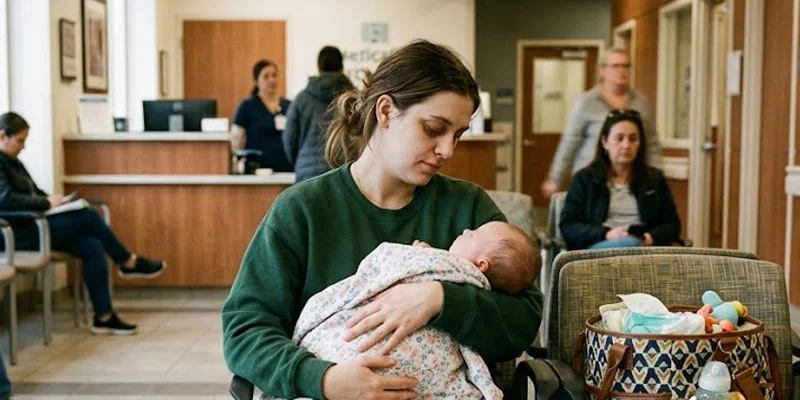
And around two in the morning, we were sitting in the emergency-room waiting area with our four-month-old daughter crying desperately in my arms.
It wasn’t her hungry cry.
It wasn’t her tired cry.
It was the cry of a baby whose body felt wrong and who had no way to understand why.
I rocked her.
Bounced her.
Sang the quiet, wordless melody I had made up during the first few weeks of her life.
Ethan paced around.
After some time, he checked the clock.
“This is ridiculous.”
I looked up.
“What?”
“I have a huge presentation at nine.”
“Her fever is still high. We have to wait.”
“I’m exhausted, Rachel.”
The words were sharp.
Then he pulled out his phone and walked away.
I assumed he was contacting work.
I kept rocking June.
Twenty minutes later, the automatic doors opened.
Sylvia entered the ER.
She was still wearing her coat.
She lived forty minutes away.
She had driven forty minutes across town at two in the morning.
Not for June.
For Ethan.
She walked straight past me.
She picked up his coat from the chair and pushed it toward him.
“Come on.”
I stared at her.
“What are you doing?”
“I’m taking Ethan home with me. He can sleep in his old room for a few hours before his presentation.”
For a moment, I genuinely believed I had misunderstood her.
“We’re waiting for June to see the doctor.”
Sylvia looked at me as if that fact was obvious but somehow beside the point.
“He’s exhausted. He cannot sit here all night.”
“So am I.”
Her expression became harder.
“You’re her mother.”
Then, in that waiting room, Sylvia finally said aloud what she had been communicating for years.
“He didn’t sign up for this much stress. You’re the mother. Figure it out.”
The room went quiet.
Not normal quiet.
The kind of uncomfortable silence that spreads through a public place when everyone realizes they have just witnessed something private.
I looked at Sylvia.
Then at Ethan.
He was holding his coat.
And waiting.
That was when everything finally made sense to me.
Ethan had learned to wait.
Wait for somebody else to decide.
Wait for somebody else to handle things.
Wait until the discomfort went away.
He had learned that if he waited long enough, another person—usually a woman—would eventually assume responsibility.
Sylvia had arrived to reinforce that lesson.
I stood.
Adjusted June against my chest.
Then looked straight at my husband.
“Ethan.”
“Rachel.”
“I need you to listen carefully.”
“I know. I’m sorry about Mom.”
“I’m not talking about your mother.”
He stopped.
“June has a temperature of 104 degrees.”
“I know.”
“She is four months old.”
“I know.”
“Do you understand why we are here?”
“We’re waiting for the doctor.”
“No.”
I kept my voice steady.
“We are here because our infant daughter has a dangerously high fever. We need to determine whether she has an infection and make certain she isn’t at risk of complications.”
He looked at me.
“This is a medical situation that requires both of her parents.”
“Rachel—”
“Not because I’m unable to handle it alone.”
He said nothing.
“I can.”
I looked down at June.
“But she deserves both parents.”
Then I looked back at him.
“And you stood in the delivery room holding her and promised you would be here.”
“I am here.”
“You called your mother from the ER and asked her to come take you home.”
Silence.
“When did you call her?”
“When I stepped away.”
“So while your daughter was screaming with a 104-degree fever, you called your mother to rescue you because you were tired.”
“My presentation is at nine.”
“I know.”
I shifted June slightly.
“But June doesn’t know about your presentation.”
He looked down at her.
By then, June had worn herself out.
Her screaming had become a smaller, exhausted cry.
Somehow, that sound hurt even more.
I turned toward Sylvia.
She was still standing beside Ethan, apparently expecting him to leave with her.
“Sylvia.”
“What?”
“Sit down.”
Her eyes widened.
“Excuse me?”
“Sit down or go home.”
She looked toward Ethan.
“Ethan?”
He didn’t respond.
He looked at me.
Then at June.
Then he sat down.
Sylvia remained standing for another moment.
Finally, she sat as well.
I remained standing.
“This is what happens now.”
Neither of them spoke.
“We wait for the doctor.”
I looked at Ethan.
“You stay.”
He gave a slight nod.
“When the doctor examines June, you are in the room.”
Still no answer.
“If she is admitted, you stay through that process.”
I continued.
“If she is discharged with instructions, you hear those instructions too.”
I looked at him.
“Your presentation may happen tomorrow, or it may not. That is something you work out with your employer.”
Then I glanced at our daughter.
“Your baby has a 104-degree fever. That is the only priority that matters tonight.”
Sylvia started to speak.
“Rachel—”
“I’m not finished.”
For once, she stopped.
“I know you love Ethan.”
Her expression changed.
“I have never questioned that.”
Then I said the thing I had avoided saying for three years.
“But I have watched what your version of love has allowed him to remain.”
“What is that supposed to mean?”
“It means that every time life became difficult, you rushed in.”
She stared at me.
“When he was uncomfortable, you removed the discomfort.”
“When he needed to learn that someone else’s needs mattered just as much as his, you reminded him that his needs came first.”
Her face tightened.
“And tonight you drove forty minutes in the middle of the night to take a thirty-three-year-old man away from his sick four-month-old daughter because he was tired.”
“I was helping him.”
“You screamed at me in an emergency room and told me your son didn’t sign up for this.”
“He didn’t.”
“He became a father.”
“That is different—”
“There is no version of fatherhood that allows you to skip sitting in an emergency room at two in the morning when your infant has a dangerous fever.”
“He has responsibilities.”
“Yes.”
I nodded toward June.
“She is one of them.”
“You can handle this.”
“Yes.”
That answer seemed to catch her off guard.
“I can handle it.”
I lowered my voice.
“I have been handling most of it for four months.”
Sylvia glanced at Ethan.
“I am not asking him to stay because I’m incapable.”
I looked at my husband.
“I am asking the man I married to stand beside me while I do something difficult.”
Sylvia turned toward her son.
“Ethan.”
He finally looked at her.
Something was changing in his expression.
Guilt.
Confusion.
Recognition.
The look of someone realizing that a truth he had lived with for decades might not actually be true.
“Mom.”
“Don’t let her speak to me like this.”
“Mom.”
“I drove forty minutes because you called me.”
“I know.”
He took a breath.
“I shouldn’t have called.”
“You needed help.”
“No.”
His voice was quiet.
“I needed to stay.”
Sylvia froze.
He continued.
“Rachel is right.”
“Ethan.”
“She’s right, Mom.”
He stared at the floor.
“I called you because I was tired and I didn’t want to be here.”
Then he looked at June.
“Not because I needed help.”
He swallowed.
“Because I wanted to escape something uncomfortable.”
Sylvia shook her head.
“She is making you say this.”
“No.”
He looked at me.
Then back at his mother.
“I’ve been doing this for months.”
His voice became stronger.
“I keep using work and exhaustion as reasons to let Rachel carry more.”
“She can handle it.”
“That isn’t the point.”
That sentence surprised all three of us.
He continued.
“I’ve watched her handle everything.”
“June.”
“Her job.”
“Her mom.”
“Everything.”
“And I’ve been acting like being tired means I get to step away.”
Sylvia looked hurt.
“I was only trying to help you.”
“I know.”
He nodded.
“You’ve always tried to help me.”
Then he paused.
“But I think some of that helping stopped me from learning how to stay when things are hard.”
Sylvia said nothing.
“That’s what I need to learn.”
He looked toward June.
“How to stay even when I don’t want to.”
His voice cracked slightly.
“That’s being a parent.”
He turned back toward his mother.
“I don’t want to be the thirty-three-year-old man who calls his mom from an emergency room because his baby being sick is inconvenient.”
Sylvia looked stunned.
“What do you want me to do?”
“Go home.”
Her face changed.
“Ethan.”
“Please.”
Then he added,
“I love you.”
His voice softened.
“But I need to stay here with my family.”
Sylvia looked at me.
I said nothing.
I didn’t have to.
She slowly stood.
Picked up her bag.
“I’ll call tomorrow.”
“Okay.”
She walked toward the automatic doors.
Then she stopped.
Turned around.
“Rachel.”
“Yes?”
Her voice was quieter than I had ever heard it.
“I’m sorry.”
I looked at her.
“Thank you.”
Then she left.
The waiting room slowly returned to normal.
People went back to looking at their phones.
The nurses resumed their paperwork.
The room became anonymous again.
Ethan sat beside me.
He gently placed one hand against June’s back.
“It’s okay,” he whispered.
“Daddy’s here.”
June opened her eyes and looked toward his face.
Then she settled a little.
Ethan looked at me.
“I’m sorry.”
“Yes.”
“For calling my mom.”
“Yes.”
“And for everything before tonight.”
“Yes.”
“I know saying sorry isn’t enough.”
“No.”
“But I mean it.”
“I know.”
He swallowed.
“What do you need from me?”
“I need you to stay.”
“I’m staying.”
“Not just tonight.”
He met my eyes.
“I know.”
“Every night that needs you.”
“Yes.”
I took a breath.
“I have been doing most of this alone for four months.”
“I know.”
“I’m good at handling things.”
“I know.”
“But handling everything alone is not what I agreed to.”
“No.”
“What did you agree to?”
“A partner.”
He nodded.
“Yes.”
“That’s what I still want.”
I paused.
“I’m not threatening to leave.”
“I’m not interested in drama.”
“I want my partner to actually show up.”
“I will.”
“Start tonight.”
“I am.”
At 3:47 a.m., they finally called June’s name.
We went back together.
The pediatric resident introduced herself as Dr. Owens.
She carefully examined June.
Then she explained that June had a urinary tract infection.
It wasn’t uncommon in infant girls.
They would take a culture.
Begin antibiotics.
Monitor her fever.
She explained the medication schedule.
The warning signs we needed to watch for.
When we should call the pediatrician.
When we needed to return to the ER.
Ethan listened.
Actually listened.
He asked questions.
Good ones.
They weren’t questions meant to make it look as though he was paying attention.
They were questions from someone who sincerely wanted to know what needed to be done.
We left the hospital around 5:15.
June had received her first antibiotic dose.
Her fever had fallen to 101.3.
She was still sick.
But she was somewhat calmer.
I sat in the back beside her.
Ethan drove.
Slowly.
Carefully.
When we arrived home, I fed June.
She ate less than normal and eventually fell asleep against my chest.
Ethan sat close by.
“Do you want me to take her?”
“In a minute.”
“Okay.”
Then he said,
“I’m calling out of work.”
I looked at him.
“The presentation?”
“I’ll tell them I have a family emergency.”
“You don’t have to.”
“Yes.”
He looked toward June.
“I do.”
“You need sleep.”
“So do you.”
“She needs to be monitored today.”
He held out his hand.
“I’m staying.”
I studied him.
Then nodded.
“Okay.”
At eight, he called his boss.
He explained what had happened.
His boss said the presentation could be rescheduled.
That was all.
No catastrophe.
No career-ending disaster.
Just a manager saying:
“Take care of your family.”
Ethan returned to the living room.
“Rescheduled.”
Then he held out his arms.
“Rachel.”
I handed June to him.
He settled her against his chest.
“Go sleep.”
I did.
For four hours.
When I woke, Ethan was sitting on the couch.
June was asleep in the bassinet beside him.
He wasn’t watching television.
He wasn’t looking at his phone.
He was watching her.
He looked up when I walked in.
“Her temperature is 100.2.”
“I checked it two hours ago.”
“I gave her the next antibiotic dose at nine.”
“She ate a little.”
“Not much.”
“But something.”
“She fell asleep about an hour ago.”
I sat beside him.
June looked more peaceful.
“She looks better.”
“I think so too.”
Then Ethan became quiet.
“Rachel?”
“Yes?”
“I want to help with your mom.”
I turned toward him.
“My mother?”
“You drive over there twice a week.”
“Yes.”
“I’ve never really helped.”
I waited.
“I’ve watched you work, take care of June, and take care of your mother.”
He shook his head.
“That’s basically three full-time jobs.”
“You work too.”
“I know.”
“But not proportionally.”
I almost smiled.
“No.”
“I want to actually be useful.”
“Not look useful.”
“Be useful.”
“What does that mean?”
He had already considered it.
“I drive your mom to her Thursday appointments.”
“You take Wednesday mornings.”
“I take Sunday afternoons.”
“And at night with June, we split it.”
He paused.
“Actually split it.”
I nodded.
“That’s what sharing looks like.”
“I know I’ve said things before and not followed through.”
“Yes.”
“I want you to call me out when I stop.”
“I have been.”
He winced.
“I know.”
Then he nodded.
“I guess I need to start listening before you reach the point where you have to force me to listen.”
“That would help.”
He gave a small smile.
Then his expression grew serious again.
“I need to talk to my mom too.”
“Yes.”
“I need to be the one who does it.”
“Yes.”
“I’ve allowed her to become a problem in our marriage because confronting her makes me uncomfortable.”
I looked at him.
“And I’ve been choosing my comfort over your reality.”
He paused.
“That’s what I’ve been doing.”
Every time he said:
“She means well.”
Every time he ignored something Sylvia said.
Every time he told me to let it go.
Every time he avoided a difficult conversation because avoiding it was easier for him.
He had been choosing comfort.
“I’m going to call her later.”
“After June’s next temperature check.”
“Okay.”
Then he asked something I hadn’t expected.
“Why didn’t you just let me leave?”
I looked at him.
“What?”
“Tonight.”
“You could have handled the hospital by yourself.”
“You could have called your sister.”
“You could have called somebody else.”
“You didn’t need me.”
“So why did you make me stay?”
I thought for a moment.
“Because I wanted you to be the person who stays.”
He looked at me.
“Not just any father?”
“You.”
“Why?”
I looked toward June.
“You were there when she was born.”
“You held her.”
“You cried.”
“That version of you was real.”
He nodded.
“And I married that man.”
“June deserves that man too.”
“Not only during the beautiful moments.”
“During nights like last night.”
“I want to be that person.”
“I know.”
“How?”
“Because you stayed.”
“You made me.”
“Yes.”
“But your mother was right there.”
“You still could have walked out.”
He looked down.
“I stopped wanting to.”
“When you said everything in the waiting room…”
He shook his head.
“I didn’t want the excuse anymore.”
“I wanted to become the kind of person who didn’t need a reason to stay.”
“That’s who I need you to become.”
“I know.”
June stirred.
Without thinking, Ethan reached into the bassinet and gently placed his hand against her.
She settled.
I watched him.
He wasn’t looking at me.
He was looking at his daughter.
“She’s beautiful.”
“Yes.”
“I don’t say that enough.”
He glanced at me.
“About her.”
Then:
“About you either.”
“One thing at a time.”
He smiled.
“First, staying.”
“Yes.”
“Then talking to Mom.”
“Yes.”
“Then helping with your mother.”
“Yes.”
“Then everything else.”
“Everything else.”
He nodded.
“Step by step.”
The morning light filled the room.
It was the kind of light you only notice after staying awake for an entire night.
June continued breathing quietly.
The antibiotic was beginning to take effect.
Her fever would keep coming down.
By the following morning, it would be below one hundred.
Soon, she would be herself again.
Hungry immediately.
Tired suddenly.
Happy with her entire face.
But first, there was that morning.
The quiet room.
Ethan’s hand resting beside June.
The strange stillness of a house that had endured something difficult and finally reached the other side.
“Ethan?”
“Yeah?”
“Thank you for staying.”
He looked at me.
“Thank you for making me.”
Then he shook his head.
“I mean that.”
“I needed someone to make me stay.”
He looked toward June.
“I’m going to work on becoming someone who doesn’t need that anymore.”
“I know.”
“But thank you.”
I nodded.
“You’re welcome.”
And we sat there together with our daughter as the morning filled the room.
The night was finished.
Nothing dramatic had changed.
And somehow, everything had.