
Easter Changed Our Family Forever
From the outside, Easter at my parents’ house looked like something out of a magazine.
The dining table was covered with my mother’s favorite spring tablecloth. The smell of roasted ham filled the house, children laughed in the backyard, and sunlight poured through every window. Anyone walking past would have thought we were the perfect family.
The truth was very different.
My wife, Marianne, had spent the entire morning helping everyone else. She set the table, checked the food, refilled drinks, and made sure my father—still recovering from surgery—never had to ask for anything.
That was simply who she was.
She never needed attention. She showed love through the little things.
After eight years of marriage, I believed no one could question whether she belonged in our family.
I was wrong.
My Aunt Carol had never truly accepted her.
She never raised her voice or started obvious arguments. Instead, she hid her insults behind polite smiles.
She would ask Marianne whether she planned to spend holidays with her “real family,” or casually remind everyone that certain traditions were only for “our side of the family.”
Marianne always smiled and ignored it.
She refused to create drama.
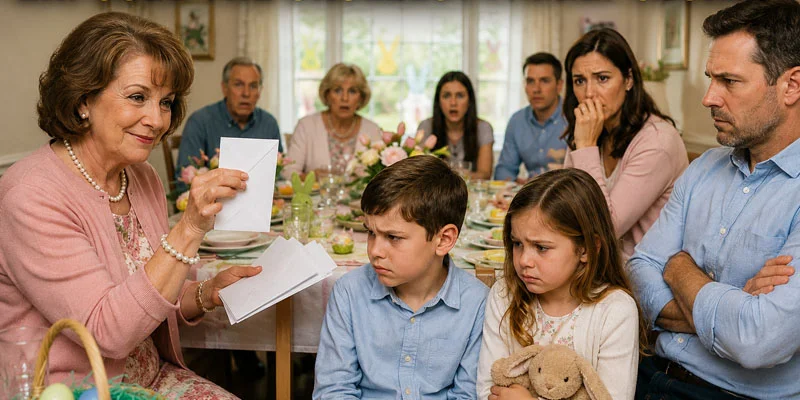
That afternoon, after lunch, everyone gathered around the dining table for coffee and dessert.
Carol suddenly picked up her expensive handbag.
“I have a little Easter surprise for the kids,” she announced.
Every child hurried toward her.
She handed thick white envelopes to Lucas.
Then Emily.
Then Noah.
Then Sophie.
Each envelope contained five hundred dollars.
The room filled with excitement.
People laughed, thanked Carol, and joked that she was spoiling the children.
My son Ethan stepped forward, expecting his turn.
My daughter Lily waited quietly beside me.
Carol closed her purse.
That was it.
Lily looked up at me with confused eyes.
“Dad… did Aunt Carol forget us?”
Every conversation stopped.
Even the children became quiet.
My mother slowly looked toward Carol.
“You missed Ethan and Lily.”
Carol didn’t even pretend it was an accident.
“No,” she replied calmly. “I only gave money to children covered by the family trust.”
The words hung in the air.
I looked directly at her.
“What exactly does that mean?”
She glanced at Marianne before answering.
“The trust is for blood relatives. Marianne married into the family. That doesn’t make her children part of our bloodline.”
Marianne lowered her eyes.
“They’re my children,” I said.
Carol shrugged.
“Maybe legally. But it’s different. If Marianne wants them to have spending money, she can earn it herself.”
The room felt colder.
Nobody defended my wife.
Nobody defended my children.
Lily started crying against my side.
Ethan stared at the floor as if disappearing would somehow make everything easier.
That hurt more than Carol’s words ever could.
I stood up.
“If that’s how you define family,” I said quietly, “then we’re leaving.”
I took Ethan’s hand.
Marianne picked up Lily.
Carol laughed behind us.
“Oh, don’t be so dramatic. It’s just money.”
I didn’t answer.
Not one person followed us to the driveway.
The ride home was almost silent.
After several miles, Marianne whispered, “I’m sorry.”
I looked at her in disbelief.
“You have absolutely nothing to apologize for.”
She nodded, but I could tell she didn’t believe me.
Carol had spent years planting doubts that finally bloomed.
Once the kids were settled in front of a movie, I walked into my home office.
Carol had forgotten one important detail.
For years, I had worked as a commercial development consultant.
When her biggest redevelopment project needed professional guarantees and regulatory support, I had personally signed documents that helped move everything forward.
She called it family helping family.
Apparently, that only applied when she needed something.
I opened my computer and reviewed every agreement connected to the project.
Everything was still there.
Within an hour, I prepared formal notices withdrawing my professional support under clauses requiring good-faith administration of the trust.
Copies went to lenders, attorneys, regulatory officials, and Carol herself.
I pressed Send.
Less than thirty minutes later my phone exploded.
Carol called.
Again.
Again.
Again.
Then the text messages started.
“What have you done?”
“Call me immediately.”
“The financing is being reviewed.”
I ignored every message.
Marianne looked at me.
“What happened?”
“I simply told everyone the truth.”
That evening my parents called repeatedly.
I didn’t answer.
Later, my father left a voicemail saying Carol insisted there was another version of the trust documents.
Curious, I checked my email.
Attached was an old amendment written by my grandfather years before his death.
One paragraph changed everything.
The trust clearly included adopted children, stepchildren raised as family, and any child openly recognized and supported by a beneficiary.
Carol had known.
She had lied anyway.
I forwarded the amendment to every beneficiary, the trust attorney, and the project advisers.
I added only one sentence.
“Please review the attached amendment before any further decisions are made.”
I didn’t need to accuse anyone.
The paperwork spoke for itself.
Within days, attorneys requested a complete review of past trust distributions.
Financial institutions paused several approvals until questions were answered.
Independent auditors became involved.
Carol called me thirty-six times that week.
I answered none of them.
Several days later, my parents arrived at our front door carrying Easter candy.
Neither looked comfortable.
My mother knelt beside Lily.
“I’m sorry,” she said softly. “I should have spoken up.”
Lily looked at me first.
When I nodded, she simply listened.
She wasn’t ready for a hug.
That was her choice.
Ethan asked my father one question.
“Why didn’t you help us?”
My father looked ashamed.
“I was afraid of upsetting your aunt.”
It wasn’t a good answer.
But at least it was honest.
The investigation continued for months.
Nobody discovered millions of missing dollars.
Instead, they found years of selective decisions.
Some relatives received benefits early.
Others waited.
People who agreed with Carol seemed to receive more opportunities.
Those who challenged her often received less.
The Easter envelopes hadn’t been the real problem.
They had simply exposed everything else.
Eventually, Carol was removed from managing the trust.
Independent oversight replaced her authority.
Future decisions required multiple approvals instead of one person’s opinion.
Months later, Ethan and Lily received the distributions they had always been entitled to, along with a written apology from the new administrator.
Ethan carefully placed the apology inside a folder.
Lily bought colorful stickers with a small portion of the money and saved the rest because Marianne taught her that saving money meant having choices.
The next family gathering felt different.
People tried much harder.
Some apologized.
Others welcomed Marianne with genuine warmth.
No one ever spoke about “blood relatives” again.
Carol wasn’t invited.
No one seemed eager to change that.
Looking back, Carol thought she could decide who belonged simply by handing out envelopes.
Instead, she reminded all of us what family really means.
It’s not defined by money.
It’s not determined by biology.
It’s measured by the people who refuse to let the ones they love stand alone.
That Easter, my children didn’t lose their place in the family.
Everyone else finally learned they had always deserved it.