
“After my daughter whispered, “Grandma h:u:r:t my hands for taking a piece of bread,” I drove straight back to that perfect-looking house—and made sure their so-called “lesson” became something the entire neighborhood would never ignore.
The call came while I was folding laundry that smelled like cheap detergent and exhaustion. Faded shirts, worn socks, Lily’s pajamas stretched thin from too many washes—everything about that moment felt normal… until it wasn’t.
My phone vibrated across the couch. Unknown number.
I picked up immediately. Mothers like me learn to sense when something is wrong before a single word is spoken.
“Hello?”
A small breath. Then Lily’s voice—soft, trembling.
“Mommy?”
Everything inside me went still.
“Lily? Where are you? Why are you calling from another phone?”
“I’m in the bathroom,” she whispered. “I locked the door.”
My heart started racing.
“Sweetheart, are you okay?”
Silence. Then a quiet sob she tried to hide.
“Mommy… please don’t be mad.”
I stood up so quickly the laundry fell to the floor.
“I’m not mad. I’m here. Tell me what happened.”
Her words rushed out, like she was afraid someone would hear.
“Grandma hurt my hands… because I took bread before dinner. She said I was stealing. She said pain teaches thieves.”
The world shifted.
“What do you mean she hurt your hands?”
“She made me hold something hot,” Lily whispered. “I tried to pull away, but she pushed my hands down. She said if I cried, it meant I was lying… Mommy, it hurts.”
Something inside me snapped into clarity. The panic disappeared, replaced by something colder.
“Where is she now?”
“Watching TV.”
“And your dad?”
“In the garage.”
My jaw tightened.
Evan had taken Lily there for what he called a “stable weekend.” He loved that word—stable. His parents loved it even more. Their spotless home, their perfect image, their quiet neighborhood—it all mattered to them. That image was everything.
“Listen to me,” I said, already moving. “Stay in that bathroom. Don’t open the door unless it’s me or the police. Okay?”
“Okay…”
I was already out the door.
I called emergency services while driving, reporting that my seven-year-old daughter had injuries and that it wasn’t an accident.
When I arrived, the house looked exactly the same—clean, polished, flawless. The kind of place that makes people believe nothing bad could ever happen inside.
I ran to the door.
Janice opened it before I could knock again, calm and composed, like she was expecting guests.
“This is unnecessary,” she said, irritated.
I pushed past her.
“Lily!”
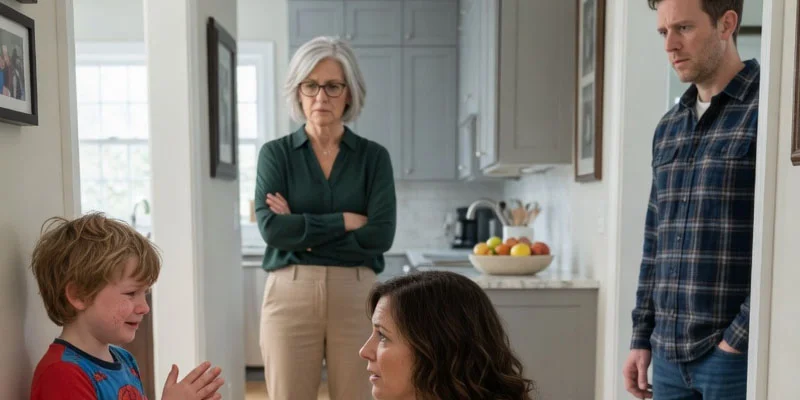
I found her curled against the hallway wall, small and shaking, holding her hands out like even the air hurt.
I dropped to my knees.
Her palms were red and swollen—clearly injured, clearly not an accident.
“Who did this?” I asked.
She glanced behind me.
“Grandma…”
Janice sighed, as if Lily had inconvenienced her.
“I corrected her,” she said calmly.
I turned slowly.
“You did what?”
“She took food after being told not to. In this house, actions have consequences.”
My phone was already recording.
“You hurt my daughter for touching bread?”
Janice lifted her chin.
“I let her feel it briefly. Better she learns now than grow up thinking she can take what isn’t hers.”
Then Evan walked in. He looked at Lily, then at me—and still tried to downplay it.
“Can we not turn this into something bigger?” he said. “Mom was just disciplining her.”
That was when I understood something clearly:
Cowardice can harm a child just as much as cruelty.
“Your daughter called me from a locked bathroom,” I said.
“She overreacts when she’s scared,” he replied.
Lily clung to my coat, careful not to use her hands.
That detail will stay with me forever.
“Look at her hands,” I said.
He glanced—and looked away.
Janice didn’t even bother.
“Children cry when they’re corrected,” she said.
I stepped closer.
“Say that again.”
For the first time, uncertainty flickered across her face. Maybe it was my tone. Maybe it was the distant sound of sirens growing louder.
“I taught her a lesson,” she said.
“With something hot.”
“I did what was necessary.”
There it was.
The sirens came closer.
Evan looked toward the window. Lily pressed into me.
“You called the police?” he asked.
“No,” I said coldly. “Lily called the only parent she knew would protect her.”
Blue lights flooded the house, reflecting across its perfect surfaces—exposing everything.
Janice stiffened, offended that consequences had finally reached her door.
I lifted Lily carefully, holding her close as she winced.
I whispered into her hair,
“No one who loves you will ever call pain a lesson again.”
Then came the knock.
And when the officer stepped inside, looked at her hands, and asked what happened—
Janice opened her mouth to answer…
PART 2
She told me she was locked in the bathroom at her grandmother’s house. She told me not to be angry. And then she said the sentence that made everything tilt: her grandmother had burned her hands for taking bread.
She said she’d been forced to hold a hot pan as punishment. That “pain teaches thieves.”
Evan—my husband, though we were barely holding the marriage together—had taken her there for the weekend, saying she needed “stability.” To him, his parents’ perfect home—large, clean, orderly—was proof of morality.
I grabbed my keys and called emergency services before I even reached the parking lot. I told them my seven-year-old daughter had burns on her hands. I said it wasn’t an accident.
When I got to the house, her grandmother opened the door calmly, like nothing had happened.
PART 3
The officer’s voice cut through the silence, calm but firm, asking a question no one in that house was prepared to answer truthfully. I felt my body trembling, my hands burning, my breath uneven as I clung to my mom’s coat. Grandma’s voice started smooth, controlled, like she had practiced it her whole life. But this time, something cracked. The room didn’t belong to her anymore. The moment didn’t belong to her anymore. For the first time, I realized—adults don’t always get to decide the truth.
My mom didn’t say much. She didn’t need to. Her arms around me said everything louder than words ever could. I could feel her heartbeat—fast, angry, protective. It felt like safety. The kind I didn’t know I had lost until that moment. My dad stood there, silent, smaller than I had ever seen him. He looked at me, then away again. That hurt more than my hands. Because in that moment, I understood something no child should ever have to learn: silence can betray you.
The officer knelt in front of me, his voice gentle, asking if I could tell him what happened. My throat felt tight, but my mom nodded softly. So I did. I told him about the bread. About the heat. About how I tried not to cry because I thought crying would make it worse. Every word felt heavy, but also freeing. Like I was finally putting something down that I should never have been carrying in the first place. And as I spoke, I saw something change in the room—belief replacing doubt.
Grandma tried to interrupt, her tone sharp, defensive, but it didn’t land the same way anymore. The officer stopped her. Just like that. Her control—gone. Her “lesson”—exposed. And suddenly, that perfect house didn’t look perfect at all. It looked cold. It looked empty. It looked like a place where fear had been hiding behind clean floors and quiet walls. I realized then: appearances don’t protect you. People do. And only if they choose to.
When we walked out of that house, the blue lights still flashing, I didn’t look back. I didn’t need to. My mom carried me to the car like I was something precious—not something broken. She kissed my forehead and whispered again that no one who loves me would ever hurt me to teach me anything. And for the first time that night, I believed her completely. Not because of what she said—but because of what she did.
That night didn’t just change what happened to me. It changed what I understood about love, about truth, about courage. I wasn’t the girl who took bread anymore. I was the girl who spoke. And they? They weren’t untouchable anymore. Because sometimes, all it takes is one voice—small, shaking, but honest—to make an entire world finally listen.