
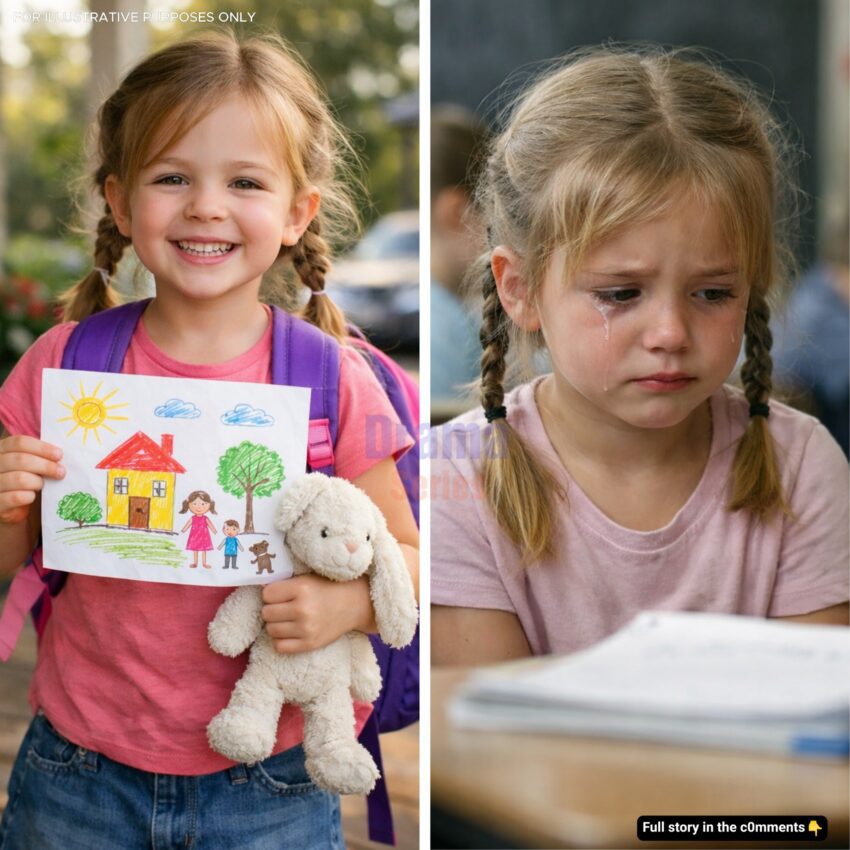
For weeks, my daughter returned from school with dim eyes and silent tears, and I couldn’t understand why. Trusting my instincts, I placed a recorder in her backpack—and what I heard was every parent’s nightmare.
I’m 36, and for most of my adult life, I believed I had everything figured out: a strong marriage, a safe neighborhood, a cozy home with creaky wooden floors, and a daughter who lit up every room she entered. That sense of certainty shattered the day my little girl started school.
My daughter Lily, six years old, was the kind of child who made other parents smile—always talking, always sharing, always dancing to songs she invented on the spot. She was the heartbeat of my world.
When she began first grade that September, she marched through those school doors as if she were opening her own little kingdom. Her backpack looked enormous on her tiny frame, the straps bouncing with every step. Her uneven braids—done proudly by herself—bobbed as she turned to shout from the porch, “Bye, Mommy!”
I laughed every time. After drop-off, I’d sit in the car, smiling to myself. Each afternoon, she came home buzzing with stories: glitter glue disasters that “exploded everywhere,” who got to feed the class hamster, and how her teacher, Ms. Peterson, praised her for having “the neatest handwriting in class.” I even teared up when she told me that. Everything felt so right.
Lily loved school. She quickly made friends, and every day she returned with joy. One morning, she reminded me, “Don’t forget my drawing for show-and-tell!” She was thriving.
For weeks, life was perfect. But by late October, something began to unravel.
It started subtly—no dramatic shift, just late mornings and sighs too heavy for a six-year-old. Gone were the cheerful skips to the car, the humming of alphabet songs, the mile-a-minute chatter about art projects and line leaders. Instead, she lingered in her room, fidgeting with her socks as if they were thorns. Her shoes “didn’t feel right.” Tears appeared without reason. She slept more, but never seemed rested. I told myself it might be seasonal blues. Kids go through phases, don’t they?
Then one morning, I found her sitting on the edge of her bed in pajamas, staring at her sneakers as if they were something to fear.
“Sweetheart,” I said softly, kneeling, “we need to get dressed. We’ll be late for school.”
Her lip trembled. “Mommy… I don’t want to go.”
My stomach tightened. “Why not? Did something happen?”
She shook her head, eyes wide. “No. I just… I don’t like it there.”
“Did someone hurt your feelings? Say something mean?”
Her gaze dropped to the carpet. “No. I’m just tired.”
“You used to love school,” I reminded her.
“I know,” she whispered. “I just don’t anymore.”
I wondered if she’d gotten a bad grade or had a fight with friends, but she refused to talk. That afternoon, she didn’t run into my arms. She walked slowly, head down, clutching her backpack like it was holding her together. Her sweater bore a thick black line across the front, as if someone had drawn on it. Her drawings were crumpled.
At dinner, she barely touched her food. “Lily,” I said gently, “you know you can tell me anything, right?”
She nodded without looking up. “Uh-huh.”
“Is someone being mean to you?”
“No,” she said, her voice cracking, before running to her room. I wanted to believe her, but I saw fear in her eyes.
She had always been happy, kind, the type to share snacks and hug friends goodbye. I knew the kids, knew their parents. Nothing about them seemed cruel. So why was my daughter coming home in tears every day?
The next morning, I slipped a recorder into her backpack.
It was a small digital recorder I’d once used for interviews in the Homeowners’ Association newsletter. I tested it, then tucked it behind tissues and hand sanitizer in her bag. She didn’t notice.
That afternoon, I retrieved it and listened while Lily watched cartoons. At first, I heard ordinary classroom sounds—pencils scratching, chairs shuffling, paper crinkling. Comforting. I almost thought I’d imagined it all.
Then came a woman’s voice. Sharp. Impatient. Cold.
“Lily, stop talking and look at your paper.”
My hand shook. That wasn’t Ms. Peterson. That voice was harsh, clipped, unsettling.
“I—I wasn’t talking. I was just helping Ella—” Lily’s voice was small, nervous.
“Don’t argue with me!” the woman snapped. “You’re always making excuses, just like your mother.”
I froze. Did I hear that right?
“You think the rules don’t apply to you because you’re sweet and everyone likes you? Let me tell you something, little girl—being cute won’t get you far in life.”
My baby sniffled, trying not to cry.
“And stop crying! Crying won’t help you. If you can’t behave, you’ll spend recess inside!”
Rustling followed—Lily wiping her face. Then the teacher muttered under her breath: “You’re just like Emma… always trying to be perfect.”
Emma. My name.
This wasn’t random cruelty. It was personal.
I replayed it, every word confirming my fear. My knees weakened. Who was this woman?
That night, I couldn’t sleep. Her venomous voice echoed in my head. My daughter had endured this daily, and I hadn’t seen it.
The next morning, I marched into the principal’s office. Calm voice, clammy hands. “I need you to listen to this,” I said, pressing play.
The principal’s polite smile faded as the recording played. Her face drained of color when the teacher said my name.
“What the hell is going on in this school?!” I demanded.
“Emma,” she said slowly, “I’m so sorry. But are you sure you don’t know who this is?”
“I thought Lily’s class had Ms. Peterson,” I said.
She checked her computer. “Ms. Peterson’s been out sick. We brought in a long-term sub. Her name is Melissa. Here’s her picture.”
Melissa. A name I hadn’t heard in over a decade.
My voice was thin. “We went to college together.”
The principal blinked. “You know her?”
“Barely,” I admitted. “We weren’t friends. She once accused me of trying to get better grades by being nice to a professor. She even said I was ‘fake sweet, like a sugar-coated knife.’ I hadn’t thought of her in 15 years.”
The principal straightened. “We’ll handle this internally. Please, Emma, let us speak with her first.”
But before I could decide what to do, the school called me in. Melissa was waiting, arms crossed, jaw clenched. When she saw me, she smirked.
“Of course it’s you,” she said flatly.
My stomach flipped. “What did you just say?”
“You always thought you were better than everyone else,” she sneered. “Professors adored you. Classmates adored you. Perfect little Emma—smart, sweet, kind. Always smiling like life was a Hallmark movie. You walked around like you didn’t even notice how everyone just… gave you things.” Her voice shook with bitterness. “Guess it runs in the family.”
“That was 15 years ago,” I said quietly. “None of that gave you the right to treat my daughter like this!”
“She needed to learn the world doesn’t reward pretty little girls who think the rules don’t apply to them,” she snapped. “Better now than later.”
“You bullied my child because of me?” I asked, heart pounding.
“She’s just like you,” Melissa hissed. “All smiles and sunshine. It’s fake!”
The principal’s voice cut through: “That’s enough. Melissa, please step outside.”
Melissa left, eyes locked on mine.
I was frozen. The principal touched my arm. “Emma, we’ll be in touch.”
That night, I told Lily only that she wouldn’t see that teacher again. The change was immediate.
The next morning, she woke early, brushed her hair, and chose her sparkliest unicorn shirt. At drop-off, she smiled. “Is Ms. Peterson coming back soon?”
“I don’t know, baby,” I said softly. “But the principal said you’ll have a different substitute for now.”
Her face lit up. That afternoon, she ran to me, waving a construction-paper turkey. “We made thankful feathers!” I nearly cried in the parking lot.
A week later, the school dismissed Melissa. They issued a public apology, brought in counselors, and offered support. They handled it better than I expected, but I couldn’t shake the horror of it.
That evening, my husband Derek—home after six months away for work—rested his hand on my knee. “She’s going to be okay,” he said.
“I know,” I whispered. “But me? I don’t know. Who holds on to resentment that long?”
“Some people never let go,” he said. “But that’s on them. What matters is Lily’s safe now.”
I leaned on his shoulder. “I just wish I’d seen it sooner.”
“You trusted the school. We all did.”
The next day, Lily and I baked cookies. Flour dusted her cheeks as she hummed, stirring chocolate chips. She looked up. “Mommy, I’m not scared to go to school anymore.”
I swallowed the lump in my throat. “I’m so glad, sweetie.”
She tilted her head. “Why did Ms. Melissa not like me?”
I knelt beside her, brushing flour from her nose. “Some people don’t know how to be kind. But that’s not your fault.”
She thought for a moment, then nodded. “I like being kind.”
“You always have been,” I said, kissing her forehead.
She went back to stirring the dough as if nothing had happened. Maybe for her, it was already over. But for me, the lesson would never fade.
Sometimes, the monsters our children fear aren’t hiding under their beds. They’re real. They wear polite smiles, carry old grudges, and walk into classrooms with teachers’ badges.
And they can be stopped—if we’re brave enough to listen.
Source: thecelebritist.com