
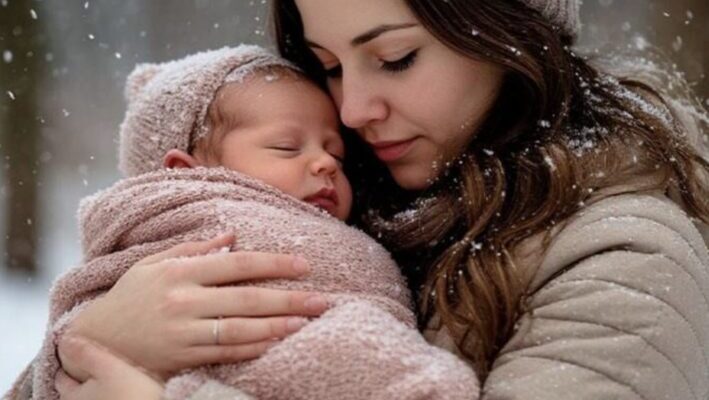
Snow was falling quietly and softly.
It covered the streets, the rooftops, and settled on the shoulders of passersby.
A woman pushed through the thick white curtain.
In her arms, she held a child — a tiny bundle in a gray blanket, with a little cap on his head.
The boy slept peacefully, pressed to her chest, unaware that his life was about to change forever.
She stopped in front of a building with a faded sign: “Infant Home No. 4.”
She looked up, as if searching the sky for forgiveness or strength.
But the sky remained silent and deaf.
Her hands trembled, her heart pounded so loudly it seemed it could be heard from miles away.
She slowly lowered the baby onto the doorstep and placed a note beside him:
“Misha. Forgive me. I love him. I had no other choice.”
She stood there a little longer, as if hoping someone might stop her.
Her fingers clenched, her shoulders shook with stifled sobs.
Then she took a step back. Then another. And ran. Into the night, into the darkness, away from everything that had been.
A few minutes later, the door flung open.
On the doorstep stood Valentina Sergeyevna — a woman in her fifties, a caregiver at the infant home.
Seeing the child, she quickly bent down, gently picked him up, and held him close:
— “Who left you here, sweet one?.. You could’ve frozen…”
She didn’t know then that this moment would stay with her forever. Like the snowflakes melting on the baby’s lashes, like how he curled into a ball, as if feeling the coldness of the world.
For Misha, this home became the first and only one. First — a crib with bars.
Then — a preschool group with yellow lockers. Then — a school room smelling of old textbooks and linoleum.
He got used to it. Got used to Valentina Sergeyevna’s voice, to Yevgenia Arkadyevna’s sternness, to the endless reminders: “don’t make noise, don’t misbehave.” He got used to expecting nothing good.
Because every time the “adults” came — the people who might take him from the orphanage — his heart would stop.
And then it would all repeat: once again, no one chose him. And he pretended not to care.
When Misha was eight, his friend Sanka said:
— “What if your mom is still alive? Maybe she’s looking for you?”
— “No,” Misha replied quietly.
— “Why do you think that?”
— “Because if she were looking, she would’ve found me by now.”
He said it calmly. But that night, he lay with his face in the pillow, holding back tears so no one would hear.
The years went by. The orphanage taught survival: how to defend yourself, take a hit, be part of the group.
But Misha was different. He read a lot, dreamed, strove to learn. He didn’t want to stay there forever.
When he turned fourteen, he asked Valentina Sergeyevna:
— “Why did she leave me?”
She was silent before answering.
— “Sometimes people don’t get to choose. Sometimes life is just too cruel. Maybe it was too hard for her too.”
— “Would you have left me?”
She didn’t answer. She just gently stroked his hair.
At sixteen, Misha received his first passport.
In the “father” field — a dash. In the “mother” field — blank.
He lived in the boarding school, preparing for college.
In the evenings, he worked as a loader in a warehouse outside the city — mopping floors, moving crates, enduring the drivers’ yelling.
He didn’t complain. He knew: once you break, there’s nothing left.
Sometimes he dreamed the same dream: he was running across an endless field.
In the distance — a woman. She was waving to him, calling, but he couldn’t hear her words.
He ran, shouted, but the closer he got — the farther she drifted away.
One evening, he opened an old cabinet and found that same note.
It had been stored in his personal file, which he’d secretly asked Valentina Sergeyevna for.
The paper was crumpled, the handwriting shaky — written by a frightened young girl with trembling hands.
“Misha. Forgive me. I love him. I had no other choice.”
He read those lines over and over, as if trying to feel each word in his soul.
And one day, he realized: he couldn’t live without the truth anymore.
He started with the archives. Made an appointment at the registry office, learned his case number — the one under which he’d been admitted to the infant home.
There wasn’t much information: birth date, health condition, approximate age.
That was all. But there was the note. That one note.
And there was one clue — the maternity hospital number.
Misha went there. He was met by a woman with piercing blue eyes — Maria Petrovna, a midwife who had worked there since the late ’90s.
— “January 2004?” she pondered. “I remember a girl. Very young. Came from a village. Gave birth to a boy… and then disappeared. Didn’t even fill out the paperwork.
We tried to find her, but she vanished into thin air.”
— “What was her name?”
— “I think Lena or Alyona… She was thin, cried all the time. Said her mother kicked her out, and the baby’s father left her.”
It was more than he had hoped for.
He went to the district archive, leafed through records of births from that time.
One entry from January 11 read: “boy, mother — unknown, maternity hospital No. 3.” That was him.
Then came trips to villages. Misha went door to door, asking the old residents.
Some avoided him, others said: “The past can’t be changed, son.”
But in one village — Nikolskoye — he got lucky.
In a local shop, he saw a woman with the same gray eyes as his. Something stirred inside him.
— “Excuse me… Are you Lena?” he asked cautiously.
The woman turned. Her face suddenly went pale.
— “Misha…?”
— “How do you know my name?”
— “I…” she sank onto the porch steps. “I’ve remembered you my whole life.
It was me who left you. Because I didn’t know how to go on. I was seventeen.
Thrown out of my home. I was living in a basement. No money, no food.
I thought — if I stayed with you, we’d both die. So I left you.
After that, I couldn’t sleep. I prayed every day. I tried to find you, but no one told me anything…”
He was silent.
— “I’m not asking for forgiveness. Not for love. I just wanted you to know: I loved you.
Always. I was just too weak.”
He slowly walked over and sat beside her. Looked out into the distance. Then quietly said:
— “I don’t know what to call you now. I don’t know how to build this… But I want to try.”
She cried. So did he.
Two lonely hearts had found each other.
Half a year passed. Misha switched to distance learning and got a job as a librarian’s assistant in the village.
He rented a room in Lena’s house — now he called her mom, even if not right away.
They had dinner together, planted flowers on the windowsill, walked through the forest.
Misha hadn’t forgotten the pain of the past, but now he knew — he wasn’t alone.
One evening, he brought her an old photo: the orphanage, he was seven, wearing a hat with a pompom, standing next to Sanka.
— “This is my friend. He’s in prison now. No one writes to him. Maybe we could visit?”
— “Of course, son.”
That word felt strange. But at the same time — warm. Alive. His own.
Epilogue
Sometimes fate takes too much. Sometimes pain becomes the foundation for something new.
Sometimes even a broken heart still knows how to love.
Misha had walked a long road — from the cold doorstep of an orphanage to the warm comfort of a mother’s home.
He learned: you don’t have to forgive to build a new life. But you must know the truth.
And the truth was in her eyes.
In her hands, trembling with emotion as she stroked his hair.
In her smile when he called her “mom.”