
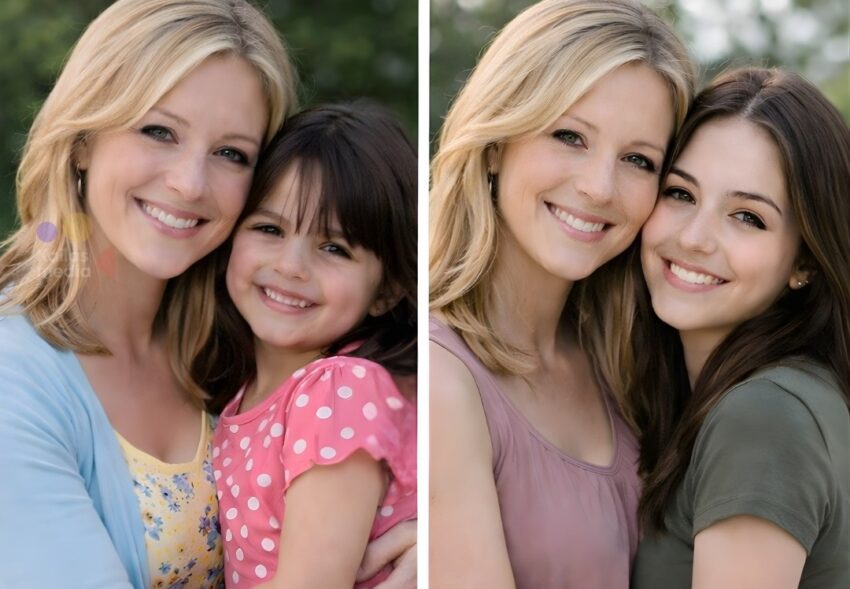
I took in my sister’s little girl after she passed away, and for thirteen years it was just the two of us. That was our life—steady, quiet, imperfect but real. And then, the moment my niece turned eighteen, everything shifted. She told me that her “mother” had reached out to her and was waiting for an answer.
I’m thirty-seven now, but I still remember the phone call that turned me into a parent in less than ten seconds.
My sister and I were never especially close, but whenever she called, I always answered.
She was reckless. I was responsible. Somehow, that imbalance worked—until it didn’t.
There was no dramatic family meeting about custody when she died. No arguments. No debates. No one fighting over what would happen next.
There was just a social worker sitting on my couch, a folder resting on her lap, and a five-year-old girl standing silently nearby, staring down at my shoes.
Maya was five years old. Her father had disappeared long before that moment. There were no grandparents willing to step in.
So she came to live with me.
On paper, I made sense—the obvious choice. I had a stable job, a small apartment, no criminal record, and no spouse to argue with.
In reality, I was twenty-four years old, kept cereal in the fridge, and regularly forgot to water my plants.
“I don’t know how to be a parent,” I told the social worker honestly.
“You’ll learn,” she said calmly. “You already care. That’s more than some kids get.”
That night, I stood in the doorway of what used to be my office and watched Maya sleep on a borrowed twin bed.
Her small hand clutched the stuffed rabbit my sister had bought her. Her face looked older than five—too serious, too aware.
“I’ll just figure it out.”
“Okay,” I whispered into the dark. “I’ll just figure it out.”
And somehow, I did—though not in any glamorous way.
I learned how to sign permission slips, pack lunches, and pretend to be enthusiastic at school concerts. I googled “how to talk to kids about death” and cried alone in the bathroom so she wouldn’t see.
Some nights, we sat at the kitchen table in complete silence, eating pasta and not knowing how to fill the space between us.
Other nights, she would curl up beside me on the couch, lean her head against my shoulder, and ask in a barely-there voice, “Do you think Mom knew she was going to die?”
“No,” I would say, because the truth wouldn’t help. “She didn’t. It was an accident. She loved you too much to leave you on purpose.”
I never tried to replace her mother.
I just stayed.
I showed up to parent-teacher meetings. I sat on plastic chairs at dance recitals. I carried snacks in my purse. And through all of it, I stayed quietly terrified that I wasn’t enough.
Years passed without any major drama. Just science projects, dentist appointments, and the slow, strange process of watching a child become a person with opinions of her own.
Somewhere along the way, I turned thirty-seven. It didn’t feel like a birthday—it felt like a checkpoint.
Still going. Still winging it.
On the morning of Maya’s eighteenth birthday, I knocked on her bedroom door.
“You want pancakes or eggs?” I called out. “Or both? It’s your day.”
The door opened almost immediately.
She was already dressed. Backpack on. Shoes laced. Her expression was closed in a way that made my stomach twist.
“I’ve been waiting for today,” she said.
“Waiting for what?” I asked, trying to keep my tone light. “The legal right to ignore curfew?”
She didn’t smile.
“The woman who says she’s my mother.”
My chest tightened.
“Someone contacted me,” she said.
“Who?” I asked.
She swallowed. “The woman who says she’s my mother.”
The hallway suddenly felt smaller.
I took a breath and softened my voice. “Sweetheart… your mother is dead,” I said gently. “She died thirteen years ago. In a car accident.”
“She told me you wouldn’t understand.”
Maya didn’t look at me—just stared at the floor.
“Whoever contacted you,” I continued carefully, “it can’t be your mom.”
She nodded slowly. “I thought you’d say that,” she said. “She told me you wouldn’t understand. She said I had to go. That I shouldn’t tell you.”
My chest tightened even more.
“She asked if I was ready to reunite with my real mother.”
“I’m not stopping you,” I said after a moment. “But I’m not letting you go alone. If something feels wrong, I need to be there.”
She hesitated, chewing on her lip. “She asked me something,” Maya said quietly.
I waited.
“She said she needed an answer,” Maya continued. “She asked if I was ready to reunite with my real mother.”
That word—real—landed harder than everything else.
“I know it doesn’t make sense,” she said quickly. “But I want to believe her. I just… I want it to be true.”
“I know,” I said, even as my throat tightened. “And if she really is your mother, she’ll recognize me. She knew me too.”
Maya studied my face for a long moment, weighing something invisible. Then she nodded.
The woman had called earlier that week, while I was at work. She told Maya she was her mother. She apologized. She said they needed to meet—and insisted I couldn’t know.
“She knew things,” Maya explained later as we sat at the kitchen table.
“Why did you believe her so easily?” I asked.
“She knew things,” Maya repeated. “From when I was little. She talked about my room. My favorite toy. The way I used to line my stuffed animals up on the windowsill.”
That part I could explain—old photos, social media. My sister had overshared everything.
“She mentioned my birthmark,” Maya added. “The one behind my left knee. I’ve never posted that anywhere.”
“And she said I had to come alone.”
That unsettled me more than I wanted to admit.
“And she said I had to come alone,” Maya repeated. “She was very clear about that.”
“That’s not fair,” I said before I could stop myself. “I raised you. I took care of you all these years. I have a right to be there.”
But that wasn’t the whole truth.
I wanted to see the woman who thought she could borrow my sister’s life for an afternoon.
“She’ll bolt if she sees you,” Maya warned. “She said you’d try to ruin everything.”
“Then I’ll stay in the background,” I said. “Another table. I just want eyes on you.”
After a long pause, she sighed. “Okay,” she said. “But you don’t talk to her unless I say it’s okay.”
“Deal,” I lied.
We drove downtown in near silence. The radio played some song about love and leaving, and I wanted to rip it out of the dashboard.
“You okay?” I asked at a red light.
“I’m fine,” she said, staring straight ahead.
I remembered when “I’m fine” used to mean a bad day in kindergarten. Now it sounded like a locked door.
The café was busy but quiet. Laptops. Low conversations. The hiss of the espresso machine.
“I’ll stand over there,” I said, nodding toward the counter. “Text me if you want to leave.”
Then I saw it—a hand waving from a corner booth.
Maya took a breath and walked forward like she was stepping onto a stage.
I hovered by the pastry case, pretending to study it while watching everything.
Maya smiled—small, hopeful.
I followed her gaze, and my heart dropped straight through the floor.
I knew that woman.
Same sharp jawline. Same too-bright eyes. Same dyed red hair, threaded with gray.
Evelyn.
My sister’s old friend. Always a new scheme. A new boyfriend. A new disaster.
I hadn’t seen her since the funeral.
I walked over and slid into the booth beside Maya.
Evelyn went pale.
“Hi, Evelyn,” I said. “Long time no see.”
“She is not your mother.”
Maya blinked. “You know her?”
“Of course she does,” Evelyn said quickly. “We’re family.”
“We’re not,” I said calmly. “She’s an old friend of your mom’s. She is not your mother.”
Maya turned sharply to Evelyn. “Is that true?”
Evelyn dropped her gaze. For a moment, I saw the frightened nineteen-year-old she’d once been.
“Yes,” she admitted. “I’m sorry.”
“You knew my mom was dead,” Maya said, her voice shaking.
“I just wanted to help,” Evelyn insisted. “I wanted to explain.”
“So you lied to an eighteen-year-old about her dead mother,” I said. “On her birthday.”
“You don’t get to judge me,” she snapped. “You think you’re a saint because you took her in?”
“I’m not a saint,” I said. “I’m just not someone who lies to a grieving kid.”
Maya stood so fast the table shook. “I’m done.”
Outside, the air was sharp and bright.
“Do you want to go somewhere else?” I asked. “Ice cream? Or just sit in the car?”
“Ice cream for breakfast,” she said weakly. “You’re really leaning into the cool aunt thing.”
“I’m thirty-seven,” I said. “My cool days are over. But I’m excellent at buying sugar.”
Later, between melting sundaes, she said quietly, “You’ve been more than that for a long time.”
And in that moment, I understood something I’d never said out loud before.
I hadn’t replaced her mother.
But somewhere along the way, I had become one.