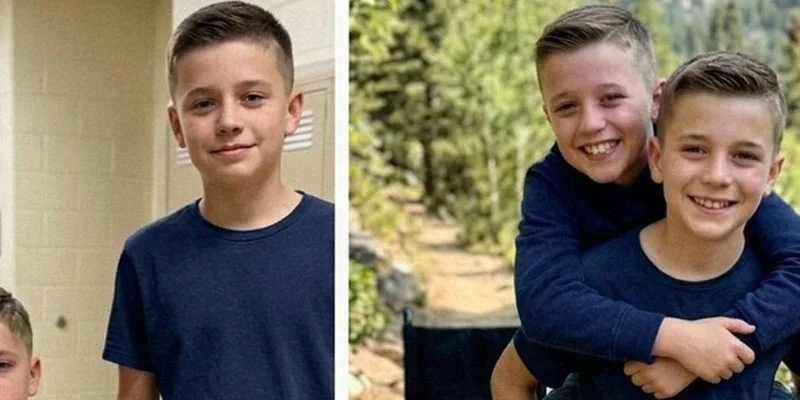
I didn’t think much about the trip at first. Just another school outing, another permission slip signed between bills and routine. But the call I received the next morning changed everything. And when I walked into the school, I had no idea how much my son had already set in motion.
I’m Sarah, 45, and raising Leo on my own has taught me what quiet strength really looks like.
He’s twelve. Sensitive in a way the world doesn’t always notice. He feels deeply but rarely speaks about it, not since we lost his father three years ago.
A week before the trip, he came home… different.
Not loud or excited. Just lighter. Like something inside him had quietly come alive.
He dropped his backpack and said, almost carefully, “Sam wants to go too… but they told him he can’t.”
I turned from the sink. “The hiking trip?”
He nodded.
Sam had been his best friend for years. Smart, funny, and always just a little bit on the outside. He’d been in a wheelchair his entire life, which meant most school activities came with limitations no one really questioned anymore.
“They said the trail’s too hard for him,” Leo added.
“And what did you say?”
He shrugged. “Nothing. But it’s not fair.”
I thought that was where it ended.
It wasn’t.
The buses pulled in late Saturday afternoon. Parents gathered, chatting, waiting.
I saw Leo the moment he stepped off.
My stomach dropped.
He looked exhausted. Covered in dirt, shirt soaked through, shoulders slumped like he’d carried something far too heavy for far too long. His legs still trembled as he walked toward me.
“Leo… what happened?” I asked.
He looked up, tired but calm, and gave me a small smile.
“We didn’t leave him.”
It took a second to understand.
Then another parent stepped in, filling the silence with words I wasn’t ready to hear.
“He carried Sam,” she said gently. “The whole way.”
Six miles. Steep terrain. Loose ground. And my son… carrying another child on his back the entire time.
I looked at him again, really looked this time, and saw the truth written in every tired line of his body.
“He kept telling him, ‘Hold on, I’ve got you,’” she added. “Even when he could barely stand.”
Before I could process it, his teacher approached, his face tight with frustration.
“Your son broke protocol,” he said sharply. “He took a different route. It was dangerous. Students who couldn’t complete the trail were supposed to remain at the campsite.”
I nodded automatically, apologizing, even as something else rose quietly beneath it.
Pride.
No one had been hurt. So I thought that would be the end of it.
It wasn’t.
The next morning, my phone rang.
The school.
My chest tightened before I even answered.
“Sarah,” the principal said, her voice unsteady. “You need to come in. Now.”
My heart dropped. “Is Leo okay?”
A pause.
“There are men here asking for him.”
I didn’t ask anything else. I just grabbed my keys and left.
By the time I reached the school, my thoughts were racing ahead of me, each one worse than the last.
And then I saw them.
Five men in military uniforms, standing outside the office. Still. Focused. Waiting.
The principal leaned in. “They say it’s about what Leo did.”
My throat went dry.
Inside, the room felt too small.
Then they brought Leo in.
The moment he saw them, he froze.
“Mom?” His voice cracked.
I crossed the room in seconds. “Hey, it’s okay. I’m here.”
But he wasn’t okay.
“I didn’t mean to cause trouble,” he rushed out. “I won’t do it again, I promise.”
That broke something in me.
Before I could respond, his teacher muttered, “He should’ve thought of that before disobeying instructions.”
Leo panicked.
“I’m sorry! Please don’t let them take me away! I just didn’t want to leave him behind!”
I held him tighter. “No one is taking you anywhere.”
Then one of the officers stepped forward, his expression softening.
“I’m sorry,” he said gently. “We didn’t mean to frighten you. We’re not here to punish you.”
Leo’s grip loosened just slightly.
“We’re here to honor you.”
The room went still.
Before I could speak, the door opened again.
And everything shifted.
A woman walked in, and I recognized her instantly.
Sam’s mother.
She looked at Leo, her eyes already filled with tears.
“He told me everything,” she said. “He said you refused to leave him. That you told him, ‘As long as we’re friends, I’ll never leave you behind.’”
Leo shifted, uncomfortable. “I just… carried him.”
One of the officers shook his head.
“No. You made a choice when it got hard. You stayed.”
Then he said something that made the room feel even heavier.
“We knew Sam’s father. We served with him.”
The air changed.
“He used to carry Sam too,” his mother added quietly. “Anywhere he couldn’t go.”
Her voice faltered.
“The last time I saw my son that happy… was before his father died.”
No one moved.
Then the officer stepped forward again, holding a small box.
“We wanted to recognize what you did,” he said. “Not just for Sam, but for what it represents.”
He opened the box.
“We’ve created a scholarship fund in your name. It’ll be there when you’re ready.”
I couldn’t breathe for a second.
Leo just stared.
“And this,” the officer added, placing a patch on his shoulder, “you earned.”
I pulled him into me, my voice breaking.
“Your dad would’ve been proud of you.”
He nodded, just once.
When we stepped outside, Sam was waiting.
The moment he saw Leo, his face lit up.
Leo didn’t hesitate. He ran straight to him.
“I thought I was in trouble,” he admitted.
Sam laughed. “Worth it though.”
Leo smiled, tired but certain.
“Yeah,” he said. “It was.”
That night, I stood in the hallway outside his room.
The door was slightly open. He was already asleep.
The patch sat on his desk.
And I realized something that settled deep inside me.
You don’t always get to choose the world your child grows up in.
But sometimes… you get to see exactly who they’re becoming.
And when that moment comes, you understand something simple, something powerful—
He didn’t walk away when it mattered.
And neither will I.