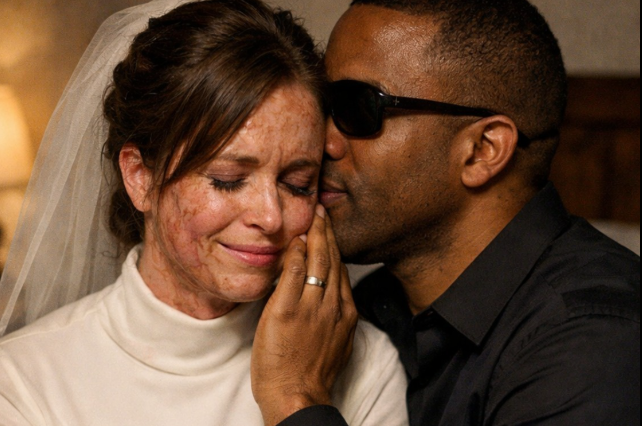
He keeps going, almost as if he knows that if he stops, you’ll bolt.
“She was angry because the story was getting buried. The bakery owner had relatives on the city council. There were photos in the file. She described one of them to me. A hospital hallway. A young woman sitting alone. Gauze around her neck. Her mother asleep beside her in a plastic chair. And in the woman’s lap was a workbook. She said even then, with her hands bandaged, that woman was trying to study.”
Your throat closes.
It had been your anatomy workbook.
You remember it. You remember the cover, bent and damp from where it had fallen in the ambulance. You remember forcing your burned fingers to turn the pages because if you stopped being a student, if you stopped moving toward a future, then the fire had taken not just your skin but your entire life. You didn’t know anyone had photographed you. You didn’t know anyone had described you to a blind stranger.
“I asked Chika to tell me more,” Obinna says. “She said the woman’s name was Adaeze.”
You close your eyes.
The name lands like ash. You have not heard it in his voice before.
When you met him, you told him to call you Eden.
It had started as an accident. The receptionist at the music school had asked your name, and you’d said, “Adaeze, but most people…” Then you saw the flicker in her face, the one people get when they’re trying not to show surprise at scars, and you changed course mid-sentence. “Eden. Most people call me Eden.”
Nobody had ever called you that before. But after the fire, your old name belonged to hospital forms, legal complaints, and whispered pity in church. Eden sounded cleaner. Like a place after ruin. Like a fresh start you did not feel but desperately wanted.
Obinna looks at you steadily. “I knew your name before you gave me the other one.”
The betrayal widens, becomes something with hallways and locked rooms.
“So that’s why?” you ask. “You heard some story about a burned girl and decided to what? Find her? Save her? Marry her?”
His face flinches for the first time. Good. Let him feel the heat too.
“No,” he says. “That’s not what happened.”
“Then what happened?”
“Months after Chika told me about you, she died.”
The anger in your chest stumbles.
You stare at him.
He rubs his thumb against his wedding band as though the metal itself is sharp. “A bus accident. Drunk driver. She was twenty-nine.”
“I’m sorry,” you say automatically, because grief is still grief even when it walks in carrying lies.
He nods once. “I kept her notes. I used to ask people to read them to me sometimes. It was my way of keeping her voice near. In one of the files, there was an update. The lawsuit from the bakery victims was dropped. Witnesses withdrew. Records disappeared. Your name showed up again. It said you had stopped attending classes and moved with your mother to another district.”
You look away.
All of that is true. After the burns, the bills devoured everything. Your mother sold jewelry, borrowed money, begged relatives who liked to quote Scripture more than offer help. The clinic treating you discounted what it could, but skin grafts and medication still cost more than mercy ever seems to. The lawyer who first promised justice stopped returning calls. The bakery reopened under another name six months later.
You had wanted to become a nurse. Instead, you became an expert in survival arithmetic. Rent or medicine. Bus fare or lunch. Compression garments or electricity.
“I thought about you for a long time,” he says. “Not in a romantic way. More like… as a question I couldn’t put down. I kept wondering what became of the woman with the workbook.”
You laugh again, sharper this time. “Congratulations. Here I am.”
He takes the blow without moving.
“Years later, when the school hired me, you walked in carrying linens and introduced yourself as Eden. The moment I heard your voice, something in me recognized you, even though I had never truly heard you before. Chika had read me a quote from that report. A nurse had asked whether you wanted a mirror after your first surgery, and you said, ‘Not yet. I’m still trying to remember the old face well enough to mourn it properly.’”
You go perfectly still.
You said that.
You had forgotten saying it, but now memory returns with ruthless precision: the smell of antiseptic, your mouth cracked from dehydration, the nurse with kind eyes trying too hard not to pity you. Your mother pretending not to cry by the window. And you, high on pain medication and grief, speaking like someone standing at her own funeral.
“When you spoke at the school,” Obinna says, “your voice had changed a little from the injuries and time, but there was a rhythm to it. A carefulness. I knew.”
You want to accuse him of impossible things. Of theft. Of trespassing through the graveyard of your former self. Instead you ask the ugliest question because it is the one already clawing at your insides.
“And when you recognized me… were you disgusted?”
His face changes so suddenly it almost knocks the air from your lungs.
“No.”
The word is fierce, immediate, insulted.
“Did you pity me?”
“No.”
“Did you stay silent because you were curious what a damaged woman would do if she thought she was safe with a blind man?”
He stands now, slowly, as if approaching a frightened animal.
“I stayed silent,” he says, “because the first time you laughed with me, it sounded like you had forgotten to guard yourself. And I knew if I said your old name, you would put the walls back up so fast I’d never hear that sound again.”
Tears sting your eyes before you give them permission.
That is the problem with him. Even his worst truths arrive dressed in tenderness.
You hate that part most of all.
“You had no right,” you whisper.
“I know.”
“You should have told me the second you recognized me.”
“I know.”