The silence that followed my husband’s passing was not the peaceful rest I had imagined after years of chaos; instead, it was a heavy, invasive presence that seemed to press into the very structure of our home. For nearly a decade, our lives had been dictated by the rhythmic humming of medical machinery, the frantic pulse of emergency room visits, and the constant, weary vigilance of a long-term illness. When that soundtrack finally stopped, the resulting quiet was terrifying. It felt as though the noise had been the only thing structural integrity left in my life, and without it, the…
The silence that followed my husband’s passing was not the peaceful rest I had imagined after years of chaos; instead, it was a heavy, invasive presence that seemed to press into the very structure of our home. For nearly a decade, our lives had been dictated by the rhythmic humming of medical machinery, the frantic pulse of emergency room visits, and the constant, weary vigilance of a long-term illness. When that soundtrack finally stopped, the resulting quiet was terrifying. It felt as though the noise had been the only thing structural integrity left in my life, and without it, the walls of the house we had built together seemed hollow, unfamiliar, and cold.
Grief, I soon discovered, is rarely allowed to exist in a vacuum. It was almost immediately shadowed by a sharp, pragmatic fear. We had poured every cent of our savings, every retirement fund, and every equity line into the battle to keep him alive just a few months longer. I never regretted a single dollar spent on that borrowed time, but the world outside our front door remained indifferent to our sacrifice. The utility companies, the mortgage lenders, and the medical billing offices continued their march, oblivious to the fact that the man who had anchored this family was gone. Once the funeral flowers had wilted and the last of the mourners had returned to their own lives, I was left standing in a cavernous home filled with debt and no clear path toward survival.
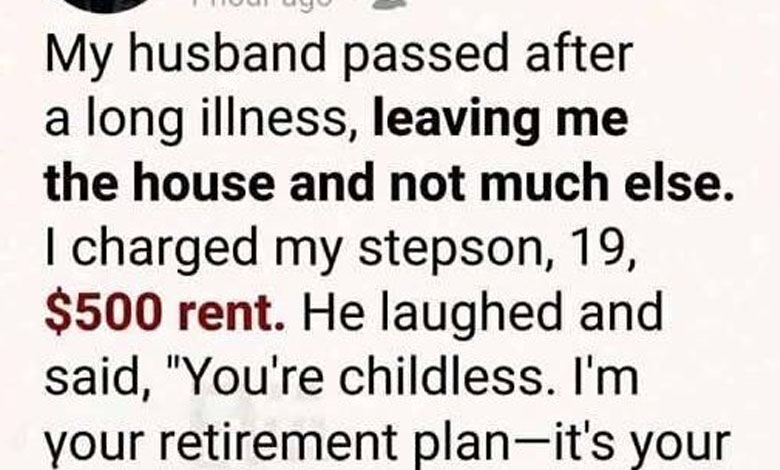
Living with me was my stepson, Leo. At nineteen, he was at that awkward threshold between adolescence and adulthood, a young man who had spent his formative teenage years watching his father fade away. Our relationship had always been steady, built on a foundation of mutual respect and the shared trauma of caregiving. However, as the financial pressure mounted, I found myself pushed to a breaking point. One evening, sitting at the kitchen table surrounded by overdue notices, I summoned the courage to ask him for a modest monthly contribution toward the rent. It felt like a betrayal of my role as a parent, but I saw no other way to keep the lights on.
Leo’s reaction was a lightning strike in a clear sky. He didn’t just refuse; he laughed—a sharp, mocking sound that I didn’t recognize. He looked at me and called me “childless,” implying that since I had no biological children of my own, I should simply view him as my “retirement plan” and stop worrying about the bills. The cruelty of the remark was stunning. In a single moment, it seemed to erase years of shared history, of me being the person who stayed up with him when he was sick, who cheered at his graduations, and who loved him as my own. Blinded by hurt and fueled by a sudden, defensive rage, I shut down.
The following morning, I allowed fear and resentment to dictate my actions. While Leo was at work, I called a locksmith and changed every bolt in the house. I began the grim task of packing his life into cardboard boxes, determined to sever the tie with a young man I believed had revealed his true, selfish colors. It was while I was clearing out the space under his bed that I encountered a weathered duffel bag. It was tucked far into the corner, as if to keep it safe from prying eyes. Thinking it was just more laundry or forgotten gear, I pulled it out, only to find a small envelope with my name scrawled across the front in his familiar, messy handwriting.
Inside the bag was a simple savings passbook, but as I flipped through the pages, the air left my lungs. It was a record of years of deposits—small, consistent amounts earned from his part-time jobs, his summer landscaping work, and the tutoring he did after school. The balance at the end was a significant sum, enough to clear the immediate debt that was suffocating me. At the top of the first page, he had written four words: “Mom’s Future Security Fund.”
Tucked into the back of the book was a letter he had intended to give me for my upcoming birthday. In it, Leo spoke with a vulnerability he had never shown in person. He wrote about watching me sacrifice my youth, my career, and my own health to care for his father. He described how he had spent years saving every dollar he could find, not for a car or a college fund for himself, but so that I would never have to face the world alone or struggle after his father was gone. He explained that he wanted to surprise me with the full amount on my birthday, hoping it would be the first night I could sleep without crying over the checkbook.
The “childless” remark, the cruel laughter, the flippant dismissal—it had all been a shield. Leo, a nineteen-year-old boy trying to play the part of a stoic man, had been so close to his goal that he had panicked. He had used a badly timed, poorly executed joke to deflect my request because he wasn’t ready to reveal the surprise yet. He wanted to give me a future, not just a few hundred dollars for rent. His words had been the clumsy armor of a son who loved his mother too much to let her see him as anything other than her protector.
When the sound of his key failed in the new lock that evening, I met him on the porch. The boxes weren’t there. Instead, I stood there with the passbook in my shaking hands and tears that finally felt like they were washing something away. We didn’t need many words. I apologized for my lack of faith, and he apologized for his lack of tact. We stood there in the fading twilight and hugged, and for the first time since the machines had gone silent, the house didn’t feel hollow. It felt warm.
I realized then that family is a structure built in the dark. It is constructed not through the titles on a birth certificate, but through the quiet, unseen sacrifices we make when no one is watching. Leo had been building a foundation for me in silence for years, and I had nearly torn the whole house down because I couldn’t see the work he was doing. We walked back inside together, and as the lights flickered on, I knew that while the grief would always be there, the fear no longer had a place to sit. We were going to be okay, because we weren’t just a widow and a stepson—we were a family, forged in the fire of loss and held together by a love that didn’t need a label to be real.