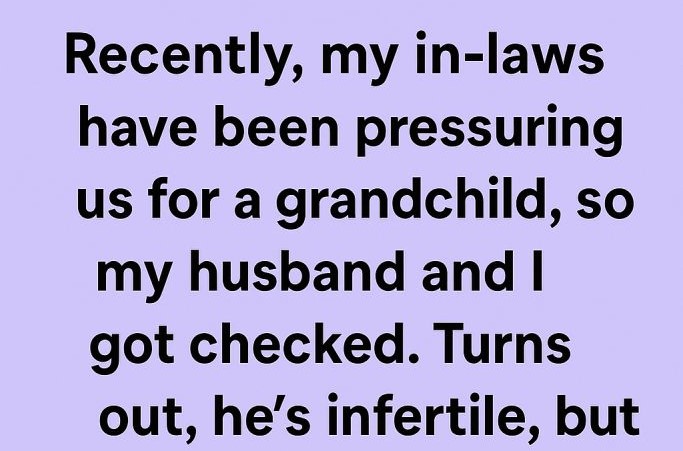
When my in-laws started demanding a grandchild, it felt less like love and more like pressure.
Every visit turned into interrogation. Every dinner ended with the same question: “When are we getting a baby?”
So my husband and I finally agreed to get tested—hoping the results would silence everyone once and for all.
They did.
Just not in the way anyone expected.
The doctor sat us down gently. My husband was infertile.
The words hit hard, but we held hands and promised we’d face it together. I thought the worst part was over.
I was wrong.
My mother-in-law refused to believe it. Instead, she accused me of lying.
Two days later, I walked into our living room and found my husband pale, shaking, staring at his phone like his world had collapsed.
“She went to the clinic,” he whispered. “She pretended to be you… and got your medical results.”
My heart stopped.
She had stolen my identity. Violated my privacy. All just to prove I was the problem.
According to her, the clinic told her I was perfectly healthy—and now she insisted the doctors were protecting me while blaming her son.
I immediately called the clinic. They confirmed everything. She had tricked the staff into releasing confidential information.
The betrayal felt unbearable.
When my husband confronted her, she doubled down. She demanded we redo the tests—with her watching.
That was the moment something inside me snapped.
I said no.
And for the first time in our marriage, my husband chose me over his mother.
Silence followed. Weeks of it. Counseling sessions. Grief. Anger. The painful realization that our future would look different than we imagined.
Then one quiet evening, he asked, “Would you ever consider adoption?”
I smiled. “Maybe. But let’s heal first.”
We began rebuilding—slowly learning how to live without expectations crushing us.
Until a message arrived that changed everything.
“Hi… I think we might be sisters.”
The woman’s name was Karina. A DNA test had revealed she shared the same father as my husband—his late father.
The man everyone believed had been faithful had secretly lived another life.
And Karina wasn’t alone.
She had a six-year-old son named Luca.
Meeting them felt surreal. But watching Tomas interact with Luca awakened something unexpected. The boy’s laughter filled a space we didn’t realize had been empty.
On the drive home, my husband said quietly, “I want to be part of his life… if she’ll let me.”
Karina cried when he asked to be an uncle.
For the first time since his diagnosis, I saw peace return to his face.
But the biggest shock was still coming.
When his mother learned the truth, she arrived at our door one night—shaking, defeated.
“I knew,” she confessed through tears. “I discovered the affair years ago. Blaming you was easier than facing what my husband did… and what it meant for our family.”
Her cruelty had never been about me.
It was guilt. Shame. Fear.
That confession didn’t erase the damage, but it changed something. Slowly, she began reaching out—especially to Luca, bringing small gifts and watching him with quiet regret in her eyes.
One afternoon, as Luca played soccer in the yard, my husband squeezed my hand.
“I thought being a father was about biology,” he said softly.
“It’s about showing up,” I replied.
And he did.
Every game. Every bedtime story. Every moment that mattered.
We never adopted. Life simply rewrote our story in a way none of us expected.
Because sometimes the greatest betrayals don’t end a family—
They reveal the one you were meant to build all along.