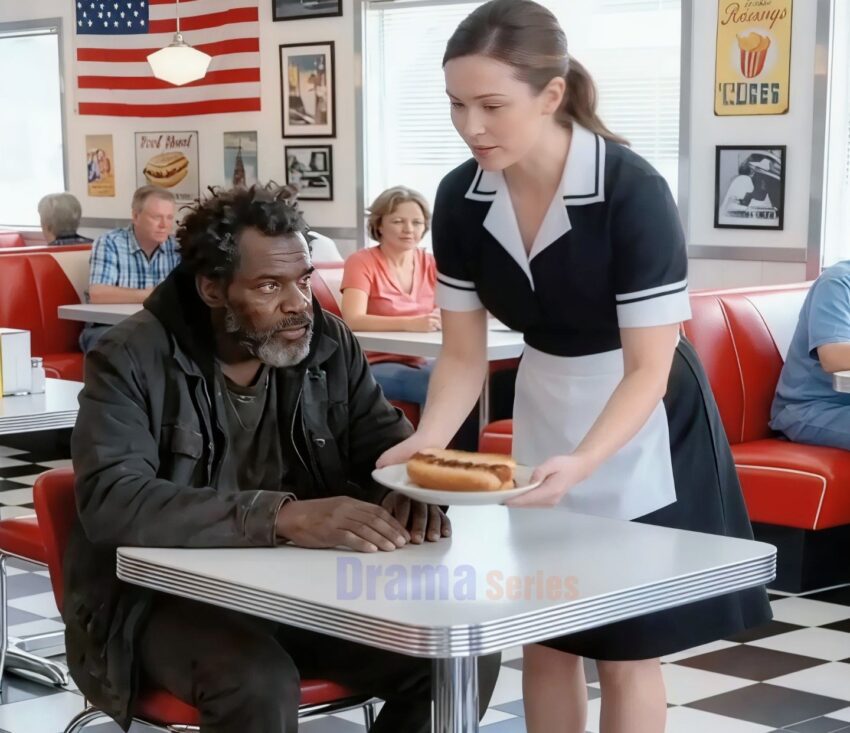
The bell above the diner door jingled like it always did—bright, cheerful, almost too innocent for the kind of day I was having.
It was lunchtime rush at Riverside Diner, the kind of old-school place with red vinyl booths, a black-and-white checkered floor, and framed photos that tried to convince you the past was simpler. The smell of grilled onions, fresh coffee, and toasted bread hung in the air like a warm blanket.
My name is Emily Carter, and I was twenty-two, working double shifts to keep up with rent, community college tuition, and the kind of bills that don’t care if you’re tired.
I wasn’t supposed to notice him.
That’s what my manager always said—Don’t make the place uncomfortable. Don’t let “those kinds” linger. Keep the dining room clean and the customers happy.
But I noticed him anyway.
He sat in the corner booth near the window, shoulders hunched as if he was trying to take up as little space as possible. His coat was old and weather-beaten, the color faded into something that might once have been brown. His hair was uncombed, his beard threaded with gray. His hands, resting on the table, looked rough—like they’d held onto life through things most people never had to imagine.
He didn’t have a menu.
He didn’t look around.
He just stared at the tabletop like it was safer than meeting anyone’s eyes.
I’d seen him before—once or twice over the last month—always in the same booth, always quiet. Sometimes he would ask for a glass of water and leave before anyone could say anything. Sometimes he didn’t even do that. He just… existed. Like he wasn’t sure he deserved even air.
That day, something in me couldn’t let it go.
Maybe it was the way the sun cut through the blinds and landed right on him, like the world was trying to remind us he was still a person. Or maybe it was because my own dad used to say, “Kindness costs nothing, Emmy. And it can save someone’s whole day.”
I glanced toward the counter.
My manager, Carl Whitman, was busy snapping at the cook and checking his watch like time owed him money. He was a big man with a thick mustache and a permanent scowl, the kind of guy who believed being loud meant being in charge. His favorite hobby was humiliating employees and acting like customers were a privilege he allowed.
I knew what Carl would say if he saw that man sitting there: This isn’t a shelter. Move him along.
So I did what I always did when I was about to do something I wasn’t supposed to.
I moved fast.
I grabbed an extra sandwich from the warming window—turkey, cheese, and a soft toasted roll. It wasn’t fancy, but it smelled comforting. The kind of food that could make your stomach stop twisting for a moment.
I poured a cup of coffee and carried everything over like I belonged there.
When I reached his booth, he didn’t even look up. His eyes were heavy, rimmed red like he hadn’t slept in days.
I set the plate down gently. “Hi,” I said softly. “I… brought you something to eat.”
His gaze flickered to the sandwich like it was a mirage.
Then he looked up at me for the first time.
His eyes were tired, yes—but sharp too, as if he had once been someone who noticed everything.
“You don’t have to do that,” he murmured.
“I wanted to,” I said, forcing a smile. “No one should sit here hungry.”
For a second, he didn’t move. Then, slowly, he reached out and touched the edge of the plate like he needed to confirm it was real.
“Thank you,” he said. And that was it—two simple words, but somehow they hit me harder than any long speech could have.
I turned away quickly, because the rush was still going and I had tables waiting. But as I walked back toward the counter, my stomach tightened.
Because Carl had seen.
He was staring at me with that look—half anger, half something worse. Like I’d offended his personal pride.
I tried to keep my face calm, but I could feel the heat crawling up my neck.
Carl didn’t say anything at first.
He just wiped his hands on a towel like he was preparing for a performance.
Then he started walking.
Straight toward the corner booth.
My feet wanted to move, wanted to stop him, but I froze—because that was what people did around Carl. They froze and hoped he wouldn’t choose them as the next target.
The diner noise softened in my ears, like my body was bracing for impact.
Carl reached the booth. The man looked up, sandwich still untouched. Emily’s coffee cup steamed quietly between them.
Carl’s voice cut through the room.
“What do you think you’re doing?” he snapped, not even at the man—at the sandwich, like it had insulted him.
The man didn’t answer. He just sat there, shoulders tense.
Carl’s gaze slid to me across the diner. “Emily. You think you’re running a charity now?”
I swallowed. “It’s just a sandwich.”
Carl laughed—short and sharp. “A sandwich that someone else could’ve bought. A table that paying customers need.”
The man’s jaw tightened. He opened his mouth, but Carl was already moving.
Before anyone could stop him, Carl grabbed the plate and flung it down.
The sandwich hit the tiled floor with a soft, ugly slap.
A few people gasped.
My heart seemed to drop right with it.
Carl took a deliberate step forward and pressed his shoe down on the sandwich like he was crushing more than bread. Like he was crushing a message.
“There,” he said loudly. “Problem solved.”
I couldn’t breathe.
I saw the man’s hands grip the edge of the table. His knuckles went white.
For a moment, I expected anger. Shouting. Violence. That’s what people always assume when they see someone pushed too far.
But that’s not what happened.
The man did something that quieted the entire diner.
He stood up.
Slowly. Calmly.
He looked at the ruined sandwich on the floor for a heartbeat.
Then he looked at Carl.
And his voice, when he finally spoke, wasn’t loud at all.
It was controlled.
“Pick it up,” he said.
Carl blinked, as if he hadn’t heard correctly. “Excuse me?”
The man didn’t move. “Pick it up,” he repeated. “And apologize to her.”
Carl’s face twisted. “To her? She’s an employee. She’ll do what she’s told.”
That’s when the man’s expression changed—not into rage, but into something colder.
He reached for his coat.
Everyone watched as he slid it off his shoulders and laid it carefully on the booth seat, like he still respected the place even after what happened.
Underneath, he wasn’t wearing torn layers or dirty shirts.
He was wearing a crisp black suit.
A white dress shirt.
A tie, slightly loosened, but still neat.
And pinned to his chest, shining under the diner lights, was a name badge.
It said:
JAMES HARRISON — CEO
The air in the room shifted so suddenly it felt like pressure.
Carl’s mouth opened.
Closed.
Opened again.
And nothing came out.
I felt like my brain had stalled.
Because this couldn’t be real. It had to be some kind of joke, or a prank video, or—
But the man—James—stood there with the kind of posture you don’t fake. The kind you earn from being listened to for years.
He looked around the room, taking in the faces. The stunned customers. The employees frozen behind the counter. The cook leaning out of the kitchen doorway with wide eyes.
Then he looked back at Carl.
“I own this diner,” he said.
A sound escaped someone—maybe a laugh, maybe a gasp.
Carl’s face turned a shade I had never seen before. “That’s—no. That’s impossible. I—”
James’s tone stayed calm, but each word landed like a gavel. “Riverside Diner is part of Harrison Hospitality Group. My company.”
Carl swallowed hard. “Mr. Harrison, I—I didn’t recognize you.”
James’s eyes narrowed slightly. “No. You recognized exactly what you wanted to recognize.”
Silence.
James stepped forward, not aggressive, just certain.
“I come here sometimes,” he continued, voice steady. “Not because I need food. Because I need to see how my businesses treat people when they think no one important is watching.”
Carl’s hands began to shake. “I can explain—”
James lifted a hand. “You already did.”
He turned his gaze to me.
And suddenly I felt exposed, like the whole room was waiting for me to speak.
“You,” James said gently, “what’s your name?”
“Emily,” I whispered. My throat felt too tight.
He nodded once, as if confirming something. “Emily, you fed someone you thought had nothing to offer you.”
I didn’t know what to say. I couldn’t tell if I was about to cry or laugh or faint.
James turned back to Carl.
“Carl Whitman,” he said, reading the name tag like it was a record. “You’re fired. Effective immediately.”
Carl’s face collapsed. “Please—Mr. Harrison—please, I have a family, I—”
James didn’t blink. “So do the people you humiliate. So do the employees you threaten. So do the customers you turn away because they don’t look profitable enough.”
Carl’s eyes darted to the crowd like he expected someone to defend him.
No one did.
James nodded toward the sandwich on the floor. “Pick it up.”
Carl hesitated.
James’s voice sharpened just slightly. “Now.”
Carl bent down, scooped up the mess of bread and crushed filling, and stood there holding it like it burned his hands.
James pointed toward the trash. Carl threw it away quickly.
Then James looked at him one last time. “Turn in your keys and leave.”
Carl didn’t argue again. He just walked out, shoulders hunched, the diner door jingling behind him as if nothing extraordinary had happened.
But everything had.
James turned toward the counter. “Everyone,” he said, addressing the staff, “I’m sorry you’ve been working under that.”
The cook exhaled like he’d been holding his breath for years.
James looked back at me.
“Emily,” he said, “how long have you worked here?”
“Almost a year,” I managed.
“And how long has Carl treated people like this?”
I hesitated, then answered honestly. “Since… forever.”
James nodded slowly.
Then he did something that made my eyes sting.
He reached out and gently adjusted my crooked name tag, the way a parent might straighten a child’s collar before a school photo.
“You have leadership,” he said. “And empathy.”
The room was so quiet I could hear the hum of the lights overhead.
James raised his voice just enough for everyone to hear.
“Emily Carter,” he announced, “is the new manager of Riverside Diner.”
For a second, no one moved.
Then the cashier behind the counter started clapping.
The cook joined in.
A waitress near the back let out a squeal and clapped too.
And then the customers—people who had watched this whole thing like it was a scene from a movie—began to clap as well.
The sound swelled, filling the diner with something warm and unbelievable.
I pressed a hand to my mouth because tears were coming whether I wanted them or not.
“Me?” I croaked.
James smiled, just a little. “Yes. You. You already acted like the kind of manager this place needs.”
I shook my head, overwhelmed. “I don’t know if I can—”
“You can,” he said firmly. Then softer: “And you won’t do it alone.”
He reached into his suit jacket and pulled out a business card.
On the back, he wrote something quickly and handed it to me.
It was his personal number.
“If anyone gives you trouble,” he said quietly, “you call me.”
I stared at the card like it was made of gold.
The employees were still clapping. Someone even wiped their eyes. Customers smiled at me like I was part of something bigger than a diner shift.
The soft piano music from the speakers—something the diner always played—seemed to rise, like it understood the moment.
James glanced toward the door where Carl had left. “One more thing,” he said.
He walked to the corner booth, sat down for a moment, and looked at the empty plate space where the sandwich had been.
Then he looked up at me.
“Emily,” he said, “next time you see someone hungry, don’t hide it.”
I nodded, tears spilling now. “I won’t.”
James stood and put his coat back on—not to disguise himself, but because he didn’t need the disguise anymore.
As he walked toward the exit, the diner seemed brighter, like someone had turned up the lights.
Before he stepped out, he paused and glanced back.
“Kindness,” he said, “is the best way to find the truth about people.”
Then he left.
The bell jingled again.
And for the first time since I’d started working at Riverside Diner, the sound didn’t feel like a warning.
It felt like a beginning.