The day we gathered to say goodbye to my father, the world felt unnaturally still.
I stood beside his open grave, staring at the casket that seemed far too small to hold a man who had filled every room he ever entered.
My dad, Robert, was my anchor.
He was the kind of man who mowed elderly neighbors’ lawns without being asked, who slipped cash to homeless veterans, who never raised his voice—even when I deserved it.
When he died suddenly from an aneurysm last Tuesday, my world shattered.
I held my mother as she trembled against me.
The priest spoke of eternal rest, of a life well lived, of Robert being a good man. But it all felt insufficient. Dad wasn’t just good. He was everything.
He taught me how to change a tire when I was twelve, how to throw a curveball, how to apologize when I was wrong. He was there for every baseball game, every heartbreak, every moment that mattered.
Then I heard it.
Click. Click. Click.
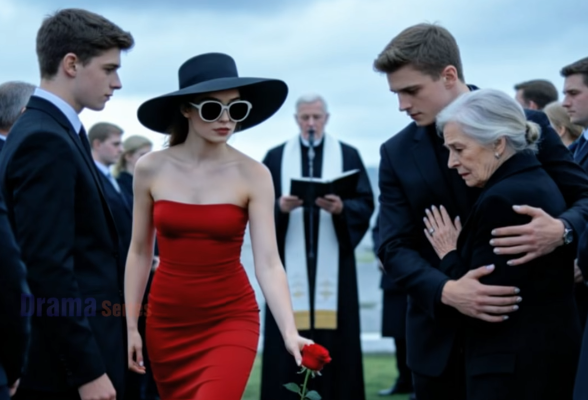
The sharp sound of stiletto heels cut through the priest’s eulogy. Heads turned. Murmurs rippled through the crowd.
Walking toward the casket was a woman I had never seen before.
She wore a tight, strapless, fire-engine red dress—completely wrong for a funeral. Oversized sunglasses. A wide-brimmed hat. She looked like she belonged at a gala, not a burial.
My mother’s sobbing stopped mid-breath. She wasn’t angry or confused. She was terrified.
“Who is that, Mom?”
Her nails dug into my arm hard enough to hurt. “Don’t, Tom. Please. Don’t look at her, son.”
But I couldn’t stop.
The woman reached the casket and removed her sunglasses. I nearly staggered. She had my eyes—the same hazel shade, the same shape, even the same crease near the left corner.
She placed a single red rose on my father’s coffin. A faint smile touched her lips.
“News in the obituary section travels faster than the wind. You did good, Robert. You kept the pact.”
Then she turned to me. My mother stared at the ground, shaking her head, tears falling straight down.
The woman stepped closer and whispered four words that made my legs buckle.
“I am your mother.”
Before I could respond, she straightened, adjusted her hat, and walked away. The click of her heels faded down the gravel path.
The rest of the funeral passed in fragments—the dirt hitting the coffin, the final prayers, people offering condolences I couldn’t hear.
At home, the silence was suffocating. I poured Mom tea she didn’t drink. Finally, I couldn’t take it anymore.
“Mom, who was that woman?”
She wouldn’t look at me.
“Mom, please. Who was she? What did she mean when she said she was my mother?”
Her breath sounded like it hurt. “Robert and I… we aren’t your biological parents.”
For a moment, even the clock on the wall seemed to stop ticking.
“What?”
“Your father… Robert’s brother… he was your biological father. And that woman…”
Before she could finish, her eyes rolled back, and she collapsed.
The emergency room lights were too bright. Forms to fill out. Questions I couldn’t answer. Waiting chairs colder than they should have been.
Finally, a doctor approached. “She’s stable. But she needs rest. No stress. No difficult conversations for at least a week.”
I wanted to scream, to demand answers, to shake someone until the truth came out.
Instead, I sat quietly at her bedside, watching her breathe, trying to hold myself together.
Back at the house where I grew up—the house Dad built, the house where he taught me to ride a bike, to change a tire, to be a man—every room felt different now.
I remembered how protective Dad always was about the attic. “Just old paperwork,” he used to say.
I climbed the narrow stairs. The attic smelled of dust and insulation. Boxes stacked everywhere, labeled in Dad’s neat handwriting.
At the bottom of the third box, I found photographs.
Dad. My mother. Another man. And the woman in red. Together. Smiling.
Then a photo of a baby. The baby had my eyes.
Digging deeper, I found an envelope with a name and an address.
“Who is Damon?” I whispered.
I grabbed my keys and drove. Forty minutes later, I knocked on the door.
The woman in red answered.
“I knew you’d come,” she said, stepping aside.
Inside sat a man in a wheelchair. Older. Gray hair. Tired eyes.
“This is Damon. And I’m Alice.”
The walls were covered in photographs of me—riding a bike at seven, graduating high school, talking with friends, playing Little League.
“You’ve been watching me?”
“I’ve been loving you from afar, Tom.”
“That’s not love. That’s surveillance.”
We sat in her living room. Damon barely spoke, just watched me with weary eyes.
Alice told me everything.
She was married to my biological father, Robert’s younger brother. She had an affair with Damon, her husband’s best friend.
When the affair came to light, she lost everything.
“He kept you. Refused to let me near you. Said I didn’t deserve to be a mother.”
“And then?”
“He died. Car accident. You were only a few months old. And Robert took you.”
“You left me?”
“I tried to fight for custody. I hired lawyers. I went to court. But Robert wouldn’t budge. He hated me.”
“You expect me to feel sorry for you?”
“I just want you to know I never stopped loving you. And even in his hatred, Robert made me a promise. He said if he was going to raise you, he’d raise you to be a good man.”
I finally understood what she meant at the funeral.
“Damon had an accident at work,” Alice added. “Lost the ability to walk. We tried for children after that, but we couldn’t.”
She looked at me with desperate eyes.
“You’re our only hope. Our only chance at being parents.”
I stood. “I’m not a chance. I’m a person. You made choices. And you lost me because of those choices. That’s not my fault.”
“I’m your mother.”
“No. You’re the woman who gave birth to me. There’s a difference.”
“Please. Just give me a chance.”
“Why should I?”
She had no answer.
I walked out.
Back at the hospital, Mom was awake, staring at the wall.
“Mom, I went to see her.”
“So, you found out?”
There was no accusation in her voice. She expected me to leave, to choose biology over everything she had given me.
But she didn’t beg. She didn’t ask me to stay. Her eyes told me everything.
I sat beside her. “It’s been a long day.”
She looked at me, tears in her eyes.
“Let’s go home, Mom.”
“Tom…”
“I’m starving. I could really use your casserole.”
Her face crumpled. “You’re not… leaving?”
“Where would I go? You’re my mother.”
She reached for my hand. “I was so scared you’d choose her.”
“There’s no choice to make. You raised me. You were there. That’s all that matters.”
That night, I went up to the attic again—not for secrets, but for memories.
I found Dad’s journal. Brown leather. Worn edges. Pages filled with his handwriting.
I opened to a random page.
“Tom called me Dad today for the first time. I had to leave the room so he wouldn’t see me cry. I never thought I’d be a father. But now I can’t imagine being anything else.”
I read that line over and over.
Mom found me sitting on the floor, crying. She sat beside me without saying a word.
“He loved me.”
“More than anything.”
“I was his whole world.”
“And he was yours.”
Alice called two days later. “Can we meet? Talk? Try to build something?”
“I’m not ready. And I don’t know if I ever will be.”
There was a long pause. “I understand.”
“I hope you do. Because I need you to understand that I’m not your second chance. I’m not your do-over. I’m just trying to grieve my father.”
“He wasn’t your father.”
“Yes, he was. In every way that mattered, he was.” I hung up.
Last Sunday, Mom and I drove to the cemetery. We brought flowers and sat on the bench near Dad’s grave.
We talked to him—about our week, about the casserole we’d made, about how much we missed him.
Before we left, I placed my hand on the headstone.
“You were my dad. In every way that mattered. And I’ll never forget that.”
I think about Alice sometimes. About the choices she made. The life she lost. The son she watched from a distance for twenty years.
I don’t hate her. But I don’t feel pulled toward her either.
Because family isn’t just blood—it’s the people who show up.
My dad, Robert, showed up every single day of my life. That’s what made him my father.
And nothing Alice says will ever change that.