I had only been married a few days when I discovered a letter hidden in my husband’s garage. Inside an old cobweb-covered couch, tucked between the cushions, was an envelope. On it were chilling words: “He’s lying to you.” But what unsettled me even more was the strange freshness of that letter.
I first met Daniel at a Saturday farmers’ market. A peach slipped from my bag, rolled across the ground, and stopped against a dusty shoe.
“Guess this one’s making a break for it,” a man said, bending down to pick it up. When he straightened, I noticed his prosthetic leg.
“Peaches are dangerous,” I teased. “They attack without warning.”
He laughed—a genuine, chesty laugh—and what felt like a random, fun encounter would eventually lead me down a much darker path.
On our fourth date, we took a slow walk through the park. That’s when Daniel told me how he lost his leg.
“I was in an accident. They had to amputate… same year the girls were born.”
“That’s a massive burden for one year,” I said.
“It was. And three months later, my wife left us.”
I stopped mid-step, stunned. How could someone walk away from a husband recovering from an amputation and two newborns?
“Why? It seems crazy to leave like that.”
He slowed, giving me a long look. “Susan said she wasn’t ready for that kind of life. Maybe she wasn’t. I wasn’t either. But the girls were already here.”
He didn’t speak with bitterness. It was simply a fact of his past, like a storm that had passed and left him to rebuild.
“You never heard from her again?” I asked.
“Not once.”
He sounded over it, as though the wound had long since healed. At least, that’s how it seemed.
I reached for his hand. “It must’ve been hard for you.”
“It was,” he admitted softly. “But sometimes the hardest things in life give you the greatest rewards.”
The first time I met his daughters, I circled the block twice before finding the courage to pull into the driveway. What if they saw me as an intruder? What if they were protective of the space their mother had left behind?
Before I could knock, the front door flew open. “You’re late!” a curly-haired girl shouted, chocolate smudged on her chin.
“She isn’t,” Daniel said, appearing behind her with another girl—neater, but clearly her twin. Both stared at me, eyes narrowed, like tiny security guards evaluating a stranger.
“This is Anna,” Daniel said. “The peach lady.”
They giggled, easing my tension. “Do you like superheroes?” one asked.
“I respect their work ethic,” I replied.
“Good,” the other said. “Because our dad is basically Superman.”
Daniel blushed. “Please don’t start.”
They dragged me inside to show me a framed Superman poster. “He even kind of looks like him,” one insisted.
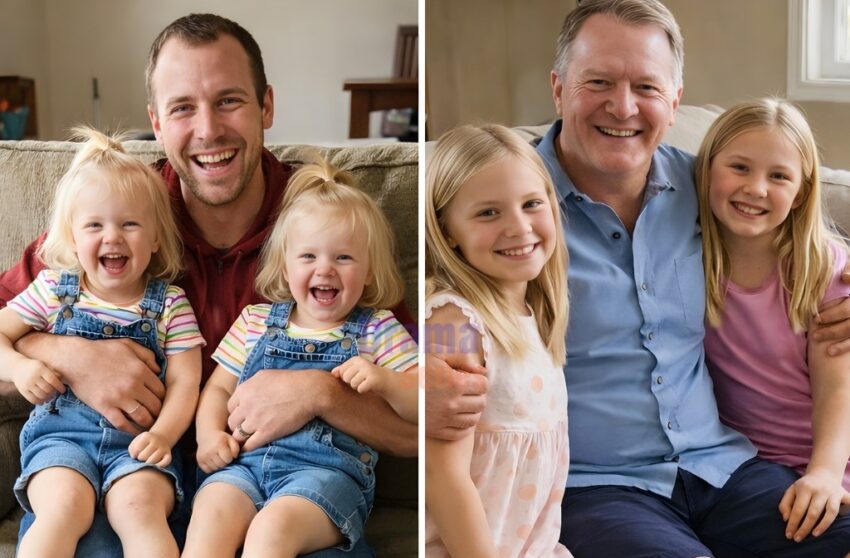
Over the next few months, I saw the reality of his “Superman” life: 6:00 a.m. cereal bowls, YouTube tutorials on braiding hair, endless laundry. His daughters were his entire world.
One night, while he scrubbed spaghetti sauce out of a shirt, I asked if he’d ever thought about dating sooner.
“Didn’t have the bandwidth. And I wasn’t bringing just anyone into their lives.”
That phrase—just anyone—made me feel honored. But maybe I should have been suspicious.
After nearly two years of dating, he proposed in the backyard. It wasn’t grand, but it was real.
“I can’t promise perfect,” he said, holding out a small box. “But I can promise steady.”
“Steady is exactly what I want,” I told him.
The girls tackled me in a hug before I could even slip on the ring. Later that night, though, I confessed my worry: “I don’t want to feel like I’m just filling a vacancy.”
“You aren’t a replacement, Anna,” he said firmly. “We aren’t waiting for a ghost. You’re building something new with us.”
I wanted to believe that. Most days, I did.
We married in a small ceremony, the girls beaming beside us. For the first time, the shadow of the woman who left seemed to fade.
But then came the school forms. At the kitchen table, the line for “Mother” sat empty. One of the girls nudged the paper toward me.
Car dealership
“Should we put you there?”
Daniel watched me carefully. “Only if you’re comfortable with it.”
“I don’t want to usurp someone’s place,” I said.
“There isn’t someone in that place,” the girl replied bluntly. And she was right.
A week after moving in, I tackled the garage. Among the graveyard of old furniture, I dragged out a cobweb-draped couch. Between its cushions was a yellowed envelope—clean, dust-free, untouched by webs.
I opened it. Inside was a letter:
If you are reading this, know that he is lying to you. You don’t know what really happened the night of the accident… After Daniel lost his leg, something in him changed. He was angry. Controlling. I felt trapped in that house with two newborns. I didn’t abandon my daughters. I was forced to run before things got worse. He will never tell you that part. Act as usual. Don’t let him know you found this. If you want the truth, call me.
At the bottom was a phone number.
My fingers trembled. Ink from ten years ago doesn’t smudge—but this did. The paper was crisp, the ink fresh. Someone had placed this envelope recently.
Had Susan returned? Was Daniel’s story a carefully curated lie?
When Daniel came home, I handed him the letter. His brow furrowed in genuine bewilderment. “What is this supposed to be?”
“The ink smudged. The paper is new. She was in our house, Daniel.”
He clenched his jaw. “I should’ve known she’d try something like this. She contacted me a month ago. Wanted to see the girls. I told her I needed to think about it.”
I pointed to the letter. “Well, she has a number now.”
“She must have slipped in when I left the side door unlocked,” he said. “But why? What is she hoping to gain?”
“She wants a phone call,” I replied. “So let’s give her one.”
Two days later, we met Susan at a café. I recognized her from an old photo. When she saw Daniel, her posture stiffened.
I laid the letter on the table. “I know this wasn’t written ten years ago. The ink is fresh. The envelope wasn’t touched by cobwebs.”
Daniel’s disappointment was heavy. “You went into our home, Susan?”
“I wanted her to know the truth!” she snapped.
“The truth,” Daniel countered, “or a version that makes you feel better about leaving? I was a mess after the crash. Angry, lost. But I didn’t make you leave those babies.”
“You rebuilt everything like I was the villain!” she cried.
“You left,” Daniel said firmly. “I told the girls the truth when they asked. But Susan, they stopped asking about you years ago.”
Her shoulders slumped. “You only know the Daniel that’s healed,” she told me. “You don’t know what he was like.”
“You’re right,” I said. “I only know the man who found the strength to raise two daughters alone. The man who overcame trauma to be the most amazing father I’ve ever seen. That’s the man I married.”
“I have a right to see them,” she insisted.
“Then we do it the right way,” I said. “Through a lawyer. With boundaries. No more letters. No more sneaking into our garage. If you want to be part of their future, stop trying to destroy their present.”
She gave a short, jerky nod.
That night, the girls picked Superman for movie night again. Daniel sat on the sofa, a twin tucked under each arm. The letter had tried to paint him as a villain, but the girls saw him as a hero. Watching him laugh at a cheesy special effect, I saw him for what he truly was: a man who had been broken and chose to rebuild, piece by piece.
I wasn’t a replacement or a shadow. I belonged there.
The next morning, I picked up the school forms. Without hesitation, I wrote my name in the “Mother” box.