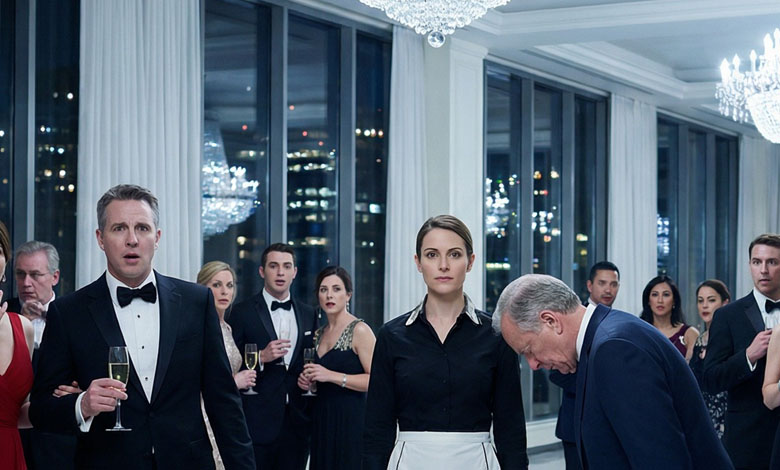
That night, I almost did what I had always done.
I almost stayed quiet.
For eight years, I let Everett believe I was simply his wife — someone who arranged dinner parties, stayed home, and “dabbled” in creative pursuits. If anyone asked what I did, he’d smile politely and say, “She prefers a quieter life.”
What he never understood was that I owned the company he was climbing.
Meridian Harbor Group — the logistics and hospitality empire he bragged about conquering — was a subsidiary of a holding corporation controlled by me. My grandfather had left me the majority stake. I expanded it quietly, carefully, deliberately. Shipping contracts along the West Coast. Boutique resorts in Southern California. Tech investments in Seattle and Austin.
I never told Everett.
When we met in Savannah eight years ago, he was earnest. Ambitious in a grounded way. He talked about building something meaningful, not about corner offices or titles. I wanted to be loved for my laugh, for my love of poetry, for the way I sang off-key in the car.
Not for a balance sheet.
But success reshaped him.
At first, it was subtle. He started talking about “leverage” instead of people. About “positioning” instead of relationships. Then came the dismissive glances when I spoke. The polite interruptions. The assumption that I had nowhere urgent to be.
The promotion celebration should have been simple.
I stood in our Georgetown townhouse holding a midnight-blue gown. I wasn’t planning to reveal anything. I just wanted to attend as his wife — equal, proud.
Everett walked in carrying a garment bag.
“What are you doing with that?” he asked.
“Getting ready.”
He laughed, sharp and hollow.
“You’re not attending as a guest,” he said, pulling a black catering uniform from the bag. “We’re short on staff. You can help serve drinks. It’ll look good.”
I stared at him.
“And don’t tell anyone you’re my wife,” he added casually. “It complicates things.”
Something inside me didn’t break.
It clarified.
I could have ended his career with one phone call.
Instead, I nodded.
When I came downstairs in the uniform, I saw Sienna — his executive assistant — lounging on our sofa in a red cocktail dress.
And around her neck was my grandmother’s emerald necklace.
“Does it look better on me?” she asked him playfully.
“It does,” he replied without hesitation.
I tied my apron tighter.
We arrived at the ballroom through separate entrances. I moved through the room balancing a silver tray, invisible among executives who barely registered my presence.
Everett stood center stage, charismatic, polished.
“This promotion marks a new chapter,” he said, lifting his glass. “I’m grateful to those who truly supported me.”
He looked at Sienna.
Applause filled the room.
Then the doors opened.
Russell Kincaid — global chairman of Meridian Harbor Group — stepped inside with members of the international board. The energy shifted instantly.
Everett straightened.
“Mr. Kincaid, what an honor.”
Russell shook his hand briefly, then scanned the room.
“I was hoping to find someone,” he said.
And then he walked directly toward me.
The tray in my hands felt weightless.
He stopped in front of me and inclined his head.
“Good evening, Madam President.”
The room went silent.
A glass shattered somewhere behind us.
Everett blinked. “There must be some confusion. She’s my wife. She doesn’t work for the company.”
Russell’s voice remained calm. “Adriana Hale is the majority shareholder and Chief Executive of the parent corporation that oversees Meridian Harbor.”
You could feel the air leave the room.
I set the tray down.
Untied the apron.
And let it fall.
Underneath, I wore the midnight-blue gown.
Gasps rippled outward.
I walked toward Everett slowly.
“You didn’t know,” I said evenly. “And that’s the point.”
Then I turned to Sienna.
“The necklace belongs to my family,” I said quietly.
Her hands trembled as she unclasped it and placed it in my palm.
Everett found his voice, but it was unsteady. “We can discuss this at home.”
“No,” I said gently. “We won’t.”
Russell stepped forward. “Your position reports directly to Ms. Hale.”
I could have fired him on the spot.
Instead, I chose something more precise.
“I’m not terminating you,” I said. “You’re resigning. Effective immediately.”
Relief flashed across his face — until he realized I wasn’t negotiating.
Security approached discreetly.
I took the stage.
“I want to speak briefly,” I said.
The room leaned in.
“Success without humility is noise,” I continued. “No title excuses cruelty. No promotion justifies shrinking someone else.”
The applause wasn’t polite.
It was real.
As I stepped down, my chief of staff hurried toward me.
“We have a problem,” she whispered. “There was an attempt to access sensitive data from one of our subsidiaries. Credentials trace back to Everett.”
Of course they did.
Access was revoked within minutes.
Later that night, I returned to the townhouse to collect what mattered. Everett stood by a half-packed suitcase.
“I was desperate,” he said. “I didn’t mean to hurt you.”
I studied him.
“You didn’t lose your title tonight,” I replied. “You lost the person who believed in you before you believed in yourself.”
He looked away.
“What happens now?”
“You build something that doesn’t depend on stepping on someone else.”
I left with only what was mine.
Six months later, we launched Horizon Forward — a corporate initiative supporting women rebuilding careers after financial or relational upheaval.
At a press conference, a journalist asked, “Do you still believe in love?”
I smiled.
“Yes,” I said. “But love should never require you to shrink.”
That night, standing in my new apartment overlooking the city, I understood something clearly.
The most important promotion wasn’t his.
It was mine.
The night he tried to make me invisible became the night I stopped hiding.
And once you step fully into your own light, you never go back to the shadows.