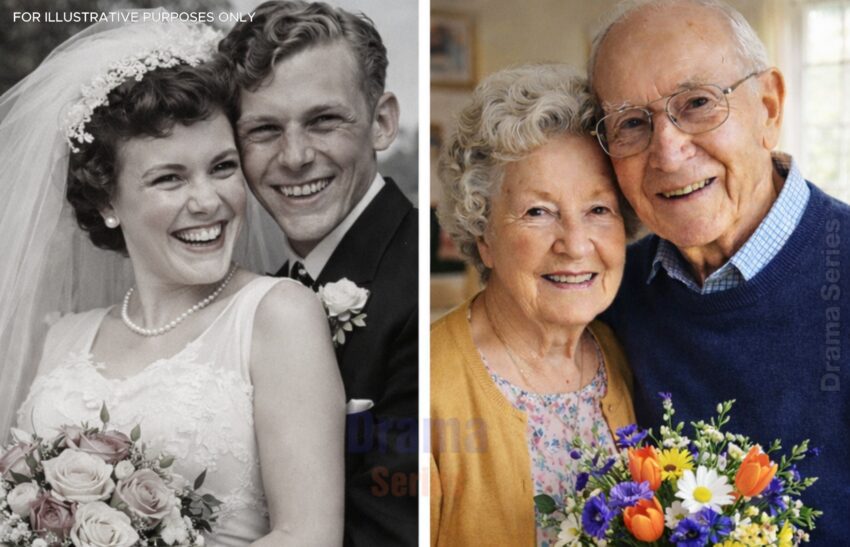
For 63 years, my husband never missed a single Valentine’s Day. Not once. After he passed away, I expected silence. Instead, roses appeared at my door—along with a key to an apartment he had kept hidden for decades. What I discovered inside still brings me to tears.
My name is Daisy. I’m 83 years old, and I’ve been a widow for four months.
Robert, my husband, proposed to me on Valentine’s Day in 1962 while we were still in college.
He cooked dinner in our dorm’s tiny shared kitchen—spaghetti with jarred sauce and garlic bread burned on one side.
He gave me a small bouquet of roses wrapped in newspaper and a silver ring that had cost him two weeks of dishwashing wages. From that moment on, we were inseparable.
Every Valentine’s Day after that, he brought me flowers.
Sometimes it was wildflowers when we were broke and living in our first apartment with mismatched furniture and a leaky faucet.
Sometimes it was long-stemmed roses when he got promoted.
Once, during the year we lost our second baby, he brought me daisies. I cried when I saw them.
He held me and whispered, “Even in the hard years, I’m here, my love.”
The flowers weren’t just about romance. They were proof that Robert always came back—through arguments about money, sleepless nights with sick children, and the year my mother died when I couldn’t get out of bed for weeks. He always returned with flowers.
Robert died in the fall. A heart attack. The doctor said he didn’t suffer. But I did.
The house felt unbearably quiet without him. His slippers still sat by the bed. His coffee mug still hung on its hook in the kitchen. I kept setting out two cups of tea every morning, only to remember he wasn’t there to drink his.
I talked to his photograph daily: “Good morning, darling. I miss you.”
Sometimes I told him about my day, about our grandchildren, or about the leak in the kitchen sink I couldn’t fix.
Then came Valentine’s Day—the first one in 63 years without Robert.
I woke up and lay in bed, staring at the ceiling. Eventually, I made myself tea and sat at the kitchen table, staring at his empty chair. The silence pressed down on me.
Suddenly, there was a sharp knock at the door. When I opened it, no one was there—only a bouquet of roses lying on the doormat, wrapped in brown paper tied with twine, just like the ones Robert had given me in 1962. Beside them was an envelope.
Inside was a letter in Robert’s handwriting and a key.
“My love, if you’re reading this, it means I am no longer by your side. In this envelope is the key to an apartment. There is something I have hidden from you our entire life. I’m sorry, but I couldn’t do otherwise. You must go to this address.”
The address was across town, in a neighborhood I’d never visited.
I couldn’t stop wondering—had Robert been hiding another life? Another woman? The thought made me sick. Still, I called a taxi. The driver chatted about the weather, but I couldn’t hear him over the roaring in my head.
We drove nearly an hour until we reached a brick building with a green door. I stood on the sidewalk for a long time, torn between turning back and needing to know. Finally, I unlocked the door.
The smell hit me instantly—polished wood, old paper, sheet music. A music room.
In the center stood a beautiful upright piano. The walls were lined with shelves of sheet music, recordings, and books. On the piano bench sat neatly stacked sheets. I picked one up: “Clair de Lune” by Debussy—my favorite. Another piece on the stand was “Moonlight Sonata.”
On a small table nearby were labeled recordings: “For Daisy – December 2018.” “For Daisy – March 2020.” Dozens of them, spanning years.
Beside them lay medical reports: “Diagnosis: severe heart condition. Prognosis: limited time.” Robert had known.
There was also a contract with the building caretaker, instructing him to deliver the flowers and envelope to me on the first Valentine’s Day after Robert’s death. He had planned everything.
Then I found a journal. The first entry was 25 years old:
“Today, Daisy mentioned her old piano. She said, ‘I used to dream of being a pianist, playing in concert halls. But life had other plans.’ She laughed, but I saw the sadness in her eyes.”
I remembered that moment. We’d been cleaning the garage when I found my old sheet music. I smiled, tucked it away, and thought I’d forgotten. But Robert hadn’t.
“I’ve decided to learn piano. I want to give her back the dream she gave up for our family.”Family games
I cried as I read about his lessons, his frustrations, his determination.
“Signed up for piano lessons today. The instructor is half my age. She looked skeptical when I told her I’m a beginner.”
“Today I tried to play a simple scale and my fingers felt like they belonged to someone else.”
“I’ve been at this for six months and I still can’t play a melody without mistakes. Maybe I’m too old.”
“I’m not giving up. Daisy never gave up on me. I won’t give up on this.”
“Today I played ‘Clair de Lune’ all the way through. It wasn’t perfect, but it was recognizable. I recorded it for her.”
Near the end, the entries grew shorter:
“The doctor says my heart is giving out. I don’t have much time. But I need to finish one more piece.”
“Daisy asked me yesterday why I’ve been gone so much. I told her I was visiting old friends. I hated lying to her. But I can’t tell her yet. Not until it’s finished.”
“My hands shake now when I play. But I keep practicing. For her.”
“This will be my last composition. I’m writing it myself. For her. I want it to be perfect. She deserves perfection.”
The final entry, a week before he died: “I’m out of time. I’m sorry, my love. I couldn’t finish.”
On the piano stand lay a handwritten sheet titled “For My Daisy.” The music was beautiful but unfinished, stopping halfway through the second page.
I sat at the piano, placed the sheet on the stand, and began to play. At first my fingers hesitated, but muscle memory from six decades ago returned. I played Robert’s melody—tender, loving, full of longing. When I reached the blank section, I kept going, letting my hands find the notes he hadn’t written. I finished the piece, adding harmonies and resolutions.
When I ended, I noticed a small envelope tucked behind the stand. Inside was Robert’s final letter:
“My darling Daisy,
I wanted to give you something you couldn’t refuse or argue about. Something just for you.
This piano is yours now. This studio is yours. Play again, my love.
And know that even though I’m gone, I’m still here—in every note, in every chord, in every song.
I loved you from the moment I saw you in that college library with sheet music under your arm. I loved you when you were 20 and when you were 80. I’ll love you forever.
Always yours, Robert.”
Now I visit the studio twice a week. Sometimes I play, sometimes I listen to his recordings. My daughter came once, and I played one of Robert’s recordings for her. My fingers stumbled, the tempo wasn’t perfect, but it was full of love. She cried when she heard it.
Last week, I recorded my first piece in 60 years. My hands aren’t nimble anymore, and I made mistakes, but I finished. I labeled it “For Robert” and placed it on the shelf beside his.
Now we’re together again—in the only way that matters.
For 63 years, he gave me flowers. And from beyond, he gave me back the dream I thought I had lost.