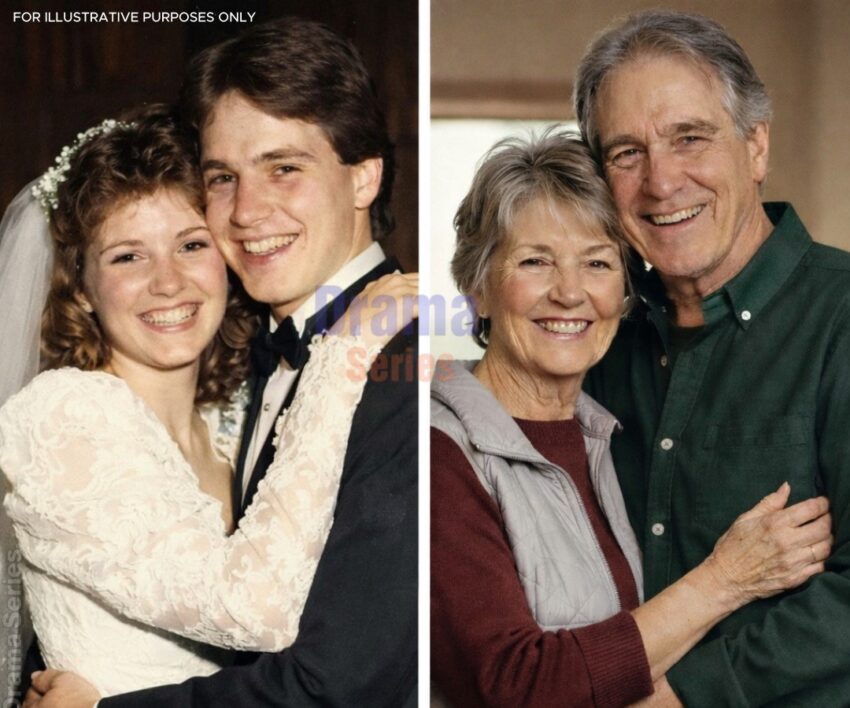
Five years after my husband confessed to an affair and ended our 38-year marriage, I stood at his funeral — still angry, still hurt. But when a stranger handed me a letter he had left behind, everything I thought I knew about love, loyalty, and goodbyes began to unravel.
I noticed her during the second hymn. She sat alone in the back pew — not crying, not praying, just watching. Her gray dress stood out among the sea of black. Her expression was unreadable, and I knew instantly that I didn’t know her. Which meant something.
Everyone else in that church belonged to the life Richard and I had built together. Our children sat in the front row beside me. Gina gripped my hand tightly when the pastor spoke Richard’s name. Alex stared straight ahead, his jaw set just like his father’s.
But that woman in the back? She didn’t belong. At least, not to me.
After the final prayer, as the pews began to clear, I moved toward her. Gina noticed.
“Bathroom,” I lied.
“I’ll come with you.”
As we passed the last pew, the woman rose.
“Julia?” she said — too loud. Heads turned. Gina’s hand slipped from mine.
“How does she know your name?” Gina whispered.
The woman flinched, then lowered her voice. “Please. I’m sorry. It’s… hospice.”
And that one word split the air in half.
“Mom? Are you all right?” Gina asked later.
“I’m fine, honey,” I said. And it wasn’t a lie. I didn’t feel broken or weepy. I just felt hollow. Five years of silence had already done the grieving for me.
That was the thing about betrayal — it didn’t end when the divorce papers were signed. It stayed, settled, and hardened into something too quiet to name.
Richard and I had met at 20. He told me my green sweater matched my eyes, and I rolled them so hard I nearly missed the bus. He was clever, patient, infuriatingly kind. We married at 22, raised two children, built a home with mismatched chairs and a leaky faucet we never fixed. He made pancakes on Sundays. I alphabetized the spice rack. We were happy.
Then something changed. Richard grew quiet, shadowed. He slept on the couch in his office, claiming work stress. He stopped asking about my day. Some nights, I heard him coughing behind the locked door.
“Richard?” I whispered. But he never opened it.
I thought he was depressed. I begged him to talk.
Then one night, after dinner, he sat at the kitchen table — the one where we’d celebrated every birthday and endured every burnt casserole — and said it.
“What?”
“I cheated. I’ve been seeing someone else. I’m sorry.”
He didn’t cry. He didn’t even look at me.
“What’s her name?”
“I don’t want to talk about it.”
“No,” I snapped. “You don’t get to shatter 38 years with one sentence and then sit there like you lost your darn keys.”
His hands shook, but he said nothing.
A week later, I asked for a divorce. He didn’t fight. He didn’t beg. It was clean, bloodless, cruel.
Five years passed. I rebuilt slowly — lunch dates with friends, holidays with the kids, rearranged rooms to feel less like him.
Then Gina called. “Mom, it was a heart attack. They said it happened fast.”
I didn’t cry. I just sat in silence.
“They’re having a service,” she added. “It’s at the old church. Saturday morning.”
The church hadn’t changed — same stained-glass windows, same creaking pews. Gina sat near the front. Alex lingered in the aisle. I kept my distance.
That’s when I saw her — the woman in gray.
After the final prayer, I approached.
“I don’t believe we’ve met,” I said.
“No. We haven’t,” she replied. “I’m Charlotte.”
“You knew Richard?”
“Yes. I was with him at the end, Julia. Hospice.”
“Hospice? What are you talking about?”
“Richard had cancer. Stage four pancreatic. He refused treatment. He didn’t want anyone to see him that way.”
“He told me he was cheating on me,” I said, my stomach twisting.
“I know.”
“You knew?!”
“He asked us not to tell you. He said you’d stay. And he couldn’t bear what staying would do to you.”
Charlotte pulled out a creased page. At the top was hospital letterhead. Below, in typed ink:
His signature sat at the bottom like a final decision.
I didn’t open it at the church. At home, I sat on the porch, the hydrangeas blooming again, and finally unfolded the letter.
His handwriting hadn’t changed.
“Julia,
I didn’t touch anyone else, my love. I promise. There was no affair. I got the diagnosis, and I knew what it would do to you.
You would’ve stayed. You would’ve fed me soup and cleaned up after me and watched me fade, and it would’ve taken you with me.
You gave me your whole life. I couldn’t ask for more.
I need you to live, my love. I needed you to hate me more than you loved me, just long enough to walk away.
I’m sorry. I’m so sorry. But if you’re reading this, it means I got my wish. That you’re still here.
That you lived.
I loved you until the end.
— Richard”
I sat with the letter in my lap, my hand over my mouth. I didn’t cry right away. I just breathed, slow and shallow, until the porch light flickered on, as if even the house didn’t know what to do with this.
The next morning, I called Gina and Alex. They came, worried but patient. I placed the envelope on the table.
“Just read it,” I said.
They leaned in. Gina’s hand moved to her mouth. Alex’s jaw tightened.
“He let us believe he was a monster,” Alex said.
“He was dying,” I whispered. “And he made sure I never saw it.”
“He thought he was saving you,” Gina said softly.
“Maybe. But he stole my choice. And he let me carry the shame.”
The silence that followed didn’t feel holy. It felt earned.
“But maybe it worked,” I added.
For illustrative purposes only
A week later, Alex returned alone, holding another envelope.
“Dad updated his will,” he said. “Charlotte helped him finalize it.”
Inside was the deed to our lake cabin — the place with the leaky roof and the swing on the pine tree. The place we used to call ours.
“He put it in your name. Fully.”
Attached was a sticky note, faded yellow, with handwriting I knew by heart:
“Keep the porch light on, my love. Do it in case the kids come back. And in case you want to watch the water again. I’ll be there. Just not where you can see.”
I traced the edge of the note. “He left,” I said softly, “so I could keep the light on. My light…”
“You did, Mom,” Alex said, his voice cracking.
And for the first time in five years, I let myself believe it. The warmth of it nearly broke me.