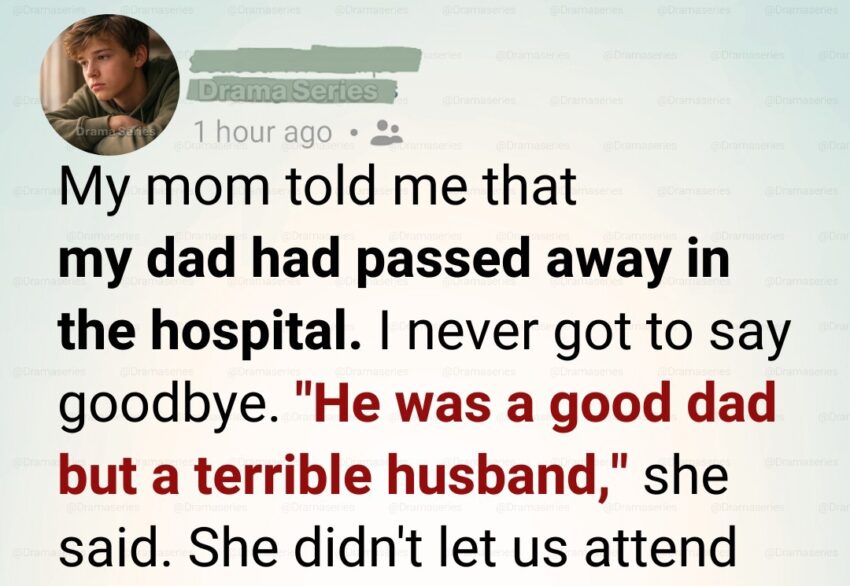
My mom never sugarcoated anything. She believed the truth—plain, sharp, and unwrapped—was kinder than lies that rotted slowly. So when my dad passed away in a hospital room when I was twelve, she sat me and my younger brother down at the kitchen table, folded her hands, and said, “Your father was a good dad. But he was a terrible husband.”
That was it. No dramatic pauses. No villain speeches. Just that single sentence, dropped between us like something heavy but solid—something she had carried alone for a long time.
She didn’t let us go to the funeral. When relatives questioned her, she didn’t argue. When we asked, she knelt to our eye level and said she wanted our last memory of him to be the man who built birdhouses in the backyard, who let us hammer nails crookedly into wood while he smiled like it was the most important job in the world. She didn’t want us remembering a box in the ground.
After that, life moved forward in a strange, uneven way. My mom worked more. She laughed less. She never spoke badly about my dad, but she never softened the truth either. He had loved us fiercely. He had failed her quietly and repeatedly. Both things could exist at once, she said. And I learned to live with that contradiction, though it never sat easily in my chest.
Growing up, I carried a split loyalty I didn’t know how to name. I loved my dad—the dad who taught me how to ride a bike, who showed up to school plays even when he looked exhausted, who called me “kiddo” like it was a title of honor. But every time I missed him, a flicker of guilt followed. Was I betraying my mom by loving him? Was I excusing what he had put her through?
We never visited his grave. Years passed, then more years. I told myself I didn’t need to. That remembering him at home was enough. But the truth was uglier and simpler: I was afraid. Afraid that if I went, I’d find bitterness waiting there—either in myself or carved into stone. Afraid the love I’d held onto would finally crack under the weight of everything I didn’t know.
Last month, something shifted. Maybe it was age. Maybe it was finally understanding how heavy adulthood can be. Or maybe it was watching my mom—older now, quieter—sit alone on the porch at dusk, holding memories she never put down. That night, I searched for my dad’s burial records. When I found them, my hands shook more than I expected.
The cemetery was smaller than I imagined. Quiet. Ordinary. I walked slowly, reading names, bracing myself for neglect or cold indifference. I expected weeds. A plain marker. Proof that time had erased him.
Instead, I stopped short and felt the blood drain from my face.
His headstone was beautiful—clean, well-kept, thoughtfully chosen. And right beside his name, bolted into the stone, was a smaller plaque. Newer. Intentional.
I leaned closer, my heart pounding.
It read: “The man who couldn’t be a husband, but never stopped being a hero to his kids. Thank you for the light you gave them.”
I knew instantly who had put it there.
In that moment, something I had carried for decades finally unlocked. My mom hadn’t kept us away from his grave out of spite. She hadn’t erased him. She had protected us—from confusion, from adult pain, from the complicated grief she knew we weren’t ready to hold.
She had gone there alone. She had faced the place, the anger, the disappointment, and still chosen grace. She honored the father he had been, without rewriting the husband he wasn’t. She carried the weight of their failed marriage so it wouldn’t spill into our childhood memories.
Standing there, I cried—not the sharp, choking grief I’d imagined, but something softer. Something like relief.