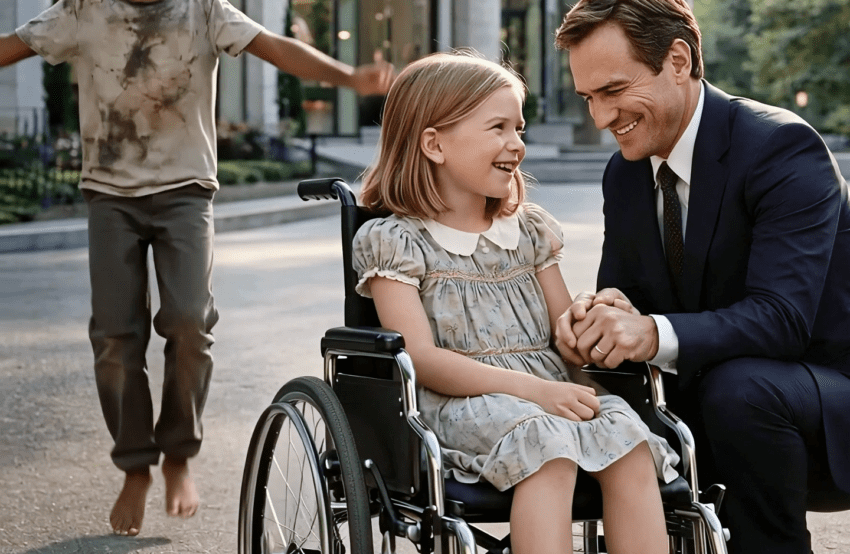
Jonathan Blackwood was not merely a man—he was an institution. In the tech world, his name carried immense gravity, spoken with a mixture of awe and caution in the highest financial circles. Power, influence, and unimaginable wealth followed him wherever he went, as naturally as his shadow.
His mansion of glass and marble towered above the city like a shrine to ambition and success. Yet within those immaculate walls, silence reigned supreme.
Jonathan’s greatest treasure was not stored in vaults or ledgers—it was his ten-year-old daughter, Lily Blackwood. And she lived imprisoned within her own fragile body. A rare and relentlessly worsening illness had stripped her of movement, confining her to a wheelchair and often to her bed. Nurses rotated in quiet shifts, silk sheets were changed daily, and beyond her wide bedroom windows stretched a lush garden she could see but never touch.
Jonathan had spent fortunes chasing hope. World-renowned doctors, experimental therapies, private specialists flown in from across the globe—none had worked. For the first time in his life, money failed him. The one thing he wanted more than anything—Lily’s real smile—remained heartbreakingly out of reach. Every business triumph felt hollow beside her stillness.
That afternoon, Jonathan was working in his office adjacent to Lily’s room when an unfamiliar sound drifted through the silence. It wasn’t quite music—more like rhythm. Light. Joyful. Alive.
He rose and moved toward the window overlooking the private road—and froze.
A barefoot boy, no more than eight years old, was dancing on the pavement. His clothes were worn, his feet dusty, yet his movements were radiant and free, as if gravity itself had loosened its grip on him. He wasn’t begging. He wasn’t asking for anything. He was simply dancing.
Jonathan’s breath caught as he turned toward Lily.
She was watching the boy, completely absorbed. And then—slowly, impossibly—something miraculous happened. A faint smile appeared on her pale face. Real. Unforced. Alive.
Jonathan didn’t stop to think. He rushed down the stairs and threw open the front door. The boy halted mid-step, eyes wide, instinctively ready to run.
Jonathan approached gently and noticed what the child was clutching in his hand—a crayon drawing.
It depicted Lily in her wheelchair, but transformed. She wore a flowing dress, a crown of flowers, and she was smiling.
Overwhelmed, Jonathan knelt in front of him.
“Who are you?” he asked softly.
“My name is Noah,” the boy whispered. “That’s Lily. I dance for her so she won’t feel lonely.”
“Why?” Jonathan asked.
Noah lowered his eyes. “I’m lonely too.”
Jonathan soon learned that Noah lived with his grandmother, Margaret Wilson, who was gravely ill. His mother had died years earlier. They had very little—but Noah carried joy within him, and he gave it freely.
Jonathan invited him inside, fed him, gave him shoes, and later that day drove to the address Noah had shared.
For illustrative purposes only
Margaret lived in a single, dimly lit room heavy with the scent of medicine and damp air. Though frail, her pride remained intact.
“I know who you are,” she said to Jonathan. “But we don’t want charity.”
“This isn’t charity,” Jonathan replied calmly. “Your grandson gave my daughter something no one else could.”
Margaret hesitated. Then she reached beneath her pillow and pulled out an old envelope.
Inside were photographs of Jonathan’s late wife, Evelyn Blackwood, standing beside a boy who looked identical to her.
“She had a twin brother,” Margaret said. “His name was Thomas. Noah was his son.”
Jonathan’s world tilted. Evelyn had always told him she was an only child.
Margaret explained everything—how Thomas had been disowned and erased from the family, how Evelyn had secretly helped him, how Thomas had died young, leaving Noah behind. Before Evelyn passed away, she had written a codicil to her will, hidden away, recognizing Noah as family.
Jonathan found it days later through his lawyers. It posed no threat to his fortune.
It was an act of love.
He brought Margaret and Noah to the mansion. Doctors helped Margaret recover. Lily met her cousin for the first time.
“You’re not alone anymore,” Noah told her.
From that day forward, the mansion changed. Laughter returned to its halls. Lily smiled more. And Jonathan began the legal process to adopt Noah—not out of pity, but out of belonging.
At last, Jonathan Blackwood understood the true legacy his wife had left behind.
Not money.
Family.