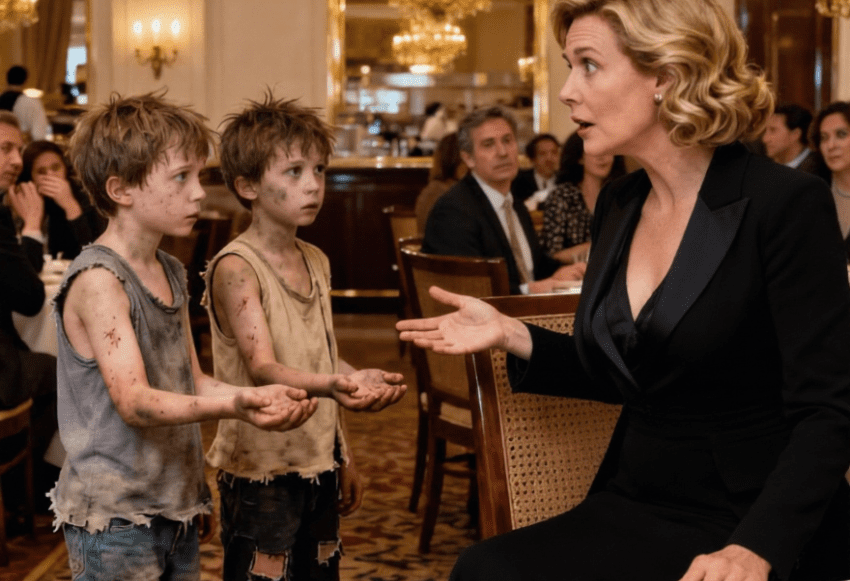
Crystal chandeliers dripped light from the ceiling like melted gold. Linen tablecloths were pressed so perfectly they looked unreal. Conversations were low and polished, laughter measured. Even the silverware seemed to know it belonged here.
Margaret Whitmore sat alone at a corner table, her emerald-green dress catching the chandelier glow. She had barely touched her food. A plate of filet mignon and potatoes rested in front of her, expensive and cooling. Eating had become a formality these days—something she did because one was supposed to.
She lifted her wineglass, then set it back down untouched.
Six years.
Six years since her life had split cleanly in two.
The waiter was just beginning to clear nearby tables when she heard it—a small, hesitant voice, close enough to feel.
“Ma’am?”
Margaret looked up.
Two boys stood at the edge of her table.
They couldn’t have been more than ten.
Barefoot. Clothes torn and stiff with grime. Knees scraped raw. Dirt smudged their cheeks like fingerprints left by a careless world. Their hair stuck out in uneven clumps, as if scissors had never learned their names.
Both of them held out their hands.
Not aggressively. Not dramatically.
Just… hopefully.
“Ma’am,” the boy on the left said again, swallowing. “Could we please have your leftover food?”
The restaurant went quiet in a way that wasn’t real, but felt like it was. A pause that made the air heavy. A few heads turned. Someone gasped softly.
Margaret’s first instinct was irritation—then confusion—then something far colder.
Because the boys didn’t just look similar.
They were identical.
And they looked exactly like her sons.
The wineglass slipped from her fingers and shattered against the floor.
Gasps rippled through the room. Chairs scraped. The waiter rushed forward.
“Madam—are you all right?”
Margaret didn’t hear him.
She was staring at the boys’ faces.
At the familiar slope of their noses. The faint scar near the right eyebrow—how many times had she kissed that spot as a baby? The way one boy leaned protectively toward the other without realizing it. The same unconscious habit Ethan used to have.
Her heart began to hammer so hard it hurt.
“No,” she whispered.
The boys flinched, hands pulling back slightly.
“We—we can go,” the other one said quickly. “We didn’t mean to—”
“Don’t move,” Margaret said, standing so fast her chair toppled backward. Her voice shook, but it wasn’t anger. It was terror. Hope. Grief colliding all at once.
People were staring openly now. A manager appeared near the bar.
Margaret knelt in front of the boys, ignoring the silk of her dress against the carpet.
“How old are you?” she asked.
The boys exchanged a glance.
“I’m Oliver,” the left one said. “This is Theo. We’re ten.”
Ten.
Margaret’s breath hitched.
“And when is your birthday?”
“March twelfth,” Theo said. “Both of us.”
Her vision blurred.
That was the date.
She reached out before she could stop herself, fingers trembling as she brushed Oliver’s cheek. Dirt came away on her skin, but beneath it—warmth. Real. Alive.
“Where… where did you come from?” she asked.
The boys hesitated again.
“We were in a foster place,” Oliver said quietly. “But it closed. So we… left.”
“Left where?” Margaret pressed.
Theo looked down. “Wherever.”
Six years ago, Margaret’s twin sons had vanished.
Not wandered off. Not run away.
Vanished.
She had been away for one weekend—one fundraiser in Paris she couldn’t cancel. Her husband, Daniel, was supposed to be watching them. When she came home, the house was silent. The boys’ beds were empty. Daniel was gone.
The police called it a domestic abduction at first.
Then Daniel’s car was found burned near the state border.
No bodies.
No answers.
Eventually, the word “presumed” began to creep into conversations. Presumed dead. Presumed lost.
Margaret never accepted it.
She funded searches. Hired private investigators. Posted age-progressed photos everywhere. She slept with the lights on for three years.
Then the world, impatient with grief, moved on.
She never did.
“Do you remember your mother?” Margaret asked, her voice barely sound.
Theo frowned. “We had a mom. She sang a lot.”
Oliver nodded. “She smelled like lemons.”
Margaret’s hand flew to her mouth.
She used lemon oil in everything.
“What happened to your dad?” she asked.
The boys’ expressions darkened.
“He was mean,” Theo said. “He said Mom left us. But she didn’t.”
Margaret closed her eyes.
Daniel.
A sound broke through the stunned silence—a woman sobbing at a nearby table. Someone else whispered, “Oh my God.”
The manager stepped forward cautiously. “Madam, perhaps we should—”
“I am their mother,” Margaret said, standing slowly. Her voice was steady now, iron-hard with truth. “Call the police. Call anyone you want.”
The boys looked up at her, uncertain.
“You’re… our mom?” Oliver asked.
Margaret dropped to her knees again and pulled them both into her arms.
“Yes,” she whispered fiercely. “I’ve been looking for you every single day.”
The boys froze for a heartbeat—then clung to her like they had been waiting their entire lives for permission.
The restaurant dissolved into motion. Phones out. Staff rushing. Someone brought water. Another wrapped a napkin around Margaret’s bleeding finger where she’d cut it on glass.
Margaret didn’t let go.
DNA tests confirmed it within hours.
Daniel had never died. He had taken the boys, spiraled into addiction, bounced between shelters and illegal work. When he overdosed two years later, the twins were shuffled through an overwhelmed system—lost under paperwork, renamed, misplaced.
Margaret filed lawsuits that made headlines.
But that wasn’t the story people remembered.
Two dirty, barefoot boys standing in a palace of chandeliers, asking for leftovers.
And a woman who looked up—and found her entire life returned to her.
That night, Margaret brought her sons home.
Not to the mansion—yet.
First, she filled a bathtub and washed their feet herself.
First, she cooked grilled cheese sandwiches, just like she used to.
First, she sat on the floor between their beds and watched them sleep, afraid they might disappear again.
In the morning, Oliver asked softly, “Mom?”
“Yes, baby.”
“Can we stay?”
Margaret smiled through tears.
“You’re home,” she said. “You never have to ask that again.”
And somewhere in a city that had almost swallowed them whole, two boys learned that sometimes, asking for leftovers can give you your whole life back.