“Alright, guys, it’s time for me to go!” Roman shouted, jumping onto the step of the departing train.
His friends waved from the platform, some shouting last goodbyes. He smiled.
It had been three years since he returned from the army. In that time, he got a job and enrolled in university as a part-time student.
But this — packing up and heading to another city — was a first.
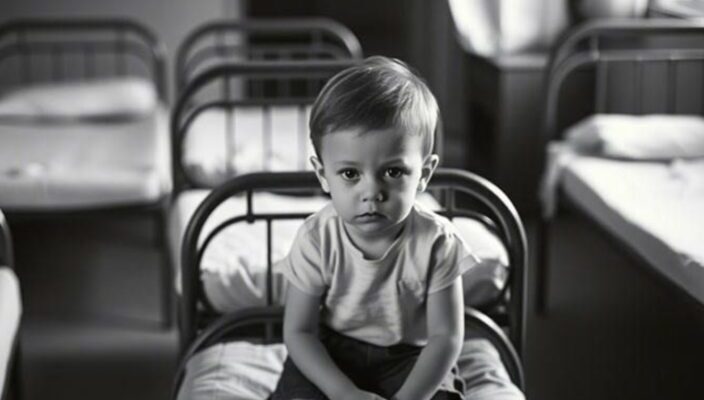
He and his friends were bonded by a shared past — the orphanage.
As children, they had no parents. Now they were adults with goals, dreams, and plans.
Anya and Petya had gotten married, taken out a mortgage, and were expecting a baby.
Roma was genuinely happy for them, a little envious — in a good way — because he wanted the same.
But his life had taken a different path.
Since his earliest years in the orphanage, he tried to understand: who was he? Where was he from? Why was he there?
His memories were vague, like drifting fragments of a dream, but deep inside, there was a warm feeling tied to the past.
The only thing he learned — a man had brought him. Young, well-dressed, around thirty.
He found out from Baba Nyura — the head cleaner, who hadn’t retired back then.
“I was younger then, had eyes like a hawk,” she used to say. “Saw him standing under a streetlamp, holding the boy’s hand.
The kid was about three. He spoke to him seriously, like to an adult.
Then rang the bell — and ran off. I followed, but he was quick — gone in an instant.
I’d recognize him today — he had a very distinct nose. Long and sharp, like Casanova’s.
Didn’t see a car — so he must’ve been local. And he didn’t even put mittens on the child.”
Roma, of course, remembered nothing. But after years of thinking, he concluded it was probably his father.
What happened to his mother remained a mystery. But he had been brought to the orphanage dressed neatly and well cared for.
The only thing that worried the staff — a large, pale birthmark on his chest, reaching toward his neck.
At first, they thought it was a burn, but later doctors identified it as a rare birthmark.
Baba Nyura said such things were often hereditary.
“Come on, Baba Nyura, you expect me to walk around beaches looking at people’s birthmarks?” Roma laughed.
But she only sighed. She had become like family to him.
After graduation, she took him into her home:
“Until you get your own place — stay here. No need for you to bounce between rentals.”
Roma held back tears — he was a man now, after all.
But how could he forget those moments, when after another “justified” fight, he came to her storage room crying on her lap?
He always tried to protect others, even against older kids. And she’d stroke his hair and say:
“It’s good that you’re kind and honest, Romka.
But life with your nature will be tough. Very tough.”
Back then, he didn’t understand. Only years later did the meaning hit him.
Anya had been in the orphanage since birth. Petya came later, when Roma was eleven.
Roma was thin and tall, while Petya was reserved and sensitive.
He had come after a tragedy — his parents had died from fake alcohol.
At first, Petya kept to himself.
But one incident bonded the three of them into a family — not by blood, but by heart.
Anya was disliked. Red-haired, tiny, quiet — an easy target for bullying.
Some teased, others pulled her braids, some just kicked her. That day, the older boys were especially cruel.
Roma couldn’t stay silent — he rushed in to defend her. But the odds were against him.
Ten minutes later, he was on the ground, shielding his face from punches.
Anya screamed, swinging her backpack like a sword.
And suddenly, everything stopped. The yelling, the hits, the mocking — like someone hit mute.
Hands lifted Roma. Petya stood before him.
“Why’d you interfere? You don’t even know how to fight!”
“Was I supposed to just watch them beat her?”
Petya paused, then held out his hand.
“You’re alright. Deal?”
From that moment, their friendship began.
Anya looked at her rescuer with such admiration that Roma covered her mouth.
“Close your mouth, or you’ll swallow a fly.”
Petya laughed:
“Hey, little one, from now on — come to me if anyone bothers you. Tell everyone you’re under my protection.”
From that day, Petya took Roma’s physical training seriously.
At first, Roma was bored — he’d rather read a book. But Petya knew how to motivate.
Eventually, Roma enjoyed it. His grades in gym went up, muscles strengthened, and girls started to notice him.
Petya was the first to leave the orphanage. Anya cried, and he hugged her:
“Don’t cry, little one. I’ll come back. I’ve never lied to you.”
He did return — once — then left for the army.
When he came back again, Anya was packing. He walked into the room in uniform, holding flowers.
“I came for you. Life’s unbearable without you.”
Anya had blossomed into a beautiful woman.
When she turned around, Petya dropped the flowers in shock:
“Wow! You’re stunning! Maybe you don’t want to be my wife anymore?”
She smiled:
“I do. And you’re not too bad yourself.”
After the army, Petya was stationed in the same city Roma was heading to.
Roma promised to visit — especially once the baby was born. He’d be the godfather.
Roma chose a better train compartment this time — he needed rest before work. He worked construction on high-rises — good pay, no overtime, and time for school and friends.
As he was settling in, he heard shouting from the corridor. A man was demanding someone leave the compartment.
Roma wanted to ignore it, but then a trembling, crying woman’s voice joined in — so familiar, it clenched his heart.
Sounded just like Baba Nyura. Roma peeked out.
A young train attendant stood there, shaking in fear.
“What happened?”
“Some ‘important’ guy,” she whispered. “An old lady spilled tea on his shirt by accident.
Now he’s screaming like she should be arrested.”
The man kept yelling:
“Get out, you old witch! You ruin the air around you!”
Roma stepped forward.
“Hey, man, calm down. She’s elderly.
It was an accident — and she paid for her ticket, too.”
“Do you know who I am? One call and you’re off this train!”
“I don’t care. Everyone’s jaw breaks the same — important or not.”
The man went silent. Roma leaned toward the elderly lady:
“Come with me. Take my compartment — it’s yours.”
The old woman cried — tears of gratitude. The attendant looked at Roma with respect.
Back in his compartment, Roma tossed his bag down and unbuttoned his shirt. The man turned pale.
“What’s that on your chest?”
Roma looked him in the eye:
“Don’t worry — not contagious. Birthmark.”
“My God…”
The man slowly sat down. Roma frowned:
“What is it?”
With trembling hands, the man unbuttoned his shirt. He had the same exact birthmark.
“I was coming to you… to apologize. I can’t sleep at night. I hear your cries…”
“You were the one who left me at the orphanage door?”
“Yes. I was a coward. Forgive me. I was married then. Your mother, Marina…
She came to me, said she had cancer and might die. Asked me to take you in.
But my wife was coming home in a few hours. I panicked…
I left you there. Then we moved. Years later, Marina found me.
The treatment worked — she survived. She looked for you. And I… told her you had died.”
“Where is she now?”
“She had a stroke about ten years ago. Placed in a care home.
In your city too.”
Roman said nothing. He stepped out and approached the attendant.
“I heard everything,” she whispered. “If you want, you can rest in my compartment.”
“Thank you. I think I know the care home he meant.”
He didn’t go to work — called to explain. The attendant, Katya, went with him.
He was grateful — it would’ve been too hard alone.
“Marina… stroke ten years ago…”
“We have one. Maria Pavlovna. Wonderful woman.
But she always said she had no one — her son died. You are…?”
Roman shrugged:
“Possibly her son. If it’s really her.”
“Come in.”
A woman in a wheelchair looked up from her knitting.
She smiled. The nurse gasped:
“You look like twins!”
Marina dropped her yarn:
“I always knew you were alive. I felt it.”
Two years passed. Marina completed rehab, funded by Roman.
She read stories to her grandson, while Katya — now his wife — cooked a festive dinner.
That day, she found out she was pregnant again.