Grandmother, at just one glance, immediately called the police.
By evening, grandmother Vera Timofeyevna was, as usual, drawing the curtains tighter, as if setting up an invisible barrier against the outside world.
Her two-room apartment on the outskirts of Komsomolsk seemed to live by its own special schedule: first the curtains, then the kettle, then the news.
It had been that way for twenty years. It felt safe that way.
The windows looked directly out onto the old cemetery, where even in calm weather the lindens creaked, as if whispering to one another.
That creaking had become part of her evening, just like the silence in the yard — it meant all was calm.
On Friday, as usual, Dasha came over — her eight-year-old granddaughter, who opened the door herself with a key after her extracurricular class.
“Hi, Grandma!” she tossed her backpack onto the hallway cabinet and shoved her hands into her pockets, as if hiding something.
“Wash your hands, dragonfly,” Vera said without turning around.
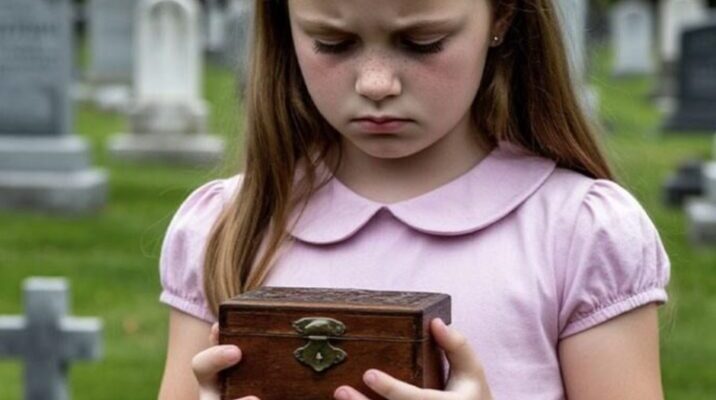
Dasha darted into the kitchen, returned with wet palms… and suddenly pulled a small wooden box from her pocket.
Dirty, battered, as if it had been underground.
“Look what I found!”
Vera frowned. A portrait of her husband hung on the shelf above the television. He hadn’t liked surprises either.
“Where did you get that?”
“By the cemetery fence. It was almost buried, like someone hid it, then changed their mind.”
The girl gently stroked the lid: cracked paint, dark stains in the carving, a brass latch covered in rust.
“We need to take it to the authorities,” Vera said. “Things from the cemetery don’t bring any good.”
“But no one’s asking for it. Can we open it?” Dasha’s eyes sparkled with curiosity.
Vera felt uneasy. She knew the omens — what remains from the dead should not be touched.
But something else stirred inside her. Curiosity. Or a memory of something long buried.
“All right, but carefully. Let’s lay out some newspaper — so nothing spreads around the house.”
Komsomolskaya Pravda was laid on the table, and on top of it — the box.
The latch was barely holding. Vera took a knife and gently pried it. The metal cracked like a joint.
“I’m opening it.”
Beneath the lid — soft velvet lining, and in it — a pouch made of darkened cloth with drawstrings.
Inside — several children’s teeth, carefully laid in a circle. Beside them — a yellowish ring and a torn piece of paper:
“To be kept for a black day.”
Dasha peeked over her shoulder.
“What is it?”
“I don’t know,” Vera replied, though she did. Her heart chilled with the realization: a ritual. A talisman. Or a curse.
The cloth smelled of dampness and must. Inside the pouch were old Soviet bills — tens and fives, tied with thread.
Beneath them — a roll of X-ray films.
The first showed a woman’s skull. A crack marked in red ink across the frontal bone. In the corner — the signature: “N. Zolotova, 1989.”
Vera’s breath caught. Her husband’s surname — Zolotov.
And then she remembered: Ninka, his cousin, who went missing in 1989.
Back then they said it was an accident at a construction site. But no body was ever found.
“Grandma, what’s wrong?” Dasha asked, looking into the box.
“Go to your room. Put on a cartoon.”
“I’m not a baby!”
“Dasha, now!”
The girl pouted but obeyed.
Vera pushed the box away as if it could burn her. Her fingers trembled.
If these were Nina’s remains — who had hidden them here? And why now?
She picked up the phone — the old landline her son had long begged her to throw out — and dialed 02.
“Police dispatch. What’s your emergency?”
“There’s a find in my home. A box. The contents… possibly human remains.”
Pause.
“Please state your address.”
Vera gave it. Hung up. Looked at the box.
At the photograph. At the world outside the window that suddenly didn’t feel calm anymore.
Half an hour felt like hours. Dasha kept peeking in, tugging on her grandmother, full of questions.
She wanted to know, to see.
“Are the police coming?” she asked, trembling with excitement.
“They’ll look into it.”
“I’ll open the door! I found it!”
When the vehicle stopped outside — blue and white stripes, two officers in uniform, and a plainclothes investigator — Dasha was already bouncing with anticipation.
Vera came out of the kitchen, holding her old handbag — the one she used to carry documents in.
Now it held the box. The police put on gloves, took photos, filled out a report.
“How was it found?”
“My granddaughter brought it from the cemetery.”
The investigator subtly shifted his shoulders. He was probably prepared for a lot. But not this.
“Whose land is that?” one officer asked.
“Municipal,” Vera Timofeyevna answered. “Public.”
Belongs to no one, except memory.
Dasha sat at the table, writing her statement under dictation, sniffling like she’d been caught stealing her favorite toy.
Vera stroked her granddaughter’s hair, repeating:
“It’s all right. Don’t be afraid.”
When the investigators packed up and left, the girl went to bed with a resentful sigh, and Vera poured herself some valerian drops.
Her hands were still shaking. Only the kettle brought a bit of warmth.
The phone rang. It was Pavel, her son — the same one who told her to toss that phone ages ago.
“Mom, what’s going on? I got a call from the department.”
“Dasha found a box at the cemetery. The police took it already.”
“What was inside?”
“Teeth. A ring. And an X-ray of a skull. Signed: Nina Zolotova, 1989.”
Pasha fell silent for a long time. When he spoke again, his voice was quieter:
“That’s family. You understand what that means?”
“I do,” Vera answered softly. “And what we know is worse than what we didn’t.”
That night, she dreamed of the cemetery.
A faceless woman wandered among the graves, something clinking in the pockets of her dress — like children’s teeth in a charm.
In the morning, Vera checked the news — not a word. The world stayed silent.
At noon, the local officer came. Again.
“We need Dasha to add to her statement. A few more questions.”
The girl signed it, pale, eyes downcast.
“Can you tell me what you found out?” Vera asked.
“Too early for conclusions,” he said, fiddling with his cap. “But the ring… it belonged to your husband.”
The words hung in the air.
Her husband had died five years ago of a heart attack.
How did his ring end up buried?
He left, but his shadow remained.
That evening, a call came from an old friend — the one who always knew everything first.
“Vera, people are saying online — the Zolotovs have their own grave! A secret burial!”
Vera hung up. Dasha sat on the floor, hugging her worn teddy bear.
“Grandma, was Grandpa a bad person?”
Vera was silent for a long time.
“Grandpa was… complicated. He made mistakes that became someone else’s tragedies.”
Dasha nodded. Pressed her nose to her toy. The silence in the room grew a bit lighter.
A week passed as if underwater.
The newspaper printed an article: “Skeleton on the Family Plot.”
Vera went shopping with her hood up, feeling the stares.
Dasha came home from school in tears — the kids whispered after her: “Grave digger.”
The police called again. Sergei, a former classmate, now in the department, spoke gently:
“The skull was found in a clay jar under the tree, near the box.”
“Sergei, just tell me — was my husband involved?”
“His DNA is on the ring. And the statute of limitations — thirty years. 1989.”
“But he said Nina left for Tomsk…”
“And we found her here.”
That night, Vera dug through every box of papers, looking for photos, letters, any clue.
She found one: young Nina smiling, holding that same box.
Fate had already been sealed — no one noticed.
An official summons arrived from the prosecutor. Identification. Evidence.
In the investigator’s office, Vera saw her reflection in the window — gray, as if faded by time.
“Could your husband have been involved?”
“He was cruel, but I don’t believe he was a murderer.”
“Were there debts?”
She remembered. Yes. Once Nina gave him money. He asked. She helped.
Now it all made sense. A fight. A blow. A fractured skull.
A body hidden under the construction fence.
Teeth in the box — protection ritual or curse.
The bills — remnants of debt repayment.
Outside, wet March snow scratched the glass. Dasha was being bullied at school.
Vera attended the parent meeting and said firmly:
“Leave my granddaughter alone. The sins of the fathers must not fall on the children.”
The teacher silently nodded. The class fell quiet.
The trial was swift. Procedural. The man was dead, case closed.
But the name Zolotov now echoed differently — like a voice that wouldn’t fade.
A year later, Vera gathered her strength and took Dasha to the cemetery.
They chose a simple stone.
It read: “Nina. Not forgotten.”
They placed it by the tree where the skull was found.
Dasha laid a porcelain lily.
“Grandma, is this her home now?”
“Yes. And we’ve done our duty.”
They left, burying the box where it belonged.
The wind stirred the lindens, and it seemed they no longer creaked.
As if a thirty-year-old whisper had finally faded.
“Let’s go home,” Vera said, taking her granddaughter’s hand.
“We need to keep living.”
Dasha squeezed her fingers tightly — like an adult, in her own way.
They both knew: evil stops living only when we stop fearing it.